Rasmus Christensen came home expecting the worst, but when he opened the door, he heard something he hadn’t heard in that house for a long time. Silence. No screams from the kitchen. No sound of things breaking.
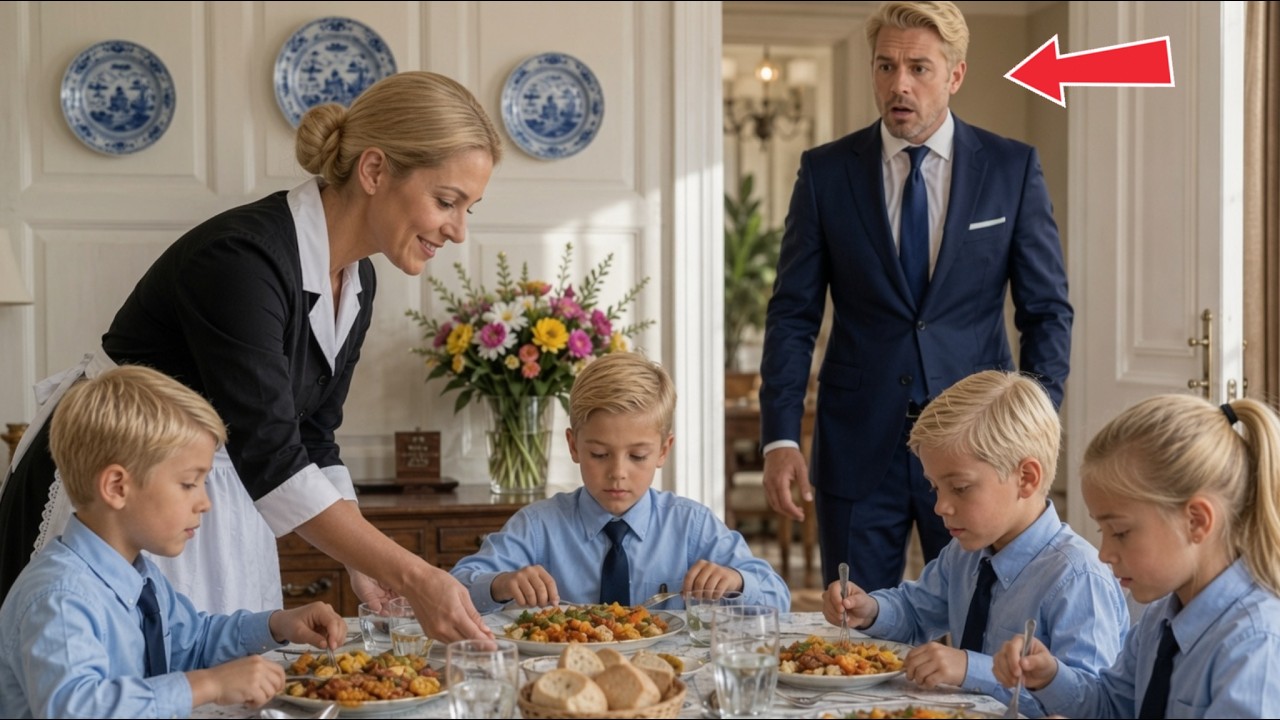
No crying. Just silence. He frowned and walked slowly toward the dining room. And then he saw them.
His four children sat around the table, holding hands with their heads bowed. They were praying. Rasmus stood motionless. It had been three years since he had last seen anything like it.
Rasmus Christensen had everything. He was one of Copenhagen’s wealthiest businessmen. Hotels, construction companies, restaurants. He had built an empire from nothing, but he was missing the most important thing.
Peace, especially in his own home. He was sixty years old and a multimillionaire, and yet he couldn’t control his four small children. Three years ago, his wife, Helene, had left him without any explanation. She left only a note on the table.
*I can’t do this anymore. * And then she was gone. She left behind four small children and a father drowning in a pain he didn’t know how to fix. Mats, Lasse, David, and Truls.
The four of them were six years old. They were full of anger, raging, and fighting against anyone who tried to get close to them. Twenty-two nannies in seven months. Twenty-two trained professionals.
They all quit. The children set traps, hid things, screamed for hours, smashed everything they could reach. They weren’t bad children. They were wounded children.
And wounded children wound others. The home no longer looked like a home. It looked like a battlefield. There was no joy, no laughter, only pain in every corner.
Until one day, a woman showed up. Susanne Henriksen, forty years old. She had worked in cleaning for years. She had no education in childcare.
She had no special experience, only an old Bible and a calm voice. She said that God had told her to come. Rasmus didn’t want to hire her, but something inside him made him say yes. Three days, Rasmus said coldly.
Susanne smiled gently. Three days is enough. The children started testing her from the first minute, but she didn’t break. She didn’t flee.
She just stayed. And on the third day, something happened. Something that changed everything. Rasmus came home early that afternoon.
The house was quiet, too quiet. Then he heard soft voices from the dining room. His heart began to beat faster. And what he saw when he walked through the door, he would remember for the rest of his life.
But before I tell you what happened in the dining room, subscribe to the channel, give a like, and tell me which country you are watching this story from. Because this story will remind you of something important. Sometimes, when we feel like we have lost all hope, that is exactly when God shows up. Now let me take you back to the beginning.
That morning started like every morning in the Christensen house, with something breaking. Rasmus heard a crash from upstairs. A vase, probably, something expensive. But he didn’t even get up to check.
What was the point? It was 6:45 in the morning, and the war had already begun. He lay there, staring at the ceiling, listening to his children’s voices. Mats giving orders, Lasse screaming furiously, David running through the hallway, and Truls beginning to whimper, which meant the screams would soon follow.
Before, at this time, Helene would make coffee, humming as she served it, bringing him a cup in bed, kissing his forehead, saying something that always made him smile. That belonged to another life. Finally, Rasmus got up, dressed, and walked down the stairs. The kitchen looked like a hurricane had hit it.
Cereal everywhere, spilled milk on the counter, four plates left wherever the children had abandoned them. The nanny was already gone. What was her name? Sara, Sofie.
Her resignation letter lay on the table next to the car keys. *Dear Mr. Christensen, I truly tried, but I can’t do this anymore. Your children need more help than I can give them.
Please don’t contact me again. *
That was the twenty-second resignation. Rasmus folded the letter and put it in the drawer with the others. The failure drawer.
A drawer full of people who had looked at his children and decided they weren’t worth the effort. He couldn’t even get angry anymore. He was just tired. Deeply tired.
The children were in the living room. Mats sat on the sofa like a little king with his arms crossed, observing Rasmus with cold, calculating eyes. Lasse paced back and forth, looking for something to destroy. David had already hidden himself under the stairs, and Truls sat in the corner, rocking gently with that expression that announced a crisis.
She’s gone, isn’t she? Mats asked. It wasn’t a question. It was a statement.
Rasmus nodded. Good, Mats replied coldly. She was bad anyway. She wasn’t bad, Mats.
You put a slug in her bed. It was just a slug. It was alive. Mats shrugged, without guilt, without remorse, and that scared Rasmus more than the anger.
That was what his children had become. Four small children who had learned a terrible lesson. If you push people away first, they can’t hurt you when they leave. Rasmus’s phone vibrated.
A meeting in one hour. Another video call. Another day pretending he had control over his life while everything in his home was falling apart. He looked at his children.
He really looked at them. Mats with Helene’s eyes and a completely closed heart, Lasse with a fire in his eyes that was slowly burning him up from the inside, David hidden away, invisible, forgotten, and Truls, the youngest, the one who cried so easily, so often, because he felt everything. What did God say about us? Truls asked quietly.
What? Rasmus turned around. The woman, Susanne. She said God told her to come here.
What if God told her something bad about us? Rasmus felt a lump in his throat. God didn’t tell her anything bad about you, Truls. Then why did she come?
Rasmus didn’t have an answer. He had never had an answer. For years, he had paid people to handle what he couldn’t, and now he stood in the middle of the ruins of his family, unable to do the one thing that mattered most. The morning of the third day arrived, and Rasmus didn’t go to work.
He called his assistant and said he was sick. It was a lie, but it was the closest he had come to admitting the truth in years. He was sick. Sick of pretending, sick of running, sick of the silence and the screaming and the broken pieces.
He went down to the kitchen, expecting chaos. Instead, he heard laughter. He stopped at the doorway. Susanne sat on the floor with the children around her.
In her hands was an old picture book, worn, with the corners of the pages turned up. She was reading, but that wasn’t what had silenced the room. It was her voice. She was using different voices for each character, exaggerated, funny, and the children were laughing.
All four of them. Even Mats, who had forbidden himself from feeling anything at all, had a smile pulling at the corner of his mouth. Rasmus couldn’t remember the last time he heard that sound. Laughter.
Real laughter. In this house. Susanne noticed him. Her eyes met his across the room, and she didn’t stop reading.
She didn’t lose her rhythm. She just kept going, as if she had been expecting him all along. When the story ended, the children protested. Again, again, Truls begged.
Not now. Your father has something to say. Rasmus’s throat went dry. The children looked from Susanne to him.
He wanted to disappear. I think you should go get ready, Susanne told them. I’ll make breakfast. They didn’t want to leave, but Mats pushed himself up, glowering, and led the others out.
The moment they were gone, silence settled over the kitchen like a heavy blanket. Rasmus cleared his throat. Where did you learn to do that? Read to children?
Make them laugh. Susanne stood up, brushing off her skirt. They aren’t bad children, Mr. Christensen.
I know. Do you? Because I’ve been here for three days, and in three days, I’ve learned more about them than most people would learn in a year. They push because they’re afraid.
They break things because they can’t break the silence. They scream because no one is listening. I’ve tried. I’ve tried everything.
No. You’ve tried everything expensive. The words hit him like a slap. He opened his mouth to protest, but the doorbell rang, and a moment later, the sound of tiny feet running through the hallway announced disaster.
Lasse, I told you to stop that! Mats shouted. The nanny, the new one he’d hired just last week, stood in the doorway, soaked, her hair dripping with orange juice. She was holding her bag, her face a mask of fury.
That’s it! I’m done. I can’t work in this madhouse one more minute! She pushed past Rasmus and stormed out the front door.
The car engine started, gravel spat from the wheels, and then she was gone. Rasmus stood in the hallway, staring at the open door. He heard the children’s laughter from the top of the stairs. They thought it was funny.
They thought driving the nanny away was funny. That was the twenty-third nanny to quit in seven months. Rasmus wanted to shout. He wanted to scream until his throat hurt.
But more than that, he wanted to walk away. He wanted to leave this house and never come back. He turned around, and Susanne was standing behind him. They’re going to do the same to you, he said quietly.
Susanne didn’t look scared. She looked at him with that calm, knowing look that unsettled him so much. Did you ever learn to swim? What?
Did you learn to swim without being pushed into the water? What does that have to do with anything? Everything. Your children are learning to swim.
But you keep throwing them in the deep end and expecting them not to sink. Rasmus didn’t have an answer to that. That night, he couldn’t sleep. He walked through the house, past the children’s rooms.
Mats had fallen asleep with his hand clenched into a fist, his face tight even in rest. Lasse lay sprawled on his bed, the covers kicked off. David had wedged himself between the bed and the wall, his small body curled into a ball. And Truls… Truls was standing in the doorway.
Dad? Why can’t I sleep? Rasmus’s heart ached. He lifted his son, and Truls wrapped his arms around his neck.
He could feel how fragile he was. I come here sometimes, Truls whispered. When I can’t sleep. I look at the stars, but there are too many lights in the city.
Rasmus looked up. The moon hung over the rooftops. Do you think Mom can see the stars? Truls asked.
Rasmus’s throat closed. He didn’t know where Helene was. He hadn’t heard from her in three years. He didn’t know if she was alive or dead, sober or drunk or anything in between.
He held his son a little tighter. I hope so, he managed. The next morning, Susanne was gone. Rasmus found her coat missing and her bag gone from the guest room.
He felt a stab of disappointment. Of course. Of course she had left too. Why would she be any different?
He walked into the kitchen, ready to face the wreckage, and felt his breath catch in his throat. The children were sitting at the table, each one holding a plate. On the table was a pot of oatmeal, a bowl of fruit, and freshly squeezed juice. And in the middle, a note.
*Rasmus. Take the day off. Susanne. *
The children were looking at each other, not sure what to do.
Well, Rasmus said slowly. I guess we’re having breakfast together. The morning was awkward. The children didn’t know what to do with him, and he didn’t know what to do with them.
They ate in silence. Mats kept looking at his phone. Lasse pushed his oatmeal around his plate. This is stupid, Mats finally said.
Where’s the nanny? She quit. Like the rest of them. Mats frowned.
Then who’s going to take care of us? Rasmus put down his spoon. Maybe today, I am. The children stared at him.
Is that some kind of trick? Lasse asked. No. You never spend time with us, David said quietly.
I know, Rasmus said. And I’m sorry. The words felt alien in his mouth. He had never said he was sorry.
Not to his children. Not to his wife, before she left. He had made a life out of being right, and he had ended up alone. The silence was heavy.
Then Truls pushed his chair back, ran around the table, and hugged his father. Rasmus stiffened, then wrapped his arms around his son. Promise? Truls whispered.
Promise what? Promise you won’t leave us like Mom did. Rasmus felt hot tears behind his eyes. He blinked them away.
I swear, Truls. I will never leave you. Never. Mats stood up, his chair scraping the floor.
He walked out of the room, slamming the door behind him. David slipped off his chair and followed. Lasse shot Rasmus a dark look and left too. Truls pulled back, wiping his eyes.
It’s okay, Dad. They’ll come around. Susanne said so. Susanne won’t be coming back, bud.
She’s gone. Then why is she still here? Truls pointed toward the garden. Rasmus turned.
Susanne was standing in the garden, tending to her herb garden like she had been doing it forever. She looked up, saw them watching, and waved. Rasmus walked outside with the children. She’s here.
She stayed. Susanne stood up, wiping her hands on her apron. Of course I stayed. I told you, God told me to come here.
I don’t think he was done with me yet. Rasmus had never been a religious man. But he looked at the woman who had walked into his house with nothing but an old Bible and a calm voice, and he felt something shift in his chest. A crack in the armor he had built around his heart.
For two weeks, Susanne came every morning at 8 a. m. and left every evening at 6 p. m.
She didn’t try to be their mother. She didn’t try to replace Helene. She just was. She showed up.
Every day, she showed up. She taught Mats how to breathe when he felt the anger rising. She showed Lasse how to punch a pillow until his arms ached instead of breaking the furniture. She played hide and seek with David and sat with him for hours, waiting for him to speak.
And Truls, she held him when he cried. Slowly, Rasmus saw his children coming back to life. The laughter returned. The hugs lingered a little longer.
His house stopped feeling like a battlefield and started to feel like a home again. One afternoon, Susanne found him standing in the kitchen, staring out the window. You’re not a bad father, she said. I don’t know what I am.
You’re a father who lost his wife and didn’t know how to be enough. But your children are starting to see that. They’re starting to see you. How do you know?
Because they told me. Rasmus turned to look at her. She was standing, wearing a cardigan that was too big for her, and she was looking at the children playing in the garden with something that looked almost like love. You make them happy, he said.
They make me happy too. He looked at her, and he meant it when he said, You’re welcome to stay as long as you like. The months passed. Susanne never tried to replace Helene.
She just stayed. She became Rasmus’s partner in ways he hadn’t expected. They would drink coffee on the porch in the mornings. She would read the Bible to the children, and when they asked her why she came to them, she said, Because God knew you needed someone to love you.
One evening, Rasmus found her in the garden. She had a cup of tea and was looking at the stars. Susanne. I have a question.
Years ago, my wife came home with a bag of plant bulbs. She was so happy. She made me promise I’d plant them before the first frost. And then she left.
I never planted them. I don’t even know what kind they are. Susanne studied his face. Then she placed her hand on his arm.
You never planted them, Rasmus. You only kept them safe in the dark. Sometimes, the bulbs need the cold and the dark ground before they can bloom. And with time, and the sun, they bloom beautifully.
Rasmus put his hand over hers. Susanne. I want you to know. You came at the darkest time, and you never gave up on us.
Susanne squeezed his hand. Sometimes, God asks us to do impossible things. But He always equips us. With love, with patience, with faith.
That September, the children went back to school. Rasmus came home to an empty house and a strange silence. He walked into the garden and stood where Susanne had been that morning. Weeks passed.
He missed her. He missed the sound of her voice. The way she laughed. The way she made everything feel possible.
One afternoon, the children came home from school and handed him an envelope. They said it was from Susanne. He opened it with trembling hands. *Rasmus.
You have the heart of a father. You have taken care of your children. Now, it’s time to make peace with yourself. Forgive her.
Forgive yourself. And teach your children to forgive too. *
He read the note twice. Then the doorbell rang.
Susanne stood on the doorstep, carrying a bag. They need you, Rasmus. And so do I. He didn’t speak.
He couldn’t. He pulled her into his arms and held her, the way he should have held her the first time. I don’t deserve you, he whispered. Maybe not.
But you need someone who truly loves you. Not because of what you can give, but because of who you are. They stood in the doorway, the evening light streaming in behind them. Inside, the house was no longer silent.
It was full of laughter, of singing, of a family that had finally found its way. And Rasmus understood something he should have known years ago. Love is a choice. Love is two people holding onto each other when it would be easier to let go.
Because someone who loves you will never just leave you with a letter and empty promises. They still come home to the blue sky and the scent of rain. Life bends but never breaks. And every night, Rasmus would look at Susanne and the children, and he would thank God for a second chance at a life he never believed he deserved.
And maybe, just maybe, that was the moment he finally learned what it meant to be whole. Because they weren’t just four traumatized children who needed help. They were forever changed, and so was he.
And the family that had been shattered by a mother’s abandonment became the strongest thing Rasmus had ever built.