She had heard worse than money before, but the way he threw the bill onto the wet gold mosaic made it sound like an insult dressed up as an offer. The thousand-krone note landed an inch from her knee, and Connie kept her eyes on the rag in her hand. “A thousand,” said Flemming Albertsen without lifting his gaze from the menu. “If you serve us in Japanese.
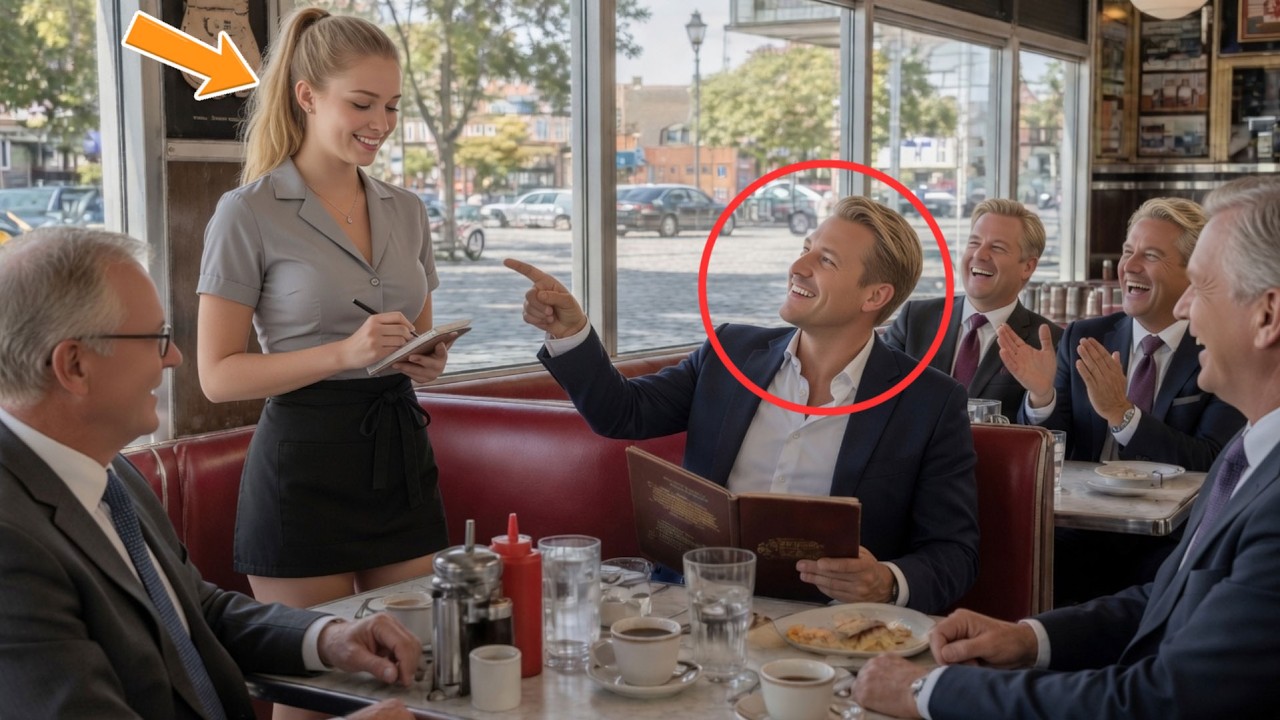
My partners want to know if anyone in this country can do anything besides wash floors. ”
His three guests laughed, the low, practiced laugh of men who were used to being the loudest thing in any room. The two Japanese businessmen at the far end of the table did not laugh. One of them, the one with the salt-and-pepper hair and the dark gray suit, lowered his eyes to his water glass and said nothing.
Connie finished wiping the last section of the mosaic, rolled the cloth slowly around the handle, then reached down and picked up the note. She folded it four times, precisely, and slipped it into her apron pocket without a word. “Hey,” Flemming said, finally looking up. “Did I ask you something?
”
“No,” she replied, quietly. “You didn’t ask me anything. ”
She wheeled the cart toward the kitchen door. The silence behind felt heavier than any of their voices had been.
The restaurant at Hotel Dejligt was one of those places where silence cost money. Heavy silverware, floor-to-ceiling windows facing the canal, waiters who smiled with the right part of their face. The kind of place where people spoke softly, not because they had secrets, but because they had learned that speaking quietly was another way of showing they belonged. Flemming Albertsen came in two, maybe three times a month, always with important people, always wearing the expression of a man who knew the table would be ready before he asked for it.
This Tuesday, he had a meeting worth, by his own account, three hundred and eighty million dollars. Tanaka Import AS had spent the year as the bridge between Japan and Europe in distribution of ceramics, handmade tableware, and luxury spirits. Flemming wanted an alliance. For months, he had courted Kenji Tanaka with emails, with invitations, with bottles of wine that arrived in Tokyo attached to handwritten notes.
And Tanaka had come. That alone was something Flemming did not understand. What he had never understood was that Japanese people observe before they speak, that silence was not discomfort. It was evaluation.
Connie knew that. Her grandmother had taught her. Her name was Conny Vatanabe. On the hotel’s cleaning schedule, that was all it said: Conny Vatanabe, Rengøringen.
No one asked what Vatanabe meant. Nobody had ever asked her mother. Her mother, Bodil, had been a nurse at Nørrebro. Her father, Hiroshi Vatanabe, had come to Denmark at twenty-six with one suitcase, a Spanish-Japanese phrasebook, and a quiet conviction that something good waited for him in this country.
They had been happy together, with the discreet happiness that doesn’t need witnesses. Connie remembered the smell of rice, the way her father folded the newspaper into perfect rectangles before throwing it out, the letters he wrote to his mother in Osaka every other week in tight, even handwriting. She remembered the day he didn’t come home for dinner. She was nine.
She never heard from him again. Her grandmother Yuki had kept teaching her through the phone, through letters, through the sheer stubbornness of an eighty-year-old woman who refused to let her granddaughter lose the only thing that connected this family spread across an ocean. Japanese had been her first language, even though she was born in Denmark. Her grandmother insisted on it.
Every phone call, every letter, every cassette tape in the mail had been in Japanese. Connie was thirty-four now. She had worked at the hotel for eight months. Before that, offices in Gladsaxe, a clinic in Valby, a fitness center where the smell of chlorine never left her hair.
Always cleaning, always invisible, always wearing the same pair of white sneakers that she bleached every Sunday with toothpaste because she couldn’t afford new ones. She knew poverty. She knew the shape of it, the weight of it, the way it followed a person like a shadow that doesn’t need light to exist. She had come home to her room in Nørrebro that night with sore knees and raw hands from the cleaning solution, and she had sat down on the bed without the strength to take off her shoes.
The thousand-krone note was still in her apron pocket. She took it out and looked at it. She had thought about it all through her shift, the way he had thrown it at her feet, the way his partners had laughed, the way the Japanese businessman had looked away. She folded the note again, slowly, and put it in the drawer of the nightstand.
“It doesn’t mean anything he says,” she told herself. “It doesn’t mean anything at all. ”
But she knew it did. She just wasn’t sure what, yet.
The next morning, she went to work as usual. She was in the staff locker room, changing into her uniform, when the manager, Jens Møller, called her over the intercom. “Conny, front desk. Now.
”
She walked down the narrow service corridor, past the laundry room, past the boiler room, past the small shrine in the corner that one of the kitchen porters had set up to a Hindu god she didn’t recognize. The hotel was a strange place. People came and went, some stayed for years, some for a single shift. The stories piled up like dust, and Connie was good at not sweeping away what she didn’t need to see.
Jens Møller was waiting for her at the front desk, a small man with the permanently worried expression of someone who had been promoted one level above his abilities. He was holding a piece of paper. “There’s a man in meeting room three,” he said. “He’s a journalist.
He says he needs to talk to you. ”
Connie looked at the paper. It was a business card. It said: Rasmus Brand, Journalist, København.
“Why would a journalist want to talk to me? ”
“He didn’t say. He just said it was about last night. About the restaurant.
”
Connie felt something cold settle in her stomach. She had not told anyone about the incident. She had not even known she was supposed to. But she walked to meeting room three.
The man inside was not what she expected. He was younger than her, mid-twenties, with tired eyes and a thin face that looked like it hadn’t seen proper sleep in days. He was dressed in a cheap jacket and worn shoes. He had a cardboard folder on the table in front of him, and when he stood up, he did it like a man who was used to waiting in line.
“Conny Vatanabe? ” he said. “Who’s asking? ”
“Rasmus Brand.
I work for Berlingske. I’m investigating something, and I think you might have witnessed something important last night. ”
Connie did not sit down. “I didn’t witness anything.
I was cleaning the floor. ”
“You were cleaning the floor,” Rasmus repeated. “And Mr. Albertsen threw a thousand kroner at you and asked you to speak Japanese.
”
Connie’s eyes narrowed. “How do you know about that? ”
“Because I have a source inside the hotel,” he said. “And because I’ve been looking into Flemming Albertsen for a long time.
Longer than I should have. And I think you have something that belongs to me. ”
Connie stood very still. “I don’t know what you’re talking about.
”
Rasmus opened the cardboard folder. Inside was a photocopy of a newspaper article. It was in Japanese. Connie felt the blood drain from her face, and she hadn’t read a word of it yet.
She looked at the headline. It said: Hvem er denne mand? Underneath was a photograph. It was an old photo, black and white, of a man standing next to a woman who was not her mother.
The man was Japanese, in his forties, with a stern face and a smell of old money. Connie had never seen him before. “That,” Rasmus said, tapping the photograph with one finger, “is Hiroshi Tanaka. Kenji Tanaka’s father.
The man you saw at the restaurant last night. The one who looked away when Flemming threw the money at you. ”
Connie looked up. “That can’t be right.
That’s a different man. That can’t be. ”
“I’ve been investigating the Tanaka family for three years,” Rasmus said. “They’re not just a trading company.
They’re one of the most powerful families in Japan. And your father’s name isn’t a coincidence, is it, Connie? Vatanabe. Your father was born in Osaka.
He disappeared when you were nine. And I think he didn’t disappear at all. I think he was taken. ”
The room seemed to tilt.
Connie put her hand out and gripped the back of the metal chair. “You’re insane,” she said. “Am I? ” Rasmus looked at her with an intensity that made him seem older than he was.
“Your father’s name was Hiroshi Vatanabe. He was born in Osaka, same as Hiroshi Tanaka. He left Japan at twenty-six with a suitcase and a Spanish-Japanese phrasebook. He never went back.
He disappeared without a trace when you were nine. And now, thirty years later, a man with the same face is sitting across the room from you at a high-end restaurant, and you’re telling me that’s a coincidence? ”
Connie didn’t answer. She couldn’t.
“I have a recording,” Rasmus said. “A meeting from 1999, in this hotel, in a room just like this one, where Flemming Albertsen and his then-lawyer discussed the transfer of certain assets. I don’t know exactly what the assets were. But I know that your father’s name was mentioned.
And I know that Flemming Albertsen, on that recording, says that Hiroshi Vatanabe is a problem that was taken care of, and that he expects the same standard of discretion from his lawyer. ”
Connie felt the air leave her lungs. “You’re lying. ”
“I wish I were,” Rasmus said.
“I have the recording. I’ve had it for a year. I haven’t been able to do anything with it because I don’t know who the men are in the meeting. I don’t know the context.
I don’t know what was transferred or why. But now I see you, and I see the resemblance, and I think you might know someone who can tell me. ”
Connie looked at the photograph again. She looked at the man’s face, the eyes.
The same eyes as her father, she thought. The same shape, the same calm. “What do you want from me? ” she whispered.
“The recording is the only hard evidence I have,” Rasmus said. “But it’s not enough. I need to know what happened to your father. If we can prove that the Tanaka family was involved in his disappearance, then we can bring them down.
All of them, Albertsen included. ”
“Why should I help you? ” Connie said. “You’re a stranger.
You come in here with wild stories about a family I’ve never met. ”
“Because your father didn’t just disappear, Connie,” Rasmus said. “He was a problem. And problems that get taken care of leave traces.
I have a copy of a log from the shipping company that Tanaka Import used in 1999. Your father’s name appears on it, in a manifest for a cargo container that was shipped from Copenhagen to Osaka one day after he vanished. The container was labeled ‘industrial equipment. ‘ It was never inspected.
”
Connie stared at him. “They shipped him in a crate,” she said. “I don’t know that for sure,” Rasmus said. “But I think it’s a thread worth pulling.
And I think you’re the one to pull it. Because you speak Japanese, and because you understand families that keep secrets. ”
Connie looked at the photo one last time, then pushed it back across the table. “You have until Friday,” she said.
“And if you’re lying to me, I will walk away and never speak to you again. You understand? ”
“Understood,” Rasmus said. The next day, Connie made a decision.
She went to a notary during her lunch break and made a formal declaration, describing in detail the documents she had handled and the recording she had kept in a safety deposit box for five years without exactly knowing what it was. She had known, of course, that it was something. She had known that the voice on the tape, Flemming Albertsen’s voice, cold and low, discussing the disposal of “the problem” with his lawyer, was evidence of something terrible. But she had been afraid to look too closely.
Now she was done being afraid. She told Rasmus about the recording, about the notary, about the fact that she had hidden the original tape in her locker at the hotel, taped behind the thin metal plate at the back where no one ever looked. She told him about the names she had collected over the years, the little pieces of paper with dates and amounts and handwritten notes that she had found in office wastebaskets and parking lots and coat pockets, items she had kept without knowing why. Later, the police would ask her why she had kept all of it.
She would shrug and say: “I don’t know. I guess I thought it would come in useful. ”
The men who arrived for the dead drop in the parking garage were not ordinary men. They were professionals.
They wore dark suits and carried black cases, and they moved like people who had done this before. Rasmus had set up the meeting because the recording had been analyzed, and because the voice on the tape had been matched with ninety-nine point nine percent certainty to Flemming Albertsen. The Japanese police wanted to know the same thing the Danish police wanted to know: where was the body? Connie watched from the car as Rasmus handed over the evidence bag.
She saw the men in suits exchange a look. She saw them nod. When Rasmus came back to the car, his hands were shaking. “It’s what we thought,” he said.
“The Tanaka family has been having people in the organization followed for years. Your father was a minor accountant. He wasn’t part of the family business. But he had access to something: documents that showed exactly how much money was being moved through the company.
And when he refused to participate in a specific transfer of funds to a private account, he made himself a problem. ”
“And they ship me my father in a box,” Connie said. “That’s what the recording suggests,” Rasmus said softly. Connie looked out the window and said nothing.
The hearing was eight months later. It was held in a courtroom in Copenhagen, and it was standing room only. The press was there, and the cameras were there, and the entire world was watching to see whether a cleaning lady from Nørrebro could take down a billionaire. Flemming Albertsen sat in the defendant’s chair with the expression of a man who was still convinced he had a way out.
His lawyers were young, expensive, and visibly sweating. The Japanese businessmen who had been seated at the table that night were not in the courtroom because they had claimed diplomatic immunity, but the Tanaka family had not been so lucky. Their assets had been frozen, their accounts seized, their holdings around the world shut down. The family that had lived on the quiet power of economic terrorism for three generations had been brought to its knees by a dead man’s daughter and a journalist who never gave up.
When the judge called for order, the room went silent. The judge was an older woman with dead eyes, the kind who had seen too much to ever be shocked again, but when she looked at Connie, there was something else there. Respect. “Conny Vatanabe,” the judge said.
“You have provided this court with evidence that has been instrumental in securing multiple convictions on charges of fraud, money laundering, and obstruction of justice. I want to make clear that, in my view, this court owes you a debt of gratitude that it can never fully repay. ”
Connie bowed her head. She did not feel like a hero.
She felt like a woman who had finally stopped running. Flemming Albertsen was sentenced to nine years. He didn’t react when the verdict was read. He had stopped reacting a long time ago.
Afterward, in the corridor, Rasmus was waiting for her. He looked older than she remembered. “You did it,” he said. “We did it,” she corrected.
“What are you going to do now? ” he asked. Connie looked out the window at the gray Copenhagen afternoon. She thought about her grandmother, about the letters in Japanese, about the father she had never really known.
She thought about the thousand-krone note, folded four times, locked in a drawer in her room in Nørrebro. She thought about what came after. “I’m going to do something I never did before,” she said. “I’m going to go to Japan.
”
Rasmus raised an eyebrow. “Japan? What for? ”
“I have a grandmother there,” Connie said.
“I’ve never met her. But I think it’s time I did. ”
She walked out of the courthouse into the cold January air, and she did not look back. Her whole life, she had been invisible.
She had been the woman cleaning the floors, pushing the cart, wearing the bleached sneakers. She had been the one the world looked through, or looked past. Not anymore. She was thirty-four years old.
She was a woman with a name that meant something. And she was going to have to learn a whole lot more about who she had been all along.