The billionaire lounged in his chair as the waiter approached, but the moment he heard her speak, something shifted. He was Sebastian Westergaard, a man whose name alone opened doors that stayed locked for everyone else. The Patek Philippe Nautilus on his wrist, worth three million kroner, caught the light as his fingers drummed impatiently against the white tablecloth. It was a gesture of impatience, of power, from a man accustomed to the world bending to his rhythm.
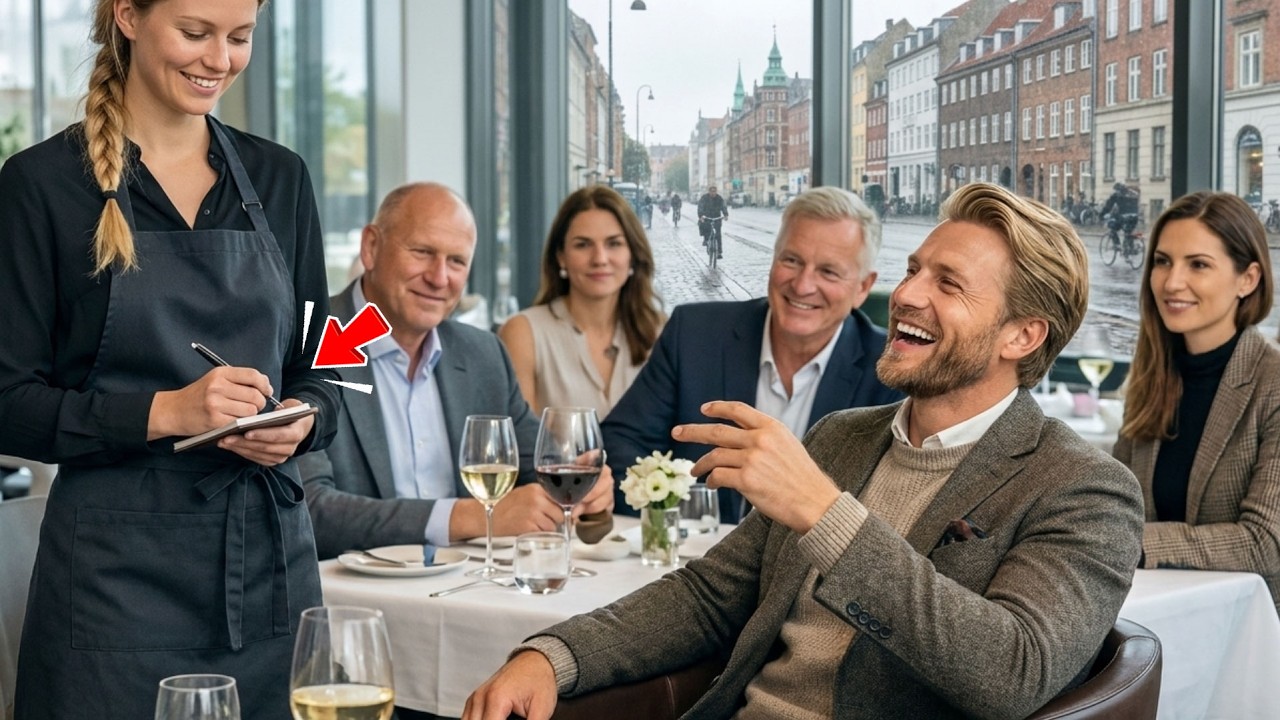
Sofia Lindgren had been on her feet for six hours. Her feet throbbed inside black shoes with a mid-height heel that were half a size too small, but they were the only presentable pair she owned. The uniform, a crisp white blouse, a black knee-length skirt, a starched apron, hid the truth that she had only had weak coffee for breakfast because her wages wouldn’t stretch to Friday. It also hid that her grandmother Gudrun was at home with swollen knees and no money for medicine, and that every step she took in this luxury restaurant was a silent act of resistance against hunger, against defeat, against being forgotten.
But no one saw that. No one saw Sofia Lindgren. They saw the waitress, a nameless body serving three-hundred-kroner dishes and six-hundred-kroner bottles of wine. A person who disappeared the moment the glasses were filled and only existed when they needed something.
The restaurant Nordstjernen sat on the top floor of the Crystal Tower, the most exclusive building in Copenhagen, valued at sixteen billion kroner. Huge panoramic windows offered a magnificent view of the illuminated city, which looked like a carpet of falling stars. The tables were spaced generously apart, giving the wealthy privacy and room for their secrets. Lamps of Czech crystal hung from the ceiling like frozen tears.
A hum of conversation in English, French, and Danish mixed with the muted clink of silverware against fine porcelain. Sofia approached table fourteen with her notepad in hand. She had learned to walk without making a sound. To breathe without being noticed.
To exist without being in the way. Good evening, gentlemen. Are you ready to order? Sebastian Westergaard only looked up for a single second.
He was forty-four. His bespoke suit, worth thirty thousand kroner, fit as if painted on his body. His dark hair was swept back with Italian gel, and his sharp jawline had been described by gossip magazines as merciless. His dark eyes had learned to assess a person’s worth in the space of a heartbeat.
And Sofia, twenty-six, with a delicate face and classic Nordic features inherited from her grandmother, small but strong hands, and brown eyes that hid entire libraries inside them, she did not pass his test. He didn’t even answer her. He turned to his guests, three European businessmen in linen and expensive suits, and began speaking Russian. Let her wait.
The waitresses here think they’re important. The Europeans laughed, a polite, knowing laugh. The laugh of men who had never waited for anything in their lives. Sofia kept her professional smile, but her knuckles turned white around her notepad.
She swallowed once, twice, and waited fifteen seconds. Twenty crowns, fifty. One of the Europeans, a German man with a trimmed blond beard, gave her a discreet sign. Sebastian ignored it.
He continued speaking Russian, gesturing with his hands, laughing at something only they understood. Sofia felt the heat rise in her throat, not from shame, but from anger. But she had learned. She had learned through hardship, humiliation, and the fear of losing her job that a poor person’s anger had no place in a rich person’s restaurant.
She took a deep breath. She counted to ten in her head in Danish, then in English, then in French. Finally, Sebastian turned his head toward her with the calculated slowness of someone who enjoys making others wait. Are you still here?
Yes, sir. Would you like to order? He squinted. Something in her tone, too firm, too steady, annoyed him.
Do you speak Russian? No, sir. A lie. Sofia had spoken Russian since she was nineteen, but she had learned another lesson.
Never show all your cards too early. Sebastian smiled. It wasn’t a kind smile. It was the smile of a shark that has just smelled blood.
What a shame. Then my order will be in Russian. He leaned back in his chair and crossed his arms. Let’s see if you can handle this.
I’ll have the ribeye, medium-rare, with truffle sauce. And… He rattled off the rest in perfect Russian, his eyes never leaving hers. Sofia stood still, her heart pounding, but she didn’t flinch.
She understood every word. He was describing the most complicated preparation on the menu, adding impossible demands, and finishing with an insult, calling her a silly girl who probably couldn’t even spell truffle. The silence that fell over the table was so deep you could hear the clinking of glasses three tables away. Sofia felt the floor open beneath her feet, but she kept her back straight, her eyes fixed on a neutral point over Sebastian’s shoulder.
Then, she spoke. In flawless Russian. Of course, sir. The ribeye, medium-rare, with truffle sauce.
And for the sides, roasted vegetables with sea salt and a creamy pepper sauce. Would you also like the green salad with walnuts and a light vinaigrette, as you mentioned? The Europeans froze. Sebastian’s smile vanished.
The German businessman let out a low whistle of surprise. You speak Russian, Sebastian said, his voice flat. You asked, sir. I answered.
She wrote down the order, her hand steady despite the storm inside her. Sebastian’s jaw tightened. For a long moment, he just stared at her, processing the fact that this nobody, this waitress, had not only understood his insult but had thrown it back in his face with perfect precision. Your name, he said.
It wasn’t a question. Sofia Lindgren. Is there anything else, sir? He dismissed her with a wave of his hand, but his eyes had changed.
They were no longer mocking. They were calculating. Later that evening, Sofia was in the back room folding napkins when the manager appeared, his face pale. Sofia.
Mr. Westergaard wants to see you. In his private dining room. Her stomach dropped.
She had been fired before, once, for dropping a tray of champagne. She knew the script. Come to my office, collect your things, security will escort you out. She walked down the corridor with her head held high, already planning how she would stretch her last paycheque, knowing it wouldn’t be enough for both rent and Grandma’s medicine.
Sebastian was alone in the private dining room, standing by the window with his back to her, a glass of scotch in his hand. The city lights glittered below him like a million tiny eyes watching. Close the door, he said without turning around. She did.
He took a slow sip of his scotch, then turned to face her. The coldness in his eyes made her skin prickle. You’re a clever girl, Sofia. I respect that.
So let me make you an offer. I need someone who speaks languages, who can handle my clients, who knows how to be invisible and present at the same time. A personal assistant. You’ll earn in a month what you earn here in a year.
Sofia was silent. The offer hung in the air, shimmering and dangerous. Why me? she asked finally.
Because you passed the test. The Russian thing. You passed. And I hate losing a good asset.
He smiled, but the smile didn’t reach his eyes. Sofia looked at him, this man whose world was made of gold and broken promises, and she felt something cold settle in her stomach. I need time to think, she said. Of course.
But not too long. I’m not a patient man. She left the room, her heart pounding. The offer was more money than she had ever dreamed of.
It would mean security for her grandmother, a proper apartment, no more fear of Friday. But something about the way Sebastian looked at her, like she was a tool he wanted to own, made her feel dirty. Over the next week, Sofia did her research. She asked questions, quietly, carefully, in the employee corridors and among the old staff who had seen generations of rich men come and go.
What she learned made her blood run cold. Sebastian Westergaard hadn’t made his fortune. He had inherited it, and stretched it, and then built an empire on land prices, on buying up old Copenhagen tenements for nothing and turning them into luxury hotels. But the land had never rightfully been his.
It was a legal loophole, a forgotten inheritance, a family that had been pushed out decades ago and had never had the resources to fight back. And Sebastian had been counting on them staying silent forever. It was the kind of story that got people killed. Or at least fired.
Sofia knew too much. She went to the police, but without proof, the word of a waitress against one of the richest men in Denmark meant nothing. The case was dismissed before it began. Sebastian found out about her visit within hours.
The next day, a man in a black suit came to her grandmother’s apartment and delivered a message. Mr. Westergaard would like to remind you that the offer still stands. But the invitation will expire soon.
And such invitations, once expired, are usually replaced by… other arrangements. Sofia’s blood ran cold, but she was more afraid for her grandmother than for herself. She made her decision.
Two weeks later, she stood in Sebastian’s office, a folder in her hands. He was behind his desk, smiling like a cat who had caught a mouse. So, Miss Lindgren. Have you made your choice?
Yes, Mr. Westergaard. I refuse. His smile flickered.
Excuse me? I know what you did. The land in Vestergade. The tenements.
The old people you pushed out of their homes. I know about the false documents, the bribes, the shell companies in Cyprus. And I have proof. She opened the folder and placed a series of printed emails on his desk.
Sebastian’s face went pale. He picked them up, scanning them quickly, his knuckles white. Where did you get this? That doesn’t matter.
What matters is that I’ve sent copies to my lawyer, to three newspapers, and to a cousin in Sweden who will release them automatically if anything happens to me or my grandmother. Sebastian laughed, but it was a hollow sound. You think you can threaten me? I don’t think anything, Mr.
Westergaard. I know. You can destroy me, yes. But you’ll burn with me.
And the world will know exactly how you built your empire. The silence stretched between them, thick and heavy. Sebastian stared at her, his eyes burning with a hatred so pure it felt like a physical weight. Then, slowly, he sat down, placed his hands on the desk, and began to laugh.
It wasn’t a joyful sound. It was the laugh of a man who had just realized he had been outplayed. Alright. You win.
What do you want? I want you to sign over the land. All of it. Back to its rightful owners.
And I want you to stop. No more schemes, no more revenge. You walk away from this, and I walk away with my silence. And if I refuse?
Then I go to the papers with everything. Sebastian was silent for a long time. Then, with a slow, deliberate movement, he opened his desk drawer, pulled out a pen, and slid a document across the desk. You know, Miss Lindgren, he said quietly.
You’re the first person who’s ever beaten me. I hope you’re happy. Sofia took the pen, signed the document, and pushed it back. She didn’t smile.
She just looked at him, this broken man in his tower of glass and gold, and felt nothing. I’m not happy, she said. I just wanted my life back. She walked out of his office without looking back.
The towers of the city glittered below her, cold and indifferent, but for the first time in months, Sofia could breathe. The aftermath was public. The scandal broke within weeks. Sebastian’s empire crumbled, not all at once, but steadily, like a slow-motion earthquake.
The land, now worth over six billion kroner, was returned to the families who had been defrauded decades ago. Sofia testified for hours in a courtroom that smelled of dust and old paper, answering questions she had rehearsed a thousand times in her head. Sebastian sat across the room, his expensive lawyers flanking him, but his composure had cracked. He looked old, exhausted, and truly defeated.
The judge, an elderly woman with silver hair and sharp, wise eyes, delivered the verdict with a steady voice. She ruled in favor of the plaintiffs, ordered Sebastian to pay two point three billion kroner in compensation and unjust enrichment accumulated over thirty years. The courtroom fell into a stunned silence, so deep you could have heard a pin drop. Sebastian’s face went ashen, but he showed no emotion.
He simply closed his eyes, as if accepting a fate he had spent decades trying to outrun. After the verdict, Sofia didn’t celebrate. She walked outside into the cold Danish air and sat on a bench near the courthouse, surrounded by the sounds of the city she had come to love and fear. The old tenements, some of them over a hundred years old, stood before her, their weathered facades bearing witness to decades of injustice.
The scent of wet earth after the morning rain, the song of birds that had never left, waiting only for their true owners to return, filled the air. It would have been a beautiful moment, if only she didn’t feel so heavy. Later that evening, Gudrun sat by the fireplace in their small apartment, her grandmother’s back straight despite her age. Sofia entered with a cup of tea, and Gudrun looked up at her with eyes that held a lifetime of unshed tears.
Was it worth it? Gudrun asked. All of it? Sofia didn’t answer right away.
She set the cup down and sat at her grandmother’s feet, resting her head on her knees. I don’t know, Grandma. He lost everything. But he was always a king without a kingdom.
He just didn’t want to admit it. Gudrun ran her fingers through Sofia’s hair. Her voice was a low, gentle murmur, tinged with a sorrow that was not for herself, but for the lives that had been broken. Miss Sofia?
Shall we go home? A nod. The old house in Jutland, the one from the family, it’s still ours. We can go there, start fresh.
Sofia looked up at her, a flicker of hope lighting in her chest. Home. She had almost forgotten she had one. The old farmhouse, with its weather-worn roof and wild roses climbing the walls, sat untouched, waiting for them.
It was modest, worth only a fraction of the fortune that had been lost, but it was heavy with the weight of generations. Her grandfather had built it with his own hands, and when he died, he had left it to Sofia in his will, a quiet act of defiance that she only now understood. She was young, strong, walking over the garden’s paths with a straw hat and a calm smile. The farmhouse became her sanctuary.
She spent her days tending the vegetable garden, repairing the fence, reading by the window as the sun slipped behind the horizon. She did not mourn Paris or the life she had left behind. She mourned the parts of herself that she had buried to survive. Months passed.
The scandal faded from the front pages, replaced by other stories, other kings, and other falls. Sofia received letters from some of the families whose land had been returned. Most were grateful; a few were suspicious, wondering why a waitress had risked everything to expose a man like Sebastian. She never responded to the letters, and she never sought to profit from her actions.
She had given up more than money when she walked away from his offer. She had given up the life she had built, the security she had finally found, in exchange for a hollow victory that kept her awake at night. And Sebastian? He was a shadow of his former self.
The scandal had destroyed his reputation, and he could not restrain his greatest fear: being forgotten. He moved to a small flat in Aarhus, a shadow of his former self, and Lisa sometimes saw his name in the papers, always as a cautionary tale about the price of pride. He died alone five years later, just as the obituary printed in the business pages noted, a man who had once owned half the city, now worth nothing but memories of what could have been. The news of his death reached Sofia in the middle of a warm Jutland afternoon.
She was sitting on the porch, a glass of lemonade in her hand, listening to the birdsong that had never quite left the old garden. She read the obituary twice, then folded the newspaper and placed it beside her. Grandma was right, she whispered to the empty air. It was a tragedy.
A tragedy for him, for his father, for all the wasted life it caused. She thought about the man who had looked at her over the rim of his wine glass, a perfect mask of amusement and contempt, and the loneliness she had seen in his eyes, a loneliness that no amount of money could ever fill. She had won. She had taken care of her grandmother, and the last years of her life were spent in comfort, surrounded by family and health.
But there was no joy in watching a man fall from such a great height. Only a quiet, certain sadness for what could have been, if only he had known that a person’s true value was never measured in millions. The sun set over the garden, painting the sky orange and purple, and Sofia Lindgren closed her eyes, drawing a deep breath. She didn’t know what the future held, one day at a time.
But for the first time, she felt something that had been absent for as long as she could remember. She felt free. And that, more than anything else, was enough.