The air in the base auditorium was thick with floor polish and salt, a familiar cocktail of ceremony and duty. I stood at attention in my dress whites, the South Carolina humidity clinging to the fabric, and searched the third row for my family. The admiral called my name. There was a burst of respectful applause.
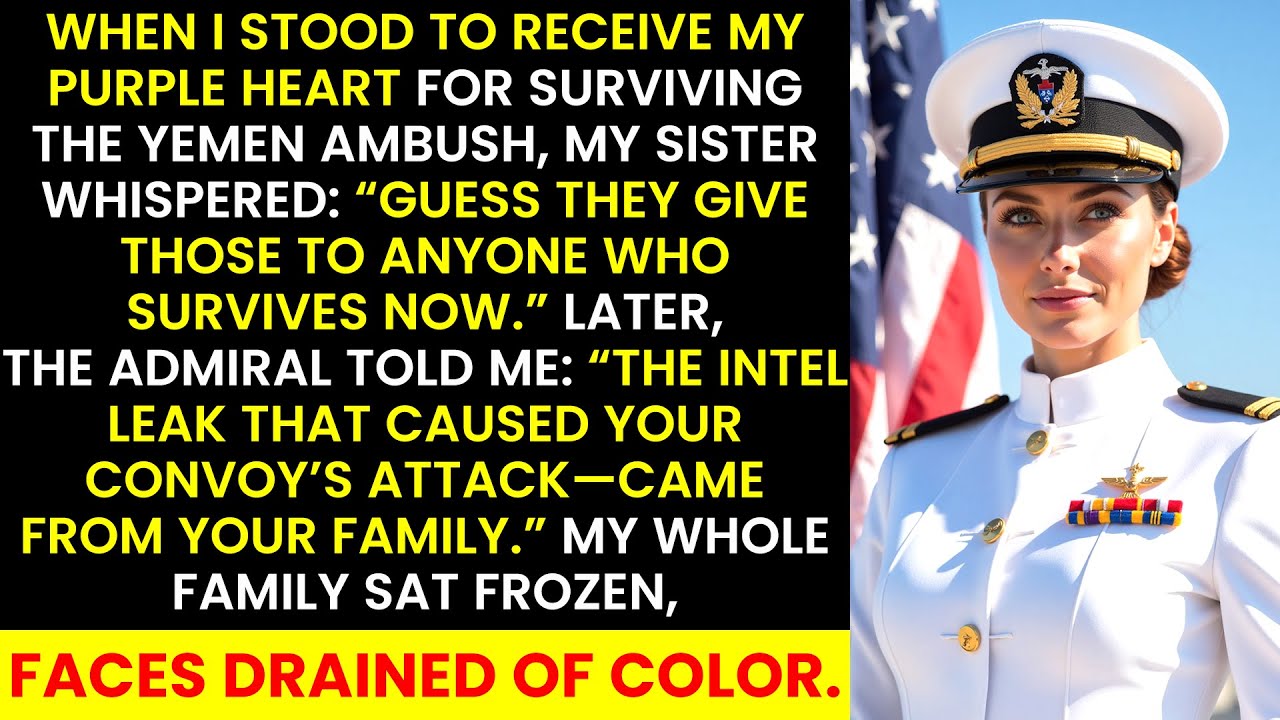
And then I heard it, sharp and crystalline, slicing through the noise of the crowd like a blade. “Guess they give those out to anyone who survives now. ”
It was Chloe, my own sister, her voice just loud enough to carry. A snicker followed.
Not from strangers. From my brother Evan. My mother’s smile didn’t waver, but it hardened into something tight and polite, the kind she used to manage a spilled glass of wine. My father sat with his arms crossed, his jaw set, his eyes full of the same old disappointment.
They weren’t embarrassed by my survival. They were covering for something. And as I approached the stage, I caught the little red light blinking on Chloe’s phone. She was recording.
My humiliation was content. I reached the admiral and let him pin the Purple Heart to my chest. He was a man who had seen combat, and his eyes flickered for a fraction of a second toward the third row before meeting mine. He knew.
He had heard it. His gaze said, without words, “I see the real injury, Lieutenant, and it isn’t the one in your shoulder. ”
Three days later, I was granted leave and drove across the Ravenel Bridge into Mount Pleasant. The old wooden sign at the entrance to the family property still read “The Masons — A Family Built on Honor.
” The paint was peeling. I passed the shipyard, its cranes silent against the sky, and the memories came back hard. I was eighteen again, sitting at the mahogany table, the taste of my mother’s shrimp and grits on my tongue as I announced I had been accepted to the Naval Academy. Evan had laughed.
Chloe had rolled her eyes. But my father had slammed his hand on the table. “No child of mine wears a uniform. This shipyard is the Mason legacy.
It’s who we are. You’re throwing it away to go play soldier. You’re an embarrassment to this family. ” I had looked to my mother for help, and she had only said, “Faith, don’t upset your father.
Family comes first. ”
Now, walking through the front door, I found her waiting with a hug and a glass of sweet tea. “I am so proud of you, sweetheart,” she said, but her eyes were cold and distant. “Your father is under such stress.
The shipyard has been struggling. Just try not to bring any more trouble home. ” Trouble, she meant the truth. In that house, family comes first meant burying the truth, protecting the facade at all costs.
I retreated to my old bedroom, looking for distraction. I opened my mother’s old vanity, searching for a box for some photographs, and my hand closed on something that didn’t belong. A plain manila envelope, tucked behind a stack of silk scarves. My breath caught when I saw the faint insignia stamped in the corner.
The seal of the Office of Naval Intelligence. Inside was a single yellowed slip of memo paper. One typed line: “Ongoing surveillance, civilian accessing classified medical data via Mason contact. ”
Mason contact.
I was the only Mason in the Navy. Were they watching my family, or watching me? My phone vibrated on the nightstand. The screen lit up with a name that made the air leave my lungs.
Admiral Harris. His voice was grim. “Lieutenant, we need to talk. In private.
”
Sleep was impossible. The admiral’s directive and that chilling memo played on a loop in my mind. Around two in the morning, I slipped out of bed and moved through the dark house with the muscle memory of a thousand night patrols. My target was my father’s office, his sanctuary.
I eased the door open and used my phone’s flashlight to sweep the room. Filing cabinets full of shipyard invoices. Tax records. Nothing.
I moved to his massive oak desk, sifting through the papers. Everything was meticulously organized, perfectly normal. But the knot in my stomach told me the truth wasn’t in the open. Then I saw it.
The bottom right drawer. It was jammed tight, wedged shut on purpose. I worked the tip of my navy-issue knife into the seam and applied steady pressure. With a sharp crack, the drawer gave way.
Inside was a single, crisp bank slip stapled to a business card. The card read Maritime Research Group, embossed in a stark, professional font. The bank slip was a deposit confirmation. Under “services rendered,” it read, “payment received, $7,500.
” And at the bottom, a signature I had seen on every report card and permission slip of my life. R. Mason. My father had lectured me for years that honor was priceless.
Apparently, his name had a price tag, and it was exactly $7,500. Back in my room, I sat in the dark with the evidence burning a hole in my mind. There was only one person I could trust. I called Ethan Cole, my former squadmate, a cybersecurity genius who had left the Navy to run his own firm.
He answered with warm humor, but his tone changed the moment I said the words “Maritime Research Group. ” “Faith, where are you right now? ” When I told him, there was a long pause. “Faith, I can’t.
I have a family now. If I run that name through my systems, if Mason contact is what I think it is, this is way beyond a simple data leak. This is treason. ” I reminded him of Sergeant Davis, the man who had died in my arms on that sand.
“Give me thirty minutes,” he said finally. The text that came back was a sledgehammer. “Faith, MRG is a shell corp. They’re under federal investigation, linked to the convoy leak in Yemen.
” A second message followed, a link to an encrypted intelligence blog post. The headline made me sick. “MRG suspected of selling medical convoy routes to foreign contractors. ” The medical convoy.
My convoy. The ambush that had killed Davis and Chen nearly killed me. It wasn’t random. It wasn’t bad luck.
My father had taken money to sell the route that led my team into a kill box. He had nearly gotten me killed for $7,500. I moved through the next two days like a ghost, watching them, waiting. They were watching me too, their hushed conversations stopping the moment I entered a room.
Then came the third day, a text from Chloe. “Family dinner at Hall’s tonight to properly celebrate you being home. My treat. XO.
” I knew it was a trap, an interrogation disguised as a celebration. They wanted to gauge what I knew. I typed back, “Sounds great. See you at 7.
”
The performance was already in full swing when I arrived. Hall’s Chophouse glowed with dark wood and crisp white tablecloths, a jazz trio murmuring in the corner. My family sat at a prime table, a flawless tableau of prosperity. The small talk rolled on through the drink order, and then my father leaned forward, a predatory glint in his eye.
“So, Lieutenant. Enjoying your newfound fame? Does that little medal get you a discount on a meal like this? ” Evan chimed in with a greasy smirk.
“Hey, if you’re not using it, can I borrow that thing sometime? Might look good hanging up in the shipyard office. ”
They spoke of my blood as if it were a cheap trinket. Before I could answer, Chloe propped her phone against a water glass.
The little red light was on. She was live-streaming. “Hey, guys. Just having a wonderful family dinner here, and I’m with my absolute favorite person, my little sister and honest-to-God American hero, Faith.
” She panned the camera to me, her smile a predatory thing, as her thumbs typed out hashtags. “Proud military family. ” “Honor. ” “Support our troops.
” The hypocrisy was so profound it took my breath away. She was using my pain to buy likes, moments after mocking my survival. I held my expression in a mask of cold neutrality. I would not lose my composure, not here, not on her terms.
Then I felt a vibration in my pocket. Admiral Harris. “We found more. Financials.
Meet me after dinner. Do not let them know. ” I looked up. Chloe was still cooing at her followers.
My father was flagging down the waiter for another bourbon. I placed my napkin on the table and stood. “Excuse me. I need to use the restroom.
” My father’s gaze followed me, sharp and suspicious, but I walked past the restroom and out the front doors into the humid night. The meeting point was a deserted parking lot overlooking the harbor. Admiral Harris was already waiting in his unmarked sedan. He wasted no time, pushing a thin file folder across the console.
“Bank records. We got a warrant this afternoon. ” He pointed at a highlighted name. “The account is in your brother’s name, Evan Mason.
Regular recurring payments from MRG, $50,000 over the last six months. ” I stared at the numbers. Evan, the golden child, the heir. “But he doesn’t know anything about military logistics.
” “Exactly,” Harris said. “He wasn’t the brains. He was just the courier. ” He turned the laptop to face me, a classified report with a section left clear.
The final two lines read, “Intel provided by E. Mason. Verified by R. Mason.
” My brother was the source. My father was the verifier. A father and son conspiring to sell information that got American soldiers killed. “Sir, what are my orders?
” “Your orders, Lieutenant, are to go home. Act normal. Do not engage. You are now a material witness in a federal investigation.
We handle it from here. ”
I drove away in a daze. Halfway home, my phone rang, a blocked number. “Stop digging, Ms.
Mason. ” The voice was flat, metallic. “You don’t want the answers you’re looking for. ” I glanced in my rearview mirror.
A large black pickup truck had been behind me for miles, mirroring my every turn. It was a message. They weren’t just selling information. They were willing to kill to protect their secrets.
They had tried once in Yemen. Now they were ready to try again in South Carolina. When I pulled into the driveway, the truck continued on down the road. My mother was waiting in the living room, a solitary figure by a single dim lamp.
“Faith, where have you been? ” It wasn’t a question born of worry. It was an accusation. She stood and walked toward me, her voice a venomous whisper.
“You are tearing this family apart. Are you sure you’re all right, honey? Is it the PTSD? The doctor said you might have episodes, that you might become paranoid.
” She called me paranoid. She called me selfish. She twisted my trauma into a weapon to discredit me. In that moment, the last shred of hope that she might be a silent victim disintegrated.
She wasn’t my mother. She was the warden of this prison. The word paranoid echoed in my head, but instead of planting doubt, it fueled a white-hot rage. I went to my room and looked in the mirror.
I saw the exhaustion in my eyes, the tension in my jaw, the faint silver scar above my temple from the shrapnel. I wasn’t paranoid. I was a witness. There was one place left I hadn’t searched, the one place my father considered more sacred than his home.
The shipyard. That same night, I drove back and approached on foot, scaling the chain-link fence and landing silently on the gravel. I made my way to my father’s main office. The computer tower was wiped, but my father was old school.
He believed in physical backups. I found the heavy, old-fashioned steel safe tucked under his desk. I knew the combination. It was my mother’s birthday.
With a heavy clunk, the door swung open. Inside was a small black external hard drive with a white label in my father’s handwriting. “MRG Reports 2022. ”
I took it, along with a company laptop, and retreated to a fabrication shed.
I plugged in the drive. It was a flood. Hundreds of emails, spreadsheets, encrypted communications. Correspondence between an anonymous address I knew had to be Evan and someone identified only as MRG Consultant.
They were discussing shipping lanes, cargo manifests, security patrol schedules. A detailed chronicle of their treason. Then I saw a subject line that made the blood freeze in my veins. An email from Evan to my father.
“Keep this from Faith. Schedule updated. ” I clicked it open. A revised timeline for medical convoys moving through a volatile province in Yemen.
The date was three days before the ambush. They hadn’t sold random information I just happened to get caught up in. They had sold the specific route of my convoy, knowing full well I would be on it. They had offered me up as collateral damage.
There was one more file. A password-protected PDF. The password hint was “legacy. ” I typed in Evan.
The title read, “Yemen Convoy — After Action Report. ” It detailed the outcome of the attack. Assets destroyed. And then the casualty list.
Sergeant Davis. Corporal Chen. And a third name, under “wounded in action. ” Lieutenant Faith Mason.
At the bottom of the report was a digital signature. R. Mason. He had signed off on it.
He had seen my name on a casualty list his actions had created, and he had rubber-stamped the murder of my men and the near death of his own daughter. I copied the entire drive onto the laptop, connected to the shipyard’s Wi-Fi, and sent the full unredacted cache to Admiral Harris’s secure email. My phone rang less than a minute later. “Lieutenant, what is this?
Where did you get this? ” “The shipyard, sir. It was in my father’s safe. ” A moment of stunned silence.
“Faith, this is a matter of national security now. You went against a direct order. Your new order is to stand down. Say nothing, do nothing.
Is that understood? ” I looked at the casualty report still glowing on the screen. I saw Sergeant Davis’s face. “With all due respect, Admiral,” I said, the tears finally falling hot and fast, “silence is what got my men killed.
”
The morning after I sent that drive, all hell broke loose. A local news alert lit up my phone. “Prominent Mount Pleasant shipyard family in federal probe for military intel leak. ” Beneath it, a picture of my family’s pristine home with two dark blue FBI sedans in the driveway.
My mother called, hysterical. “You’ve ruined us, Faith. How could you do this to your own family? ” “Family!
” I shouted. “You want to talk about family? You stood by while he signed my death warrant. You are not my family.
”
An hour later, Chloe launched her weapon. A video, masterfully produced, titled “My sister, the hero — PTSD and the military cover-up. ” She appeared in a soft cream sweater, her eyes glistening with well-rehearsed tears. “My sister Faith is a hero,” she began, her voice trembling artfully.
“But she’s been suffering from severe PTSD. She’s unstable. I believe she is being manipulated by certain people in the military to create this horrible story about our family. ” She used footage from the ceremony, edited to make me look disoriented and confused.
She twisted my trauma into a weapon and my service into a sign of insanity. In three minutes, she transformed me from a whistleblower into a dangerous, mentally ill villain. The hashtag started trending. Save Faith from herself.
The official call came that afternoon. Admiral Harris’s voice was strained, heavy. “Lieutenant, I’ve seen the video. The brass is getting nervous.
The optics are challenging. I’m placing you on temporary administrative leave. It’s to protect you and to protect the integrity of the investigation. ” The line went dead.
My own family had successfully gagged me. For the first time in my life, I felt truly and utterly defeated. I spent the next few days in a fog of despair. Then one afternoon there was a knock at the door.
A delivery driver handed me a small brown paper package. No return address. Inside was a handwritten letter on simple, elegant stationery. “Dear Lieutenant Mason,” it began.
“My name is Sarah Davis. I am Sergeant Michael Davis’s mother. ” My heart stopped. “We have seen the videos.
We do not believe a single word of it. We know you were with our Michael in his final moments. You never gave up on him then, and we know you are not giving up on the truth now. ” I clutched the letter to my chest, a ragged sob breaking from my throat.
This piece of paper held more honor, more love, more truth than my family had shown me in a lifetime. This was my real medal. The military hearing room at the Charleston Naval Base was as cold and silent as a tomb. I sat alone at the witness table in my dress whites.
Across the room sat my family. My father projected arrogance. Chloe whispered to their lawyer. My mother stared at her hands, twisting her wedding ring.
Evan looked pale and terrified. As I walked in, I thought of my grandmother, the only kind soul in that family. A line she used to quote from her worn Bible echoed in my mind. Then you will know the truth, and the truth will set you free.
After hours of procedural motions, my father was called to the stand. He was masterful, his voice steady, tinged with the sorrow of a loving father forced to endure a nightmare. “This is all a terrible, tragic misunderstanding. My daughter is a hero.
But she suffers from severe PTSD. She is not well. She has been manipulated by the Navy into constructing this fantasy to lash out against her family. ” He turned and looked directly at me, his eyes commanding.
“Faith, tell them. End this now. ” I met his gaze and held it, my expression as unyielding as the granite of his own shipyard. When his testimony concluded, the prosecutor turned to Admiral Harris.
“Admiral, does the Navy have any rebuttal to Mr. Mason’s claims? ” Admiral Harris stood. “We do not have a rebuttal.
We have evidence. ” The lights dimmed, and a large screen flickered to life. The emails from the hard drive. The bank records.
The $7,500 deposit slip, followed by statements showing $50,000 flowing into Evan’s account. A murmur rippled through the gallery. Chloe glared at me. My father’s composure began to crack.
“And finally,” the Admiral said, “we have audio. ” The first recording played, the flat metallic voice from the threatening call. “Voice analysis experts from the FBI have confirmed with 99% certainty that the speaker is Mr. Evan Mason.
” Evan sank in his chair. The second recording was a phone call between my father and the MRG consultant. His voice was cold, clipped. “Confirmed.
The convoy is mobile at 0600. Payment as arranged. ”
My mother let out a high, piercing shriek, a sound of pure horror as the final truth crashed down upon her. The room erupted.
When it quieted, the presiding officer turned to me. “Lieutenant Mason, do you have a final statement? ” I stood, my posture straight. I looked straight at my father.
“I only have one thing to say. I didn’t survive that ambush by luck. I survived in spite of you. ”
Three months passed.
I sat in my temporary apartment watching the evening news. The anchor read the verdicts. Richard and Evan Mason, twenty years in federal prison for treason and conspiracy. Chloe Mason, five years for obstruction of justice and witness tampering.
Eleanor Mason, two years probation for misprision of a felony. Justice. It was served. But there was no triumphant surge.
Only a profound and hollow emptiness. My family was gone. My career was in limbo. I had won the war, but I was standing alone on the battlefield, surrounded by the wreckage of what used to be my life.
A few days later, there was a knock on the door. Admiral Harris stood there, not in uniform but in a simple polo shirt and jeans, holding two cups of coffee. He sat with me at my small dining table, and we watched the afternoon light slant through the window. “Your career, Faith,” he began, “is complicated.
By exposing this, you’ve embarrassed some very powerful people. But you also reminded every one of us what honor, courage, commitment actually look like in practice. ” He leaned forward, his gaze unwavering. “Whatever happens next, I want you to know that I am proud to have served with you, Lieutenant.
” The word hit me like a tidal wave. Proud. It was the one word I had spent my entire life trying to earn from my own father. A dam I didn’t know I had built inside me broke.
For the first time in months, I cried, not tears of rage but of quiet, overwhelming gratitude. The following weekend, there was another knock. My niece, Hannah, Chloe’s sixteen-year-old daughter, stood in the hallway, small and scared, clutching a small backpack. She reached inside and pulled out a silver USB drive.
“This is the raw footage from before my mom edited it all together. ” She looked up at me, her eyes swimming with tears. “Because she lied. And Grandma and Grandpa, they lied too.
I already sent a copy to the FBI, so everyone would know you weren’t making things up. ” I pulled her into a hug as she sobbed against my shoulder. “You’re not destroying this family, Hannah,” I whispered. “You just started rebuilding it.
”
Five years later, I stand on the balcony of a new building of glass and steel, looking out over Charleston Harbor. Below, a gleaming bronze sign reads “The Mason Academy for Ethical Service. ” When Hannah’s evidence completely exonerated me, the Navy offered my career back. But something inside me had changed.
I took an honorable discharge. When the US Marshals seized all Mason assets, I waited. And at the government auction, I bought the old shipyard. Where my father had built a legacy of greed, I planted one of integrity.
A voice cuts through my thoughts. “It looks good, Aunt Faith. ” I turn. Standing beside me is a midshipman in the crisp uniform of the Naval Academy.
It’s Hannah. At twenty-one, she is no longer the scared girl who showed up at my door. Another Mason in uniform, but this time, a choice made in service of an ideal. She looks at the flagship of the academy’s small fleet, the refurbished vessel used for humanitarian missions, once my father’s prize boat, still bearing the nameplate Eleanor.
“Do you ever forgive them? ” she asks quietly. I follow her gaze. The old, searing anger is gone.
What remains is a hollow sadness, the ghost of a wound long scarred over. “Forgiveness isn’t about forgetting, Hannah,” I say. “It’s about accepting the truth in all its ugliness, and then choosing not to let it have power over you anymore. ” “So you finally found peace?
” she asks. I shake my head slowly. Through the glass balcony doors, I can see the wall of my office, where my Purple Heart hangs in a simple frame. It’s not a reminder of betrayal anymore.
It’s a reminder of the price of truth. “No, Hannah. I didn’t find it. I built it.
Because a true legacy isn’t the name you’re given. It’s what you build from the broken pieces of your life. ” I was given a legacy of lies and dishonor. But I chose the truth.
And from the ashes of betrayal, I had created a legacy of my own. One that was quiet and honest and unbreakable.