The hoe hit the hard earth and bounced. Before Luciana could lift it again, she looked up at the man watching her from the fence line. He had not spoken yet, only studied her from under his straw hat. In that silence she understood that her life had shifted, and there was no going back.
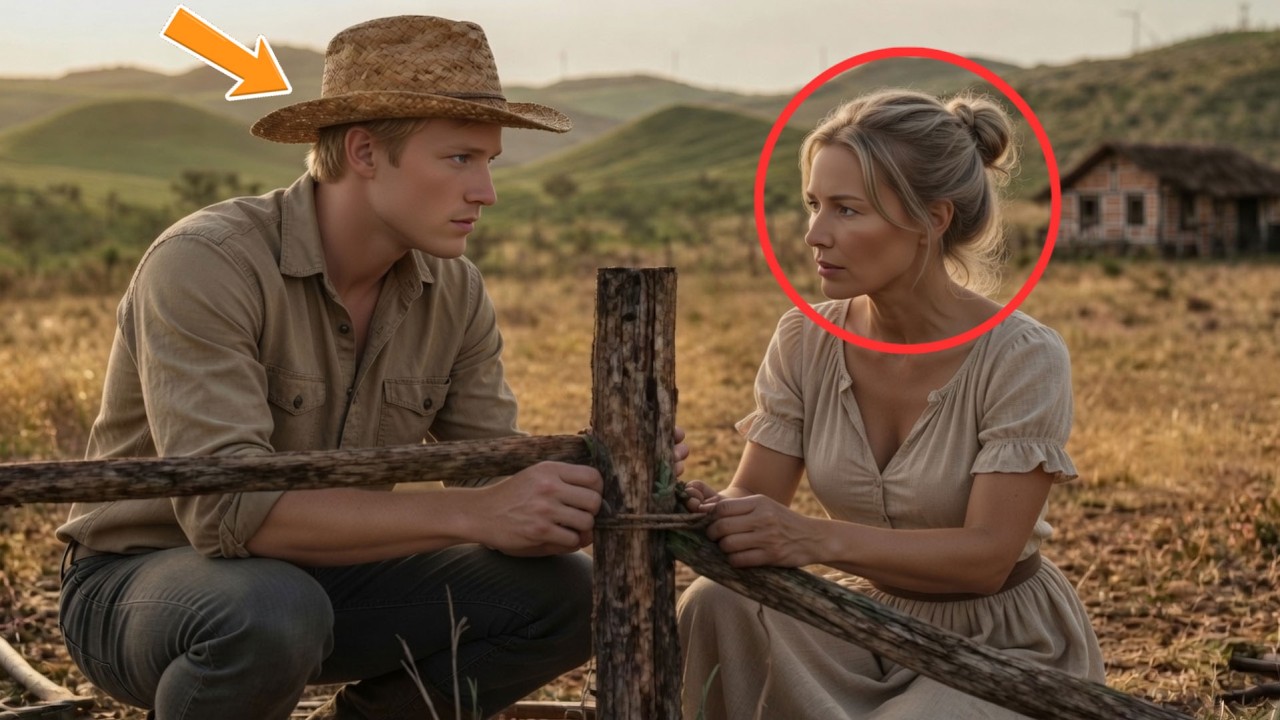
She could not tell if it was for the better or the worse, but the ground under her feet had changed. The farm lay behind them, old and tired, like she felt she had become. And that man with his calloused hands and quiet eyes was the only person who had offered her anything in a long time. Not money, not pity.
Work. And at that moment work was worth more than anything else. Luciana had arrived in the village of Skovlund three weeks earlier. She came with a worn suitcase, a seven-year-old son asleep on her shoulder, and a debt that could not fit in any pocket.
Her husband René had died six months earlier of a fever that came fast and did not ask permission to stay. They buried him on a Tuesday afternoon with four people present and a wooden cross that the neighbor had made in a hurry. Luciana did not cry at the burial. Not because she did not love René.
She did. But because she had already cried everything out in the weeks before, when she watched him lose weight, lose his voice, lose hope bit by bit. By the time he was buried she was empty, and empty people do not cry. They only feel cold.
What came after was worse. The debts René had collected without telling her appeared one by one like uninvited guests. The bank wanted the house. The merchant in town wanted the livestock that was left.
And a man named Osmar wanted the plot of land where Luciana kept her kitchen garden, the one she had worked with her own hands. She fought. She spoke to lawyers who did not understand her situation. She signed papers she barely understood.
She asked relatives for help, but they had problems of their own. In the end she had nothing left but the boy, the suitcase, and the name of a village written on a crumpled piece of paper her neighbor Dona Filomena had given her before everything was lost. Skovlund. Dona Filomena told her there was land there, that people worked hard, that someone always needed help.
Luciana did not think twice. She took what little she had left, grabbed her son Peter by the hand, and boarded the first bus she found. The trip lasted four hours. Peter slept almost the whole way.
She did not close her eyes. She stared out the window at the red earth flying past like a dream and wondered what kind of life she was traveling toward. They arrived in Skovlund early in the morning. The village was still asleep.
Only a woman at the bus stop saw them arrive. She looked them up and down, said nothing at first, then pointed to a pension three streets away. Luciana thanked her and walked with Peter on her shoulder until she found the door. She knocked and waited.
An older woman opened the door with sleep still in her face. She saw the woman and the child and opened the door without asking questions. That was the first sign that maybe it was not going to be so bad. The first days were hard.
Luciana asked at the grocery store, at the bakery, at the church. She needed work. Anything. Washing dishes, cleaning houses, tending animals, planting, whatever.
Some people listened and said they already had help. Others did not listen at all. But it was at the bakery that she first heard the name Martin Albertsen. The woman behind the counter said without hesitation that there was a man north of the village who had a farm and was looking for people to work, that he did not pay much, but that he paid on time, and that he was a man of few words.
The next day Luciana left Peter with the older woman at the pension and walked to the farm. The road was long and dusty. The sun was already strong by mid-morning. When she arrived, she saw the property from a distance.
The main house still stood, but time had marked it. The roof was damaged in one corner. The wooden fence had collapsed in several places. The ground around it was dry and poorly tended.
But there was also life. There was a small kitchen garden with new plants. There were tools neatly arranged against the wall. There were signs that someone was fighting against the decay with whatever they had.
Then she saw him. Martin stood at the fence driving posts into the ground alone, with slow but certain movements. He stopped when he heard her approach. He looked at her from under his straw hat without saying anything.
Luciana introduced herself. She said she was looking for work. She said she knew how to sow, how to tend animals, how to build fences, and how to cook for ten people if needed. He listened without interrupting.
When she finished, there was a long silence. He looked at her again and said, yes. She had not expected it to happen so quickly. She did not know what to say.
He did not say more either. He went back to his post, and she understood that this was the beginning. What neither of them knew yet was how much it would cost to rebuild the farm. And they were not only talking about wood, earth, and wire.
Martin Albertsen had been silent long before Luciana came to his door. He was forty-six and carried a history he told no one, not from shame, but because some things are too painful to tell. He was born on that same farm, in the back room, on a night of heavy rain. He grew up watching his father work the land with his hands and his heart.
He learned that the land does not lie, that it gives back what you sow, that it is not in a hurry, but it does not wait forever. His father Bent was a simple and honest man. He never became rich, but he never felt shame. When he died, he left the farm divided among his three sons.
The two older brothers, Erik and Lars, sold their shares soon after. They said the land no longer produced, that their future was in the city. Martin stayed. He bought their shares with the small savings he had and a loan that took years to pay back.
He was left alone on the land his father had built, weighed down by debt and convinced he was doing the right thing. For years the farm flourished. Martin worked tirelessly. He had cattle, crops, a small pig farm, and a kitchen garden that supplied part of the village market.
He did not get rich, but he lived well. Then came the drought. Not just any drought. It was a terrible drought that lasted three years, drying up rivers the oldest residents had never seen dry.
The cattle died little by little. The crops lost their strength. The well grew shallow and then disappeared. Martin fought as best he could.
He hauled water from far away, sold what he could, took loans when he had no other choice. But the drought did not stop. When the rain returned two years ago, the farm was on the edge of ruin. By then Martin had a wife.
Her name was Selma. They had been married eight years. She had come to the farm young and full of hope. In the good years the marriage was calm.
Not a relationship of grand gestures, but solid. When the drought came, something changed between them. Selma was a woman who needed stability. Her family had never faced great hardship.
She did not know how to handle scarcity, exhaustion, the uncertainty that each morning brought with the dry sun. The arguments started small, then grew. Selma wanted to go to the city. She wanted to leave the farm.
She wanted Martin to sell everything and start over somewhere else. Martin refused, not out of blind stubbornness, but because that land was part of him. In the fifth year of the drought, Selma left. It was not sudden.
First the visits to family in the city grew longer. Then the returns were delayed, until one October afternoon she came back for her last belongings. They did not argue. There were no screams, no smashed plates.
Only silence, the kind that hurts more than any word. She packed her things carefully, put them in two suitcases, and looked at Martin before she left. She said she loved him. She said she could not go on.
She said she hoped he would find a solution. Then she walked out. Martin stood in the doorway until her car disappeared down the gravel road. Then he went inside, sat at the kitchen table, and stayed there until it got dark without lighting a lamp.
The next day he went back to work, because it was the only way he knew to move forward. When Luciana appeared at the farm gate that hot morning, Martin had already turned away three people that month. Part of him wanted to say no again. But there was something different about her.
It was not beauty, although she was a handsome woman. It was something else. It was the way she spoke, without asking for favors, without bowing her head, with a clarity and firmness of someone who knows her own worth and does not ask for a discount. That was what made Martin say yes without thinking twice.
Peter arrived at the farm on a Tuesday morning with big curious eyes, the kind only a seven-year-old can have. He did not yet know what kind of place this was. He saw only the wide-open land, the fence, the fence posts, the enormous orange sky over the fields, and he smiled. It was the first real smile Luciana had seen on her son in months.
She took his hand as they walked down the gravel road toward the main house. Martin stood on the porch with a cup of coffee. He looked at the boy without changing his expression. Peter returned the look without shyness.
Something passed between them in that gaze. Martin lowered his head a little to greet the boy. Peter said good morning in a clear, steady voice. Martin answered the same way, and that was it.
Luciana started working that same day. Martin showed her the whole farm that morning. The small kitchen garden he had tried to keep alive with little water. The half-empty barn where the cattle used to be.
The fence that needed repair in at least six sections. The house with the roof that dripped in two corners when it rained. The cistern that was half full and needed cleaning. It was a lot of work for two people, but Luciana did not say that.
She observed everything carefully. She asked direct questions. How many daylight hours could be used for heavy work. What were the priorities.
What could she expect, and what could she not. Martin answered with the same objectivity, and by the end of the tour they both had a rough plan in their heads without needing to write anything down. The division of labor was natural. Martin took the heaviest part of the fence and the barn.
Luciana took the kitchen garden, the cistern, and the meals. Peter, who never stood still for a second, took on simple tasks, carrying small pieces of wood, watering the young plants with a watering can almost as big as he was, picking stones from the road. He did all this with a seriousness that almost made the adults smile. Almost.
Neither of them was yet capable of laughter. In the first week Luciana learned things about Martin. He woke before dawn every day, drank his coffee without sugar and without talk. He worked with a concentration that bordered on overwhelming, as if every nail was a way of paying off a debt.
At the end of the day, when the light turned orange and the heat eased a little, he put everything down, went out onto the porch, and stood looking at the land for about fifteen minutes without doing anything. Just looking. She never interrupted those moments. In the second week he began to talk a little more at meals.
Not about himself, but about the farm. About what it had been before. About the cattle his father had kept. About the harvest festival they celebrated every year when he was a child.
About the smell of wet earth after rain, which he still waited for each year with the same childlike expectation. Luciana listened, asked a question or two, never too many. Peter sometimes stopped chewing to listen, as if the stories from the dry and silent man were also for him. In the third week something small happened that changed the atmosphere between the two.
Peter slipped on a stone and fell on his knee. It was not serious, but it bled a little. Luciana dropped everything, ran to her son, cleaned his knee with water and a clean cloth she always kept in her pocket. Peter did not cry.
He just looked at his knee with his usual seriousness. When Martin came back and saw the makeshift bandage, he looked at the boy, then at her, and went out to the barn. He returned with an old but complete first aid kit. He placed it on the kitchen shelf without a word, pointed at it, and went back to tending the cattle.
Luciana stood looking at the kit for a moment. It was a small gesture, but it came from a man who did not make gestures lightly. She understood what he had said without words. That Peter mattered.
That the farm had room for both of them. That she was not alone on this foreign ground. That evening, after putting Peter to bed, Luciana sat on the porch looking at the star-filled sky. She thought about René, about the farm she had lost, about the debt, about the day she left with a suitcase and a son in her hand without really knowing where she was going.
And for the first time in a long time she felt something different. Not happiness. Not yet. But something that resembled relief.
But Luciana’s past was not finished knocking on her door. A man named Osmar arrived in the village on a Thursday morning in an old car with an expression that clashed with Skovlund’s calm atmosphere. He was tall, broad-shouldered, with a thin mustache and small eyes that always seemed to be calculating something. He walked into the market and asked for a woman named Luciana.
Not aggressively, but with a disturbing certainty, as if he already knew she was there. The market owner, Dona Anete, said she did not know anyone by that name. She lied with the ease of someone who lies for good reasons. Osmar thanked her without believing her and walked out.
But before he drove off, he left a folded note on the counter with a phone number. He said it was in case anyone remembered something. Dona Anete waited until his car disappeared down the street, then went straight out to warn Luciana. She arrived at the farm at sunset and found Luciana in the garden, hands in the dirt, Peter at her side collecting stones.
She called Luciana aside, discreetly, careful not to alarm the boy. She described the man. Luciana did not need to hear the name. From the description she already knew who it was.
She took a moment. Then she thanked Dona Anete with a voice that was steadier than she felt inside. Osmar Cabalero was not a criminal, at least not in the legal sense. He was a businessman who operated at the edge of the law.
He had bought René’s debt before René died. When Luciana’s husband passed, Osmar knocked on her door, not with violence, but with paper. With metal. With a cold formality that was almost crueler than direct aggression.
The plot of land Luciana had worked with her own hands, where her kitchen garden stood, her chicken coop, the mango tree she loved so much, was in René’s name, and the money came due. The lawyers she consulted were blunt. She had no chance of keeping the land. Osmar had not been satisfied with the land alone.
There were other amounts he claimed René owed, amounts she could not verify. She had refused to sign anything in relation to them. Now she had disappeared before he could insist again. But he had found her.
That evening, after putting Peter to bed, Luciana went out onto the porch where Martin stood looking into the darkness. She had not planned to tell him anything, but the words came out before she could decide. She told him about Osmar. About the debt.
About the land she had lost. About the money Osmar claimed she owed, money she did not believe was real. She spoke clearly and without drama, like someone giving a report, not someone asking for help. Martin listened without interrupting.
When she finished, he was silent a long moment. Then he said only one thing. He said the farm stood in his name, that she lived and worked there, and if anyone came looking for something, they would have to speak to him first. And he was not the kind of man who let strangers onto his property without an invitation.
Luciana looked at him. There was no romance in the words. There was something more solid. It was a statement.
She thanked him briefly and went to bed. Two days later Osmar returned to the village. This time he did not ask at the market. He went straight to the registry office, where he learned that a woman named Luciana Moraes worked at a farm to the north.
He got the owner’s name. The next morning his car appeared on the gravel road leading to Martin Albertsen’s farm. Martin was at the fence when he heard the engine stop. He stayed where he was, tools in hand, and watched the car approach.
Luciana was in the kitchen garden watching from a distance. She felt a knot in her stomach. Peter, at her side, noticed the shift in the air and stayed quiet. Osmar got out slowly, looked around with his calculating gaze, then at Martin.
Neither of them knew each other, but both understood what this conversation was. Osmar greeted him with a voice used to opening negotiations on unknown ground. He said he was looking for one of Martin’s employees. He said he had an unsettled financial matter with her.
A documentation issue. Nothing complicated. Martin did not move. He answered slowly.
He said that any matter concerning people who worked on his farm went through him first. He asked if the man had a formal document signed by a judge. Osmar said it was not like that. A friendly conversation.
Martin said friendly conversations did not require surprise visits to private property. Osmar smiled. It was the smile of a man used to intimidation who had just run into an unexpected obstacle. He took a moment, said he would return, got into his car, and drove slowly away.
Martin stood until the car disappeared. Then he went back to the fence and picked up the hammer. The rain came on a Friday evening without warning. It was not a gentle drizzle.
It was the kind of rain that arrives with force. Martin woke before everyone to the sound of a drip in the corner of the room. He put a bucket under it, then went to check the rest of the house. He found Luciana already standing in the kitchen with Peter half asleep in her arms, looking at a damp spot growing in the ceiling.
She said nothing. She went to get another bucket, placed it under the critical point, and went to make coffee. Martin watched her for a moment. She had not treated it as a tragedy.
She had treated it as part of the work. Peter went back to bed. The two of them stayed in the kitchen with their coffee while the rain continued outside. Martin talked about the roof, how he had tried to repair part of it the month before but lacked materials.
Luciana asked what was missing. He listed the roof tiles, the rotten wood, the beams, the cost he did not have at the moment. She listened, then said something he had not expected. She said she understood construction, that she had helped her husband renovate their house from the ground up a few years back, that she had learned to work with tile, wood, and mortar.
If he could get the materials, she could help with the repairs. Martin took a moment. It was not distrust. It was genuine surprise.
He had spent years believing certain things had to be done alone. He said he would think about it. The next Saturday the two of them climbed onto the roof together before the sun grew too hot. Peter stayed below and passed the materials.
Martin removed the old tiles. Luciana assessed the condition of the wood. They worked in silence, but it was a different silence than before. It had rhythm.
It had understanding. By midday half the roof was repaired. They came down to eat. Peter had helped prepare the meal with more enthusiasm than skill.
Martin asked if he was learning to cook. Peter said yes, but the beans were a little too salty. Martin said they were fine like that. It was the first time Luciana saw him almost smile.
The roof repair took three days. When the last beam and the last tile were in place, Martin climbed down and stood looking at the result with the restrained expression Luciana was learning to read. It was satisfaction. Not expressed in words, but visible in his eyes, in the way his shoulders lowered a little, in a deeper breath.
That evening the house felt different. It was not just the repair itself, but what it represented. The first concrete improvement the place had received in a long time, carried out by two people who a month earlier had not even known each other. The routine settled more naturally from the fourth week.
Luciana woke early, made coffee, woke Peter, and tended the kitchen garden before the intense heat came. Martin worked in parallel, always with the heaviest tasks. Sometimes they met in the middle of a task and worked together without needing to plan. Peter had become a constant presence.
The boy had a bottomless curiosity and asked about everything. Why did that plant grow differently from the others. How did the cistern hold water without leaking. Where were the animals kept that used to be in the enclosure.
Martin answered the boy’s questions with the same seriousness he used with adults. He never simplified too much. He treated each question with respect. One afternoon, while Martin explained to Peter how to choose good wood for a fence, identifying it by smell, color, and resistance to bending, Luciana stopped what she was doing and watched from a distance.
There was something in that scene she had not expected to feel. A kind of quiet beauty. A man who had been alone for a long time, teaching a child who had lost his father. Neither of them named what it was.
That same week Martin mentioned the idea of expanding the planting. He said it briefly during dinner. The garden had responded well. The rain had helped.
There was a piece of land by the new fence that got the right amount of sun. If they planted now, there was a chance for a small but real harvest. Luciana leaned in. He said corn and beans for their own use.
Maybe some squash. She said she knew something about beans, that she had planted many on her husband’s farm, that she knew which varieties thrived best in this kind of red earth. The next day the two of them went out to the piece of land and examined the soil together, talking about moisture, distance, drainage. It was a technical and objective conversation, but it had a quality of growing collaboration.
It was that afternoon that Osmar’s hired man appeared on the road, standing by the fence as if resting. Martin noticed him first. He observed him for a moment without changing expression, then went back to what he was doing. Later he told Luciana that a man had been watching the property for two days, that he had seen him before by the entrance, that he had not done anything wrong yet, but he was there with a purpose.
Luciana recognized the description. A man she had seen several times in the village. She named him. Martin took a moment, then said he would go to the village the next day and speak with the local officer.
He did not want to wait for the problem to reach his door. Luciana said she did not want to cause trouble for him. Maybe it would be better if she spoke to Osmar herself and tried to settle it once and for all. Martin looked at her with an expression she had seen before.
It was not anger. It was a calm firmness that left no room for negotiation. He said she would not talk to that man alone. It was not about lack of trust in her abilities.
It was about not allowing anyone with dubious intentions to believe she was alone and vulnerable. It would only encourage Osmar. They would solve it together or not at all. Luciana stared at him a long time.
Part of her wanted to argue. She had learned long ago to fight her battles alone. But another part recognized that he was right. Accepting help from someone you trusted was not weakness.
It was intelligence. The next morning they went to the village together. Dona Anete met them with urgent news. Osmar had been to the registry office two days earlier with a document claiming Luciana owed a specific sum under a credit agreement signed by René with a spousal liability clause.
The document appeared authentic. It had numbers, dates, a signature that resembled René’s. And another name that resembled Luciana’s, though she had never signed it. The registry official, a cautious man named Herr Knudsen, had examined the papers and said he would need time to verify their authenticity before registering anything.
Luciana examined the documents calmly. She identified the problem in the second contract. The signature attributed to her had certain similarities to her handwriting, but there were clear differences for anyone who looked closely. The shape of the initial L.
The tilt of the M. Details a graphologist would identify but which could be overlooked in a small registry. She explained this to Knudsen, who listened carefully. He said he had not yet registered anything, precisely because he had detected an irregularity.
He would keep the papers and request a handwriting analysis before taking any further action. They went to the police station. The local officer, a pragmatic man named Jensen, listened to the whole account, asked Luciana to sign a formal statement denying the signatures, and said he would open an investigation into the origin of the documents. Osmar Cabalero’s name was not unfamiliar to him in other municipalities with similar schemes.
When they left, Martin and Luciana walked in silence for a while. Then she said she had not expected things to end this way. She had come to the village expecting to face it alone. He said some fights were fairer when not fought at a disadvantage.
She had arrived at the farm alone, but that did not mean she had to continue that way. Luciana said she was afraid of being dependent on others. She had been dependent on René, and when he left, everything disappeared with him. She had promised herself she would not build anything on a foundation that was not her own.
Martin listened without interrupting. Then he said slowly that he understood. He had also lost things when he thought he had a solid foundation. It was not about being dependent or not.
It was about choosing the right person to share the burden with. There was a difference between support and dependence. Support strengthened. Dependence weakened.
And what was happening at the farm did not feel like dependence to him. It felt like partnership. Three days later the news arrived that changed everything again. Herr Knudsen drove out to the farm, which already suggested it was not a small matter.
The identification institute had confirmed what Luciana had said. The signature attributed to her in the second contract was false. And there was more. The investigation had uncovered another older document Osmar had used in another municipality two years earlier, with the same method, the same type of contract, a different widow.
The police officer had contacted the prosecutor’s office. A formal investigation was opened against Osmar. A preliminary court order was requested to prevent him from carrying out transactions related to the documents in question. The documents presented in Skovlund were blocked.
They could not be used against Luciana. Knudsen said it was not a guarantee that the problem was over. Legal processes take time. But the main door had closed.
Luciana listened with her hands flat on the table. When Knudsen finished, she took a long moment. Then she thanked him in a voice steadier than her hands. After he left, Martin said it was good news.
She nodded. She said she had spent months feeling alone against something bigger than herself. That she had come to Skovlund with more desire to escape than to plan. Martin said sometimes escaping was the beginning of the right plan.
Coming to the right place at the right time required more wisdom than people believed. She smiled. It was a small tired smile, but real. That week the rhythm of the farm changed.
Not in busier or more urgent. Something else. It was a space that had been freed. Luciana worked with more ease.
The garden responded. The beans had their first leaves. The corn stood tall and green on the ground they had prepared together. There was real life in the earth that had been so tired.
Peter had created his own ritual. Every morning before breakfast he went out to inspect the plants. He bent down and examined each one with a budding agronomist’s seriousness. Sometimes he called Martin to show him something he had discovered.
A different leaf. A spider carrying something bigger than itself. Martin always came to look. One day Peter asked if the farm would have cattle again.
Martin paused. He said that was the plan. First the land had to be fruitful, then the cattle would come. It would take time, but good land was the beginning of everything.
Peter said he would help feed the cows when they came. Martin said he would need help. Peter said he knew how to tie knots. He had learned from a neighbor where they used to live.
Martin said knots were important on a farm. Peter went to get a piece of rope and returned with a knot that, by Martin’s silent assessment, was quite decent for a seven-year-old boy. Martin said it was good, but there was a better way. He spent the next ten minutes teaching Peter a gripping knot, which the boy repeated five times until he got it right.
Luciana watched from the kitchen window, standing still so as not to interrupt. There was something in that scene both simple and unspeakable. A man who had closed off a large part of himself, teaching a child with genuine patience. A child who had lost his father, finding someone who took his questions seriously.
The letter arrived on a Thursday in a brown envelope with no return address. Martin went to get the mail as usual and came back with the envelope in his hand. He recognized the handwriting on the address. It was from Selma.
He opened it slowly and read it standing on the road. When he walked past Luciana to go inside, she noticed a stiffness in his shoulders she had not seen in weeks. She said nothing and let him go in. Martin stayed inside for almost an hour.
At lunch he said nothing about the letter. After lunch, when Peter went out to play, Luciana said quietly that she had noticed he had received something in the mail. He was not obligated to tell her, but she was there if he wanted to talk. Martin took a long time.
Then he said it was from Selma. She wanted to come back. She had written that she had made a mistake, that she had thought a lot, that she missed the farm and the life they had had, that she wanted to talk, to see if there was a way back. Luciana listened without changing expression.
Inside she felt something she had not expected. Not jealousy. Something more complicated. The recognition that something was growing on that farm that she had not named, and Selma’s letter had the power to change everything again.
Martin said he did not know what to answer. The farm had been the apple of discord between them. She had wanted him to sell it. He had refused.
If she came back, she would return to a life she had already rejected. Luciana said he had laid out the situation clearly. The real question was not whether Selma wanted to return. It was whether the thing she wanted to return to still existed.
Martin looked at her. It was the first time in a long time that someone had said something so direct about such a personal matter without seeming intrusive. He said that was exactly it. He would need a few days to think.
She said that made complete sense. That afternoon Martin walked alone across the property, something he rarely did. That evening he came back with calmer eyes. He called Luciana out onto the porch.
He said he had been thinking. What he had had with Selma was over. Not because she left, but because the reasons that made her leave still existed. Love alone cannot hold two people together who want fundamentally different things.
He had learned that the hard way. He would not open a door he had rightly closed just because the longing from the other side was real. Luciana listened and said it was a brave decision. He said there was something on the farm now that had not been there before, and he would not lose it by not paying attention to what he had.
She understood what he meant. But Selma had not only sent a letter. She had arrived in the village two days earlier, waiting for Martin’s answer in person. She was staying at the same pension where Luciana had lived in her first days.
Martin found out when he went to the market for supplies. Dona Anete told him with the objectivity of someone who knows that hiding information now would be worse. He listened, stood still a moment, thanked her, and went about his business. He returned to the farm without saying anything yet, but Luciana noticed.
During the meal Martin said Selma was in the village. Peter was at the table, so there was no way to deepen the subject. Luciana said simply that she understood. After lunch, when Peter went to rest, Martin said he would go to the village the next day to talk to her.
He preferred to settle things directly rather than leave the situation unresolved. Luciana said she agreed. She would stay at the farm with Peter. The matter was between him and Selma.
The next morning Martin went to the village. Luciana stayed behind. She worked with more concentration than usual. At one point, without looking at his mother, Peter asked if Martin would stay on the farm.
Luciana stopped what she was doing. She looked at her son and said yes, the farm belonged to Martin, and he would stay. Peter said he was not asking about the farm. He was asking about Martin, whether he would stay with them.
Luciana took a moment. She said she did not know yet. Some things need time. Peter nodded with the quiet resignation of a child who accepts incomplete answers because he trusts the one giving them.
Martin found Selma on the small square in front of the church. She was sitting on a bench with her hands in her lap and stood up when she saw him coming. He walked over and stood in front of her for a moment before sitting down beside her. There was no embrace, no kiss.
Two years of distance and a history they both knew intimately. Selma said she had missed him. She said she regretted leaving. She had stayed in the city hoping things would improve, but she had discovered the problem was not the place.
It was the separation from something that had been real. Martin listened carefully. Then he said he understood longing, that he had felt it too, but what had been between them had reached a point of no return. Not because she left, but before that, when they had become people who wanted fundamentally opposite things.
Selma said she had changed. She had thought a lot. She was willing to try again. Martin was quiet a long time.
Then he said something he had not planned to say. There was something different at the farm now. He spent months alone and learned the price of solitude. He had also learned the value of real presence, the kind that shows itself in work, in silence, and in the will to stay when staying is hard.
Selma looked at him. She asked if there was someone else at the farm. He did not lie. He said there was a woman who worked alongside him.
She had a son. She had come when the farm was at its worst. Selma asked if there was something between them. Martin took a moment.
He said there was respect. There was trust. There was something he was still trying to understand, but whatever it was, it was real, and he would not deny it. Selma stared at him a long time.
There was sadness in her eyes, but also something like acceptance. She said she had come too late. Martin said he was sorry, and he meant it. There was no cruelty in the meeting.
Selma said she would leave the next day, that she would send the divorce papers through the lawyers, that she hoped he would be happy. She said it with dignity. He said the same. When Martin returned to the farm that afternoon, Luciana was sitting on the porch with Peter asleep in her lap.
She looked up when he came. He sat in the chair beside her. For a while they were quiet. Then he said it was all settled.
He had been honest. Selma was leaving tomorrow. Luciana said it was a hard thing, that it had taken courage from them both. He nodded.
They sat with the child sleeping between them as night fell slowly over the rebuilt land, brick by brick, nail by nail, word by word. Selma left on a gray Tuesday morning. The bus went at seven. Martin did not go to the stop.
Not because he did not care, but because he had already said everything he had to say. Luciana knew she had left when Martin appeared in the garden earlier than usual with the contained energy that was his way of processing things. He worked silently beside her for a while, then, without looking at her, said it was all right. She said she knew and went on planting.
It was a normal day on the farm. At lunch, while Peter explained what he had learned about barbed wire that morning, Martin looked at Luciana once. She was serving the beans she had cooked early that morning, a smell that had filled the kitchen since six. He looked at her, and she looked up.
It was a brief look, but there was something different in it. A clarity, as if a fog he did not know was there had finally lifted. After lunch, when Peter went to sleep without being asked, which said much about how hard he had worked that morning, Martin said he wanted to talk. He said he had spent so much time holding things in.
Since she had come to the farm, something had changed. Not only on the farm, though it had changed too. Something in him. There was a different quality in the days.
Something he had forgotten, slowly come back without asking permission. He did not know if it was too early to speak. He did not know if she felt anything similar. But he knew that if he did not say anything, he would be making the same mistake he had made before, letting what mattered turn into silence until it was beyond repair.
Luciana looked at him a long time. She said she had come to the farm with open hands and a closed heart. She had promised herself she would build carefully. She had watched him for weeks, not from distrust, but from respect for what they were doing.
What she had seen was a man who worked with honor, who treated a child with dignity, who had faced the man from the registry without hesitation, who had told the truth to a woman coming back for what she had left. Those things were not small. And yes, something was growing in her too. She had resisted naming it.
Naming something too early is the fastest way to break what is still fragile. But if he could say what he said, she could say the same. Martin looked at her with the contained expression she had learned to read as intensity. Then he slowly reached his hand across the table.
It was not an embrace. It was not a kiss. It was his open hand on the table, waiting. She placed her hand on his.
They stayed that way for a time they could not measure. Peter woke earlier than expected and came into the kitchen with half-closed eyes. He stopped when he saw them. He looked at their hands, then at his mother, then at Martin.
With the direct logic of a child who does not need an explanation for what he already understands, he went to get water from the filter, drank two glasses, said good afternoon to them both, and went out to the porch to look at the plants. The two adults watched where he had gone with a silence that was almost laughter. That afternoon the three of them went out together to look at the part of the fence they had measured in the morning. Martin showed them where the new fence would go.
Peter offered suggestions with the authority of someone who had learned everything about fences that same morning. Luciana assessed the terrain and pointed out a spot where an extra post would be needed before the wire fence. Martin looked where she pointed. He nodded.
The three of them stood at sunset, with the orange sun going down over the red earth, and there was a future in that place. Work. A growing crop. A fence being rebuilt.
A child learning knots. Two adults who had reached the same place by different roads discovering that what the farm needed was exactly what they had to offer. The last obstacle came in the form of a phone call the following Friday. Martin’s old mobile phone almost never rang.
It was Officer Jensen. He told him that Osmar Cabalero had been arrested in the capital two days earlier. The investigation opened based on Luciana’s case had uncovered a much larger scheme than anyone suspected. At least six cases in different municipalities.
Six women who had been victims of the same type of forged documents. Luciana’s case had provided the concrete evidence the prosecution needed to assemble the whole case. The prosecutor wanted her to give a formal statement in the capital. Martin listened, thanked him, hung up, and went out to the garden where Luciana was working.
He told her what had happened. She listened in silence, hands still in the dirt. When he finished, she took a moment. Then she said only one thing.
She said the other women would also be able to prove what had been done to them. That was what mattered. She said nothing about herself first. Martin noticed it.
It was the kind of thing he had learned to notice about her. Peter, who had heard parts of the conversation, asked if the bad man had been arrested. Martin said yes. Peter said cool, with the simplicity of a child who needs no deeper analysis to recognize justice when it appears.
Then he went to look at the plants. The statement was scheduled for three weeks later. Martin said he would go with her. She said it was not necessary.
He said he knew that, and he would go anyway. There was no discussion. The difference between the two is that a decision does not require arguments. The night before the statement, they planted the last piece of land they had prepared together.
It was late when they finished. The sun was almost at the horizon, the orange landscape light that transforms everything it touches. Both of them stood looking at the planted ground, still dark with freshness. Peter stood beside them with his hands dirty to the elbows and an expression of satisfaction.
Martin stood a while longer, then said slowly that he had not seen the farm so alive in years. There had come a time when he felt it was no longer worth it. He had stayed, not out of stubbornness, but because there was something in that place he could not give up. Something his father had planted there that was more than just land.
Luciana listened in silence. Then she said she understood. Some things were worth more than the effort they cost, and recognizing that was a kind of wisdom. Martin looked at her, then at Peter, who was trying to stack three stones on top of each other with an engineer’s concentration.
He said he wanted to ask something. He said the farm was too much for one person. It had been that way for a long time, and that time had been costly. He said there was room there.
Land. A house. A future. He said he was not asking her for anything she was not willing to give.
But if she wanted to stay, not as a worker, but as part of it, there was room for her and for Peter. There was no rush. There was time. But there was a way of building that was more solid than another, and the most solid way was what he was proposing.
Luciana stared at the planted ground for a long time. She thought about everything she had been. The lost farm. The debt.
The suitcase. The bus. The pension in Skovlund. The gravel road.
The man with the straw hat and the hammer who had said yes without hesitation. The repaired roof. The planned statement. The gripping knot he taught a seven-year-old boy.
All the small pieces that together formed something she had not planned, but which had happened with the solidity of something that belongs where it is. She said yes. She said it slowly and clearly, without drama, without tears, exactly as he had said yes at the farm gate that first morning. Simple.
Direct. Real. Peter, who had stacked his three stones, stood triumphantly beside them and asked what they were talking about. Martin said they were talking about staying.
Peter looked at the pile of stones, then at the two of them. He said that was a good idea. The farm had good stones for stacking. Then he went to find another one.
The two adults looked at the boy with the silence that is warmer than any word. The ground before them was planted. The roof was repaired. The fence stood because time had been met and not overcome.
And there was a future, just the right size for three people who had arrived at the wrong places in life and found their way home.