Axel Sandard had been standing in front of the bailiff’s men for a long, silent moment, and no one in the parish would have given a single copper coin for his life. He was fifty-two years old, his hands worn raw by decades of work under the harsh Jutland sky, and his face carried an expression that did not know the meaning of fear. Behind him, Lærke Melossen gripped the handle of her suitcase so hard that her knuckles had gone white. She was not crying.
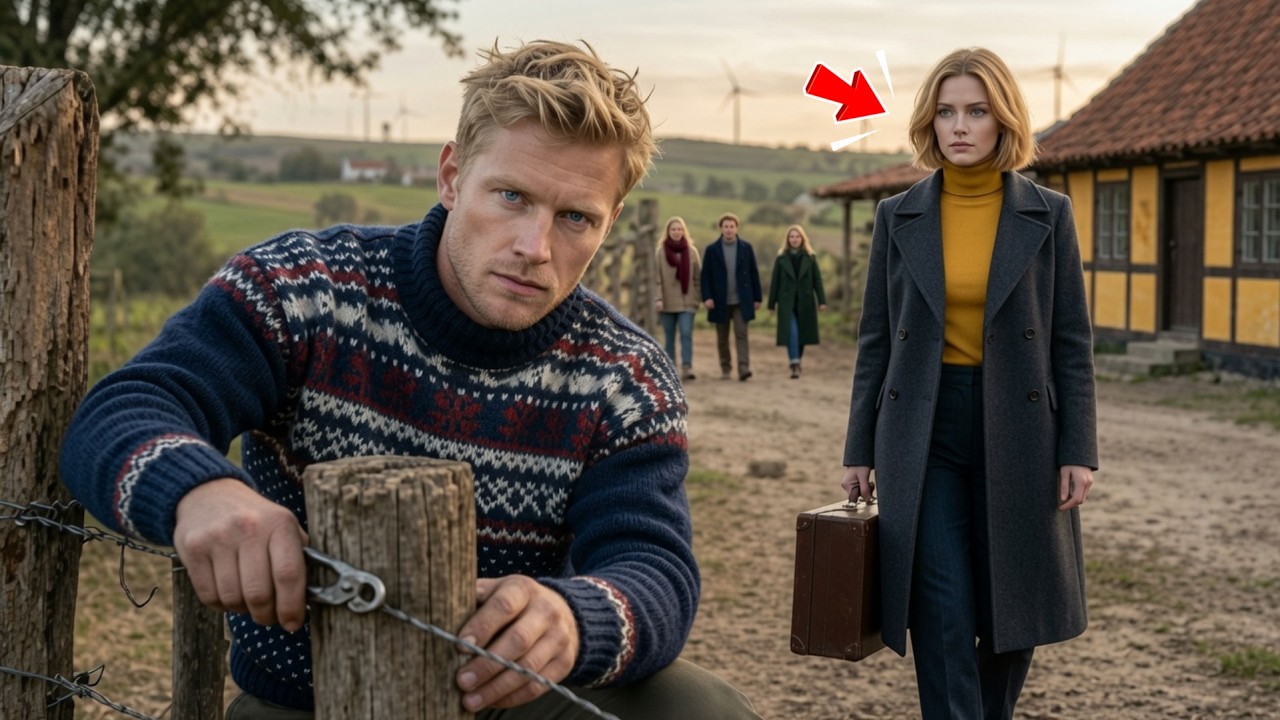
She had no tears left. She simply stared at the man who had just placed himself between her and the people who wanted to destroy her. No one understood why he had done it, least of all herself. But that morning, everything was about to change for both of them.
To understand how they had reached that point, you would have to turn time back. You would have to go back to the very beginning, to the day Lærke arrived at Axel’s smallholding with a worn suitcase in her hand and a heart shattered into a thousand pieces. The village of Gunderup on the Jutland heath was small and proud of it. It had a small village pond in the middle, a whitewashed church, and a row of low, thatched houses that lined the gravel road like tired soldiers.
People had known each other for generations. They married each other, buried each other, and judged each other with the same ease with which they breathed. In that closed-off world, Axel Sandard was a figure everyone knew but no one cared for. They called him the hedge-mender.
Not because he was so old, but because he spent his days repairing and sealing the fences on his smallholding, alone, speaking to no one more than was absolutely necessary. He owned a piece of land north of the village. It was neither large nor fertile. It was sandy heath with scattered clumps of heather and a small stream that nearly dried up in the summer.
But it was his. He had worked it since he was eighteen, when his father died and left him nothing but this patch of ground. Nothing else. Just the land and the name.
The neighbors said Axel was surly, that he didn’t greet people properly, and that he never came to the parish harvest festivals or dances. When his wife, Ruth, died twelve years earlier, he didn’t even accept the funeral food that the women from the neighboring farms brought him. He sent it all back unopened, without explanation or a word of thanks. That act was never forgiven.
In a village, refusing a neighbor’s help was almost an insult, and Axel had done it without blinking. Since then, the distance between him and the village had only grown with each passing year. The men didn’t invite him to the parish agricultural meetings. The grocer overcharged him whenever he could get away with it.
Axel knew all of it, but he kept his mouth shut. He had learned long ago that a man who owned only a poor strip of heath had no right to complain. It happened in April that everything changed. The landowner, Valdemar Vasgård, was not a man accustomed to losing control of things.
His estate dominated the entire region, and his word had been law for as long as anyone could remember. When a legal matter threatened his authority, he did what he always did: he summoned the parties involved, made sure they understood their place, and expected them to fall in line. But Lærke Melossen was not like the others. She had come to the village a year ago, a stranger with a secret heavy in her chest, and she had refused to be silenced.
She had brought a letter, a piece of paper that could bring down the landowner’s entire house of cards, and she had placed it in the hands of the notary, Brand. Now, the question was whether the law would actually protect her, or whether Vasgård would simply crush her like he had crushed so many others. When notary Brand finished reading the letter, a deep silence fell over the room. Brand adjusted his spectacles and looked up over the rim at Lærke.
He asked her where she had found it. She told him the truth. She had found it among her late mother’s belongings, hidden inside the lining of an old coat. The letter was old, yellowed with age, but the writing was still legible.
It was a record of an injustice that had been committed against the region for years. It detailed how Vasgård had systematically taken land that did not belong to him, how he had forced small farmers off their property under false pretenses, and how the local authorities had turned a blind eye in exchange for a share of the profits. If an independent court were presented with this evidence, with the right guarantees, Vasgård would face tremendous problems. Brand set the letter down carefully on the desk.
He looked at Lærke, then at Axel, who stood by the door with his cap in his hands. Brand asked if they understood what they were accusing a man of Vasgård’s standing of. Axel said that they did. Brand asked if they were prepared to testify to the authenticity of the document.
Lærke said that she was. Brand nodded slowly, then rose and walked over to one of the large bookshelves at the back of the room. He pulled out a heavy volume and began to leaf through it. He asked Axel if he could give them the formal confirmation right away.
Axel said that he could, but that it would take a couple of hours to prepare the documents. Brand gestured to the chair in front of his desk. “Then sit down,” he said. “We have work to do.
”
But that kind of silence did not suit Axel. He was not used to sitting still, let alone inside a stuffy office. He was drawing a map in his head of the state of the fences, of the repairs that still needed to be done before the early summer grazing. His arms were crossed, and his breathing was a little fast.
Lærke sat beside him, her hands folded tightly in her lap. She had thought about this moment many times, dreamed about it even, but now that it was here, it felt unreal. She had kept the secret for so long, carried the weight of it alone, that she had begun to doubt whether it was even real. But here, in this room, with the notary’s quill scratching across the paper, it was finally becoming real.
When the documents were ready, Brand looked up. He explained that Axel would have to take them to a higher authority, someone who could enforce a temporary ruling. He mentioned the name of a judge, a man he described as honorable and independent. He said that if they could deliver the evidence to him before the official visit, the judge would be able to protect Lærke and stop Vasgård from taking any further action until the investigation was complete.
Axel took the documents, folded them carefully, and placed them inside his coat. He asked Brand where they could find the judge. Brand gave him directions, then added that he would send word ahead to prepare the judge for their arrival. The following day, before dawn, while the sky was still dark, Axel set off on foot across the heath to see a man by the name of Søren Albriksen.
He did not think much about it at the time, but later that evening, as he sat on the bench outside his house after Lærke had gone to bed, the thought struck him, and it did not feel unpleasant. He could not quite explain why he had chosen to help her. He had never helped anyone before, not really. He had kept to himself for so long that helping had become a foreign concept, something that belonged to other people, the kind of people who went to church and greeted each other on the road and brought food to the bereaved.
But something about Lærke had gotten under his skin. She was stubborn, proud, and broken in ways that reminded him of himself. And she had nowhere else to go. Lærke had told him about Frederik the other afternoon, while the sun was setting and the long shadows of the trees stretched across the road.
Frederik was the father of her child, a man she had loved with all her heart, a man who had been taken from her before she could tell him the truth. He had died in an accident at the timber camp where he worked, and she had been left alone, pregnant, with no family and no money. She had come to Gunderup because it was the only place she could think of, the only place where she had a distant relative who might take her in. But her relative had turned her away, and Vasgård, who had always resented her family, had seen an opportunity to settle an old score.
He had threatened to take her child, to declare her an unfit mother, to have her committed if she didn’t leave quietly. She had refused, and so he had come after her with everything he had. That had been the moment when it all changed. That had been the moment when a lonely, embittered man who had spent his whole life building walls around himself decided to tear them down.
Axel had been mending his fence, with his back to the road, when he heard the commotion. He turned and saw Lærke standing in the middle of the path, her face pale with fear, and two of Vasgård’s men closing in on her. He did not think. He simply walked over, planted himself between her and them, and told them in a calm voice that they would have to go through him.
The men had laughed at first, until they looked into his eyes and saw that he was not joking. They had left, muttering threats, but they had not dared to touch him. He did not know why he had done it. He only knew that he could not have lived with himself if he had done nothing.
The news of what Axel had done spread through the village like wildfire. It was not a fire that created immediate anger, but rather a kind of relief, the relief of knowing that one was not alone in one’s powerlessness, and that what one had experienced was real. For years, the families on the heath had suffered under Vasgård’s thumb in silence, each one believing that they were the only ones. They had watched their neighbors get cheated, threatened, and forced off their land, and they had said nothing, because what was the point in fighting a man who owned half the region?
But now, someone had finally stood up to him. Someone had finally said no. And they began to look at Lærke with different eyes. The same women who had once crossed the road to avoid her now approached her in the village square, their eyes resting on her belly with a mixture of warmth and shame at having been so slow to show themselves.
On the third day after Søren’s son had been sent off, a reply arrived. It was not a personal visit, but an official document sealed with the high court’s seal, addressed to pastor Klemmensen. The pastor read it aloud to the gathered crowd in the church square. The judge had acknowledged receipt of the evidence and had issued a temporary ruling that same afternoon.
The ruling stopped any further action by Vasgård over the properties in question for as long as the investigation was ongoing. He also summoned the goose-farmer Søjnefod Poulsen and Herr Stommer to appear before the court to give testimony. When the pastor finished reading, a stunned silence fell over the crowd. Poulsen, who had been standing at the back, looked like a man who had found himself on unstable ground without knowing it and had only just realized it.
Axel did not go to the church square that day. He stayed on his land, as always, but he did not mend the fence. He sat on the bench outside his house, looking out over the dark fields, and thought about everything that had happened. He had spent his whole life believing that a man’s only duty was to himself, to his own piece of land, to his own survival.
But now he understood that survival meant nothing if you had no one to share it with. He had made his choice when he stood between Lærke and Vasgård’s men, and he had made it again when he walked into the notary’s office. There was no going back now. And for the first time in his life, he did not want to.
Lærke came out and sat beside him on the bench. She had a dark wool shawl over her shoulders, for the morning air was still sharp and cold. They sat in silence for a long time, watching the sun rise over the heath. Finally, she spoke.
“Why did you do it? ” she asked. “You don’t even know me. You could have just let them take me.
”
Axel was quiet for a long moment. Then he said, “I knew your mother. ”
Lærke turned to look at him, her eyes wide. “You knew her?
”
“We were courting once,” he said, his voice rough with old memory. “Before she met your father. She was the only woman I ever loved. When she chose him, I promised myself I would never care for anyone else again.
I kept that promise for a long time. ” He paused. “But she would have wanted me to help you. And I should have done it a long time ago.
I was too proud, and too scared of being hurt again. That was my mistake. ”
Lærke said nothing. She had no words.
She had been carrying her burden alone for so long that she had forgotten what it felt like to have someone else share it. She put her hand on his arm, and they sat there together in the growing light, two broken people who had found each other on a barren heath. In the days that followed, the investigation moved quickly. The notary had been true to his word, and the intervening order held.
Witnesses came forward on their own, speaking now with a courage that had been unthinkable just a week earlier. That courage fed on itself, and more families came forward, each adding their piece to the story. Søjnefod Poulsen, seeing which way the wind was blowing, had tried to retract his statement, claiming that he had been mistaken. But the notary reminded him that withdrawing testimony was not a decision he had the power to make, as everyone who had spoken had done so of their own free will.
The court would decide whether his testimony was credible. Vasgård’s empire crumbled with astonishing speed. Nothing could have halted it once the first stone was dislodged. His lands were placed under sequestration pending the outcome of the full investigation, his accounts frozen, and his personal papers seized.
He was indicted on charges of fraud, perjury, and the illegal acquisition of property. The trial was set to begin in the autumn, and there was little doubt in anyone’s mind about the outcome. He spent his final evenings of freedom pacing the rooms of his great house, surrounded by the servants who no longer respected him and the silence that pressed in from all sides. The night before the trial, Lærke and Axel sat on the bench once more, looking out over the fields.
The heather was beginning to turn purple, and the air was thick with the scent of the earth after the long dry summer. Lærke reached down and placed her hand on her belly. “Do you think he will be found guilty? ” she asked.
“I don’t know,” Axel replied. “But I know that he will never be able to hurt you again. Or your child. And that’s all that matters.
”
Lærke smiled, a small, tired smile. “You know, you’re not the same man I met all those months ago. You used to be so grumpy and closed-off. ”
“I’m still grumpy,” he said.
“I just have better reasons to be alive now, that’s all. ”
She laughed lightly, a sound that was still new and strange to her ears. She had not laughed in so long that she had almost forgotten the sound of her own joy. She leaned her head against his shoulder, and they sat there as the sun dipped below the horizon, two lonely people who had found in each other the family that neither of them had expected.
The fence around Axel’s land had never needed mending that day, and for the first time in as long as he could remember, he did not have to fix anything.