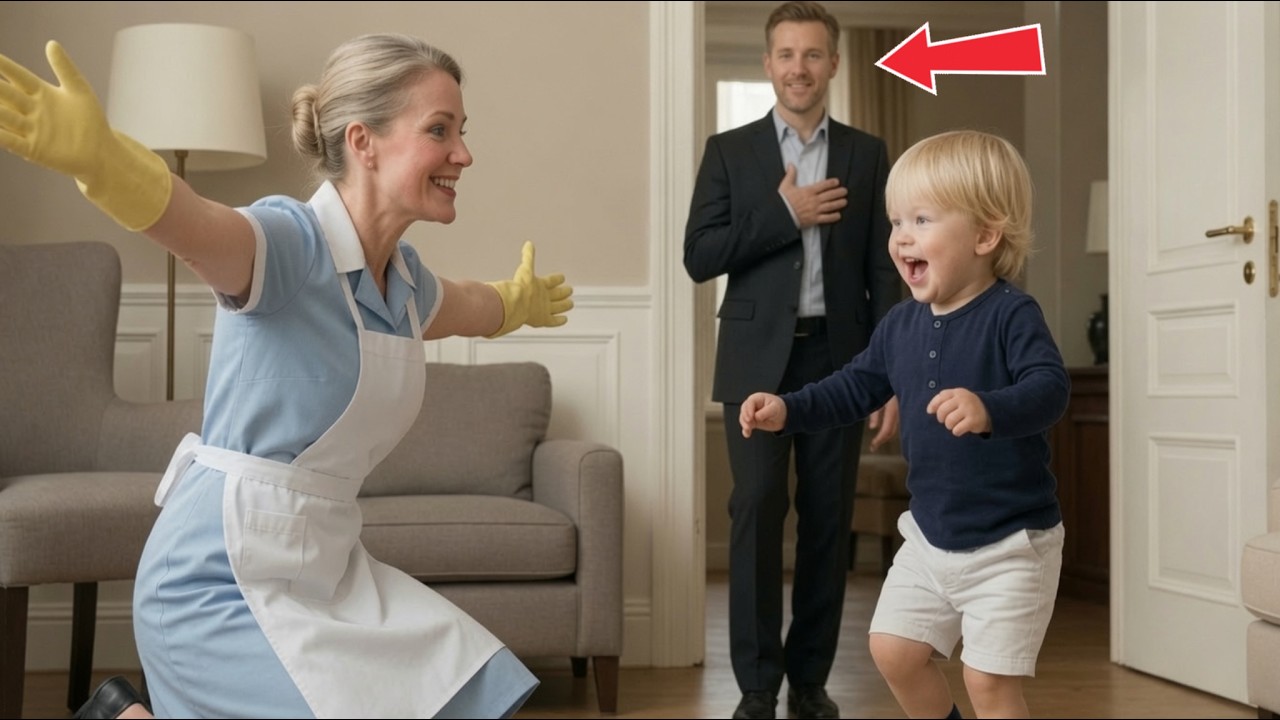
Martin had hidden cameras installed throughout the house. He was certain the new nanny, like all the previous ones, would turn out to be a fraud, but the footage showed him something entirely different. His three-year-old son did something he never could have imagined, and it shattered him. Martin Østergart was thirty years old and had everything money could buy.
A three-story house in Hellerup, imported cars, a bank account that grew every month. But no fortune could give him back what he had lost. Eight months ago, he had lost the peace that disappeared when his wife Sofie died in an accident. Now he lived alone with Emil, his three-year-old son.
A boy with big eyes who looked more and more like his mother every day. And that resemblance was a knife in Martin’s heart every morning. I need a new nanny, he had told his assistant two days earlier. It would be the thirteenth in eight months.
Martin always found reasons to fire them. They came late, used their phones, didn’t follow instructions, or there was simply something about them that didn’t inspire trust. The truth was more complicated. He couldn’t stand watching another woman care for his son.
Every hug a nanny gave Emil broke him, because that hug should have come from Sofie. But Sofie was no longer there. And Emil needed someone. That Monday morning, Martin walked downstairs adjusting his tie.
The silence hit him as always. Before, there was laughter, music, life. Now only emptiness. Lene, the housekeeper, appeared and dried her hands.
Emil has already had breakfast. He’s in his room playing. Alone. Martin frowned.
Yes. As you asked. No TV. No tablet.
Only his toys. Martin nodded, ignoring the small knot in his stomach. It was better this way. Emil needed to learn independence early.
The world wasn’t kind to the weak. When does the new nanny arrive? Ten o’clock. A woman named Simone Jensen.
Martin checked his watch. He had forty minutes before he needed to leave for the office. Time enough to set the rules. He went up to Emil’s room.
His son sat on the carpet surrounded by blocks, building something that looked like a tower. Good morning, Emil. The boy looked up. His dark brown eyes, identical to Sofie’s, looked at him cautiously.
Good morning, Dad. Martin sat on the bed, not on the floor next to him. A new nanny is coming today. Her name is Simone.
Emil nodded slowly. He was used to it. Nannies came and went like seasons. I need you to behave well.
I always behave well, Dad. And it was true. Emil was calm, almost too calm for a three-year-old. He didn’t have tantrums, didn’t cry, didn’t ask for anything.
Sometimes Martin wondered if that was normal. I know, son. You’re a good boy. Emil smiled a little.
A small smile that disappeared almost immediately. Martin wanted to say more, to hug him, to ask how he was feeling, whether he missed his mother. But the words got stuck as always. I’m leaving.
See you tonight. Goodbye. And with that, Martin left the room, closed the door behind him, leaned against the hallway wall, and took a deep breath. Why was it so hard?
Why did every interaction with his son feel like walking on broken glass? He went down the stairs and was about to leave when the doorbell rang. It was 9:30, half an hour early. Martin opened the door with a frown.
Imprecision was a serious flaw, but arriving early also showed a lack of respect for his time. In front of him stood a woman around twenty-nine with her brown hair up, not too much makeup, clean jeans, and a white shirt. She carried a worn backpack. Good morning.
I’m Simone Jensen. Her voice was soft but firm. She looked him directly in the eyes without lowering her gaze. You’re early.
The appointment was at ten. I know. I’m sorry. The bus came earlier than expected, and I preferred to wait here rather than walk around the neighborhood.
At least she was honest. Martin opened the door fully. Come in. Simone stepped inside and looked around with restrained curiosity.
There was no amazement on her face at seeing the luxurious house. No intimidation. Only quiet observation. The shoes, she pointed.
Martin looked down at his shoes, then at the shoe rack by the door. He had forgotten to take them off. He felt a strange flicker of embarrassment. Yes.
Of course. Simone took off her own shoes and placed them neatly. She followed him into the living room. Sit down, Martin said, pointing at the sofa.
He sat across from her. Do you have references with you? Yes. Simone took out a folder.
Martin reviewed the papers. Three families, good reviews. A letter mentioned two years of caring for young children. Why did that job end?
Two years is a long time. The family moved to Spain. They offered to take me with them, but I have obligations here that I can’t give up. What kind of obligations?
There was a brief pause. Simone remained composed, but something flickered in her eyes. Pain, maybe, or worry. I take care of my mother.
She’s sick. Martin nodded. I’m sorry to hear that. Thank you.
The silence settled between them for a moment. Martin continued. My son Emil is three. He lost his mother eight months ago.
He’s a quiet boy. Too quiet. I understand. The rules are simple.
Martin took out a printed sheet. Strict schedules. No candy between meals, maximum one hour of educational TV. No tablets.
Structured activities and above all professionalism. You are not his friend. You are his responsibility. Simone took the paper and read it carefully.
Her expression didn’t change. Is there a problem? No. She folded the paper and put it in her pocket.
No problem. The salary is as agreed on the phone. Yes. Good.
Then I’ll see you this evening. Martin grabbed his briefcase and walked toward the door, then stopped. He turned around. The kitchen is fully stocked.
If you need something for lunch, help yourself. Thank you. Martin hesitated for a moment, then left without saying anything else. Simone stood in the hallway and listened to his car start.
She let out a breath she hadn’t realized she was holding. She walked toward the living room and looked around. The house was immaculate, cold, and precise. Like a showroom.
No family photos on the walls, no drawings on the refrigerator, no signs of a child’s life. She turned around and looked at the stairs. Somewhere up there, a little boy was alone with his blocks. She walked up the stairs slowly, step by step, and stopped at the half-open door.
Emil sat on the carpet, surrounded by blocks. He was building a tower. He heard her footsteps and looked up. His eyes were serious, far too serious for a child his age.
Hello, he said quietly. Hi. My name is Simone. I’m going to be your nanny.
Oh. The word was flat. He turned back to his blocks. Emil?
He didn’t answer. I know what it’s like to lose someone important. He stopped. His small hand froze above a block.
She had his attention. Emil turned to her. He studied her face as if looking for something he could trust. What did you make?
Simone asked, sitting down on the floor a few steps away from him. A castle. For my mom. But she can’t come.
So it’s just a castle. Simone felt a tightness in her chest. She didn’t move too close. She kept the distance.
Do you remember her? A little. Her voice was soft. She used to sing.
With a small voice he added, she was the best singer in the entire world. That must have been beautiful. He let a block fall. It hit the carpet with a soft thud.
Are you going to leave too? Simone’s heart broke. I’m not planning to, she said softly. Everyone leaves.
That’s what Dad says, but not with those words. He says it differently. He understands. I’d like to stay.
Emil looked at her for a long moment. Okay. He handed her a block. But you have to help me build the tallest tower ever.
Simone smiled. Deal. For the next hour, they built. Not just a castle.
They built a fortress with walls and towers and a gate. Emil directed with a quiet seriousness that surprised her, but there was something in his eyes that shifted. A small spark of light she hadn’t seen before. By noon, Emil was hungry.
Simone made him a simple lunch. Grilled cheese and cut-up carrots. He ate without complaint. Thank you, he said.
You’re welcome. She didn’t comment on his manners. She didn’t fuss over him. She just sat with him.
The first week went smoothly. Simone arrived at nine every morning and stayed until six in the evening. She learned that Emil liked his toast cut into triangles, not squares. That he was afraid of the dark but would never admit it.
That he kept a photo of his mother under his pillow. She never brought up the photo. She just let it be there. Martin came home every evening at seven.
He checks his watch, fixed himself a drink, and observed her silently. He looked for signs of failure, evidence that she was like the others and she would leave him too. That she was breaking. The way the others broke.
At the end of the second week, Martin came home earlier than usual. He found them in the kitchen. Simone was stirring a pot while Emil sat on the counter beside her. She was reading something from a book while she watched the pot.
Laughter. Sweet music. The old familiar mistake. He stood in the doorway and pulled back slightly.
Emil looked up. His face was transformed by a wide, real smile that Martin couldn’t remember ever seeing before. Dad. Come look.
Martin walked in cautiously. What is it? I drew a picture of me and Simone and you. And Mom.
She said she’s like an angel now. So she’s in the sky. Close your eyes and she can see. He held up the drawing.
Martin took it. In the picture, there were four figures. A tall man, a tall woman with a bun, a little boy, and a woman in the sky with wings and a halo. The man looked at the drawing and felt the old familiar ache twist in his chest.
His throat tightened. That’s beautiful. It was all he could manage. Later, he pulled the door closed and stood in the hallway.
He pressed his hand to his chest, where it hurt, and took a long, slow breath. He wasn’t sure if the feeling was pain or something else. That night, after Emil was asleep, Martin sat in his office. He had the security cameras on screen.
He told himself it was routine. A check, just to make sure everything was in order. The kitchen was empty. Then he saw them in the living room.
Simone and Emil sat on the floor next to the camera. No sound played, and he watched her as if under a spell as she leaned down and pointed something out to his son with a soft smile. She didn’t touch him unnecessarily. She didn’t hover.
She was simply present. He felt the knot in his chest loosen. Something was different. She was different.
He stared at the frozen image and felt his world shift slightly, almost imperceptibly, like a slow landslide. And for the first time in eight months, Martin felt a flicker of something. He didn’t name it. He didn’t want to jinx it.
The following week, Martin came home with a headache. The office had been chaos, and the pain pressed behind his eyes. He had to wait a moment before he walked up the stairs. He expected to hear the TV or the low murmur of Simone’s voice.
Instead, he heard silence. He walked down the hallway and stopped at the kitchen door. The room was empty. Where were they?
Then he heard it. A soft voice, barely a whisper, coming from the living room. Martin looked in. The lights were off.
Emil lay curled up on the sofa, his head resting on Simone’s lap. She sat with her back against the armrest, a book in her hands. She was reading aloud. And Martin listened.
There once was a little prince who lived in a big castle. He had everything he could ever want except for one thing. Someone who could love him not just because he was a prince but simply because he was himself. Martin didn’t move.
The words floated in the darkness, but soft and low. The little prince grew up thinking he wasn’t allowed to be sad. Because princes don’t cry and they don’t show fear. But one day a fairy came to the castle.
The fairy told him that feelings are real. And that the ones you loved and lost never truly leave. They stay with you in your heart. So even if you can’t touch them or see them, they’re never far away.
The prince asked, will I ever stop missing her? The fairy said, if you miss her, it’s because you’ve loved her. And love is the only thing that never truly leaves. Martin felt tears sting his eyes.
He didn’t move. He stood in the shadow of the hallway, watching them, his son and the woman he had been so sure would dissolve into disappointment like the others. There was a long pause. Emil stirred.
Simone, she said softly. Yes, little one? Will he be less sad tomorrow? No.
But it will get a little easier to breathe. And when he’s sad, he should remember the fairy loved him the most. That’s the most important part. Because she never really leaves when he lives, quietly, in the castle.
Martin took a step back into the hallway, leaning against the wall with his eyes closed. His hand trembled as he wiped his eyes. He couldn’t remember the last time he cried. When Sofie died, the tears wouldn’t come.
He was a rock that held the world together. But now, alone in his own home, the walls he had built were cracked. A young woman he barely knew was exposing parts of his son he had never been brave enough to see. Simone set the book down softly and stroked Emil’s hair.
He’s asleep, she murmured to herself. She rested her head for a moment and took a deep breath. She was on her feet and looked up as she made her way to the door, stopping short as she saw him in the doorway. Martin.
She froze. Confusion and shame crossed her face as she realized what he had witnessed. How long were you standing there? A long time, he said his voice rough.
I’m sorry. I didn’t mean to interrupt. You weren’t interrupting, she said. I read to him until he fell asleep.
It’s quiet without you working on your computer. He knows you’re here. I made that clear. Martin stepped further into the room.
The only light was the moon through the window. It cast silver shadows on the floor. He looked at his son, who was still asleep on the couch. He doesn’t even need me, he whispered.
That’s not true. He does. He just doesn’t know how to say it to you. And maybe you don’t know how to say it to him either.
The words hung between them, heavy and honest. You’ve read his file. I know he had a nanny. He has a home, a bedroom, more toys than he could ever play with.
Is that what you’re saying? I’m not judging you, Martin. I’m just saying that you’re scared. Scared to love him the way he needs to be loved because love means you can lose it again.
He looked away. It’s not that simple. It never is. She turned to leave.
He reached out and caught her wrist. She stopped, looking down at his hand, then back up at him. Wait. She waited.
Her hair had come loose from her bun, and in the moonlight, her face was softer, more real. He had never noticed before how her eyes held a sadness that mirrored his own, maybe that was why he trusted her. Maybe that was why he didn’t push her away as he had the others. Why do you do it?
She looked at him in confusion. This job. With me. With my son.
You could work anywhere and not have to read three years’ worth of my rules. She offered him a small, almost melancholy smile. Because I know what it’s like, she said. To feel alone.
To feel like you’re broken. And if someone had stayed when I was little, maybe… She trailed off and pulled her hand back. She moved past him.
I don’t want to be a shadow of your wife, she said. You don’t have to be, he said. She stopped. You’re already different, Martin let the words linger.
In a way I don’t fully understand. She didn’t answer. She simply nodded and continued down the hall. That night he lay awake and her words echoed in his mind.
For the first time in a long time, he thought not about the past he was trying to hold on to. Instead, he thought about a future he wasn’t sure he deserved. The days that followed were filled with a new kind of ease. Martin found himself coming home earlier.
He started eating dinner at the table with them instead of in his office. He watched Simone. The way she tied Emil’s shoes, the way she spoke to him and how she never treated him like a fragile toy, but like a person with his own thoughts and feelings. One evening, Martin and Simone sat on the deck while Emil was asleep inside.
The night was warm, the sky clear with stars. There’s something I never asked you, Martin said. Her mother. You said you take care of her.
How is she? She hesitated. She has multiple sclerosis. She’s getting worse.
That’s why I can only work during the day. I need to be there to make her dinner at night and help her get settled. I’m sorry. It’s not your fault.
She paused. I’ve been looking at care facilities. Just in case. It makes me feel like a bad daughter.
It makes you human, he said. You’re taking care of your son, your mother, and you still found room in your heart to care for mine. She gave a small smile. Thank you.
For a moment, they sat in comfortable silence. Martin doubted why he had been so afraid before this, why he pushed everyone away. Maybe because he had mistrusted the world. He had mistaken it for protection and realized it was not that at all.
It was about trying to maintain control over something when everything else felt out of control. Simone pressed her cold feet into his warm legs under the blanket. He laughed and wrapped his arm around her, the cold touching his skin. Your feet are freezing.
You know they say that people with warm feet have warm hearts. Is that so? So that must mean you have a heart of ice. He tickled her and she laughed, and for a moment it felt like everything he had known before was a dream.
Then her face grew serious. Martin, there’s something I’ve been meaning to tell you. His heart slowed. What is it?
She looked at him, uncertain. It’s about Emil. The other day, when you were at work, we were looking at pictures of his mother. He started talking about the accident.
He thought it was his fault. Martin felt the air freeze around him. What do you mean? He said his mother was mad at him.
The day she died, she was rushing home because he’d been sick. She told him she’d be right back, and he said she seemed upset. He heard his mother crying, and he thought she was upset because of him. She never came home.
His words echoed in the room like the boom of a bell. Martin felt a cold wave pass through him. Why would he think that? It wasn’t his fault.
Sofie died in a car accident on her way home from an appointment. It was a rainy road and a truck crossed the center line. It was simply the wrong place at the wrong time. But children don’t understand things the way we do.
They make up stories, and when they don’t have the truth, they carry the weight. Martin sank onto the bed, his hands covering his face. He heard the quiet creak of the door. He looked up.
Emil stood in the doorway. The boy was hugging his pillow and looking at him with his mother’s eyes. Daddy? Martin opened his arms and Emil climbed onto his lap and buried his face in his father’s chest.
He hugged his son, and as he did he felt a sob escape his own chest. I’m sorry. He didn’t say anything else. He cried, great, silent, heaving sobs that came from a deep and secret place.
He grieved for the wife he had lost, for the son he had, for the eight months he had wasted so lost in his own grief that he failed to see the eight years of pain his own child was carrying. I’m sorry, he whispered over and over into his son’s hair. It’s not your fault. It was never your fault.
She loved you. Do you hear me? She loved you. And I love you.
I am so sorry I haven’t been there for you. I was too sad to see you were sad too. I promise you. I promise you from now on, I will be here.
I will always be here. Martin smoothed his hand over his son’s hair, the way Sofie used to do, and held him close. When Martin looked up, Simone was gone. There was only an empty doorway.
He felt a hollow ache in his chest, but he held his son and let him cry. Emil’s sobs slowly began to calm. Then he pulled back and looked at his father with red eyes. Daddy.
Yes, son? Do you think mom forgives me? Martin’s chest felt raw. There’s nothing to forgive, my boy.
But if you need to hear the answer, then yes. I know with all my heart, she forgives you. Emil curled against his chest and was quiet. Within minutes his breathing evened out, and he was asleep.
Martin carried him to his bed, tucked him in, and stood in the doorway. He looked at the small figure under the blanket, the sleeping face so peaceful, and made a promise to the universe. He was going to be the father he should have always been. He found Simone in the kitchen.
She was gathering her things, and her hand was trembling. Her eyes were red-rimmed. He closed the distance between them. Thank you.
She shook her head. You don’t have to thank me. I didn’t do anything. You told me about the photograph.
You told me what he said. You helped him. You helped me. She wiped her eyes quickly.
I should go. My mother will start to worry about me. She reached for the door, and he placed his hand over hers. Thank you, he repeated.
For seeing my son. For seeing him. And for everything. When her eyes locked with his he saw the words she couldn’t say silently speaking volumes.
She squeezed his hand briefly and left. The door clicked shut and he was alone with his thoughts. A week later, on the porch, a bouquet of sunflowers. There was no note.
After the rain, he found a second bouquet of wildflowers with a note attached. For the rainy days. Emil found him holding them and asked, Who sent them? I don’t know, Martin said.
But I think someone is trying to tell me something. That Saturday, he took a deep breath and walked to Simone’s house. It was a small, modest home. He could see the garden from the front step and the curtain move in the window.
Before he could lose his nerve, the door opened. Simone stood there, her hair loose, a cardigan over her shoulders. She looked at him and the sunflowers and put a hand to her lips. Martin.
He handed her the flowers. I don’t know how to do this, he said. I’m not good at people. I’m not good at feelings.
But I’ve spent the past eight months being scared to let anyone in. And then you came, and my son woke up. I woke up. She looked down at the sunflowers.
She was quiet for a long moment. Martin’s confidence flickered. Say something. Please.
She looked up and there were tears in her eyes, but she was smiling. You brought me sunflowers. His heart sank. You hate them?
No. He squeezed his eyes shut, took a deep breath, and knelt before her. Her eyes widened. What are you doing?
I’m going to do this right. She looked at him, bewildered. Martin, I think you’ve confused me with someone else. Maybe.
But I don’t think so. He reached into his pocket and pulled out a small velvet box. He opened it. Inside was a modest ring with a small, clear stone that caught the light.
I know we haven’t known each other long. I know I’m a disaster. I’m a single father who’s bad at words and can’t seem to keep a nanny. He paused.
But I also know that I don’t want to imagine a single morning without you. I know that my son has been more like himself in the last month than he’s been in the last eight. And I know that I have never, ever met anyone like you. So, Ms.
Simone Jensen, if you would do me the honor of being my wife, my partner, and the mother of my son, I would spend the rest of my life pouring you a cup of coffee that’s always a little too hot and holding your hand through every storm. She stared at him, her hands shaking, tears streaming freely down her cheeks. He began to sweat. Say something.
We kissed. He looked at her. She was smiling. I said we kissed.
He stared at her blankly, and she laughed. I’m dreaming. You’re not dreaming. This is happening.
She looked at the ring, then back at his face. Yes. Yes. Yes.
Is that a yes? Yes, that’s a yes. She launched herself into his arms, and he caught her, laughing. She pulled back, her voice wet with tears.
You’re asking me to be her mother? I’m asking you to be mine. She sobbed, then smile. I thought you’d never ask.
When Martin got home with Emil, he was asleep in the car. He carried him to bed and tucked him in. Then he went back out to his car and drove up the drive. The garden he had helped her with earlier in the summer was still early, not yet in bloom.
He stopped and looked at it. A voice came from the front porch. She sat on the step, wrapped in a blanket with her phone lit in her hand. Oh.
Sorry. I didn’t mean to startle you. You’re up. I couldn’t sleep.
I thought I would count stars. He gave a small smile. Need company? She hesitated for a moment, then pulled back a corner of the blanket.
Don’t say I never offered you anything. He sat down, and she made a sound of protest as he pulled her into his lap, tucking the blanket around her. Is this okay? She wiggled closer.
This is more than okay. They sat for a while, looking up at the stars. He had forgotten how clear the sky could be at this time of year. This was his favorite part of the day.
The quiet. The dark. The world asleep. No judgment, no expectations.
Just space. I never thanked you, he said. For Emil. For the filming.
For you kept him safe. She tilted her head back to look at him. I didn’t film him. I filmed you.
He blinked. I designed it. I felt safe. No.
He was quiet, letting the admission settle. His chest tightened. Why? Because I was scared you weren’t real.
Because the one thing I couldn’t imagine was you walking away too. And I thought if I wrote a program to see your worst nightmare, you’d be gone. She was quiet, he waited. Did you find it?
My worst nightmare? He looked at her, his voice barely a whisper. That I’d be sitting here, holding you, and you still wouldn’t love me. She reached up and cupped his face, her hand warm, her thumb brushing his cheek.
Then you’re not looking very hard. And she kissed him. When she pulled back, the stars didn’t seem so far away anymore. Light years away.
That’s the distance light travels in a year. He rested his forehead against hers. Promise me something, he said. Anything.
That you’ll always be you. That you’ll never let me turn into someone I don’t want to be. Never stop asking for what you need. And when the world gets a little too heavy, you’ll let me hold it.
Okay. She said. For the first time in a long time, Martin felt the weight lift off his shoulders. He knew he was at the beginning of something beautiful.
The night of his dreams was over. In fact, his heart hammered with it. So he held her there and watched the stars, and for the first time in eight months, he wasn’t afraid of tomorrow. He wasn’t afraid of what the future held.
He was grateful that, in spite of the grief, the fear, and the mistakes, they had found each other. And they would build something beautiful, day after day, from the ground up. It wasn’t about escaping the past, he realized. It was about building something new.
And no matter what came next, he knew with a certainty. He was exactly where he was supposed to be. Their story had just begun.