The Golden Star was one of those places where money hung in the air like a heavy perfume, so thick you could almost choke on it. Crystal chandeliers scattered their light across white tablecloths and polished silver, and the murmur of conversation was a low, self-satisfied hum. For the people who dined there, it was a stage. For Ida Jensen, it was just a room she had to clean.
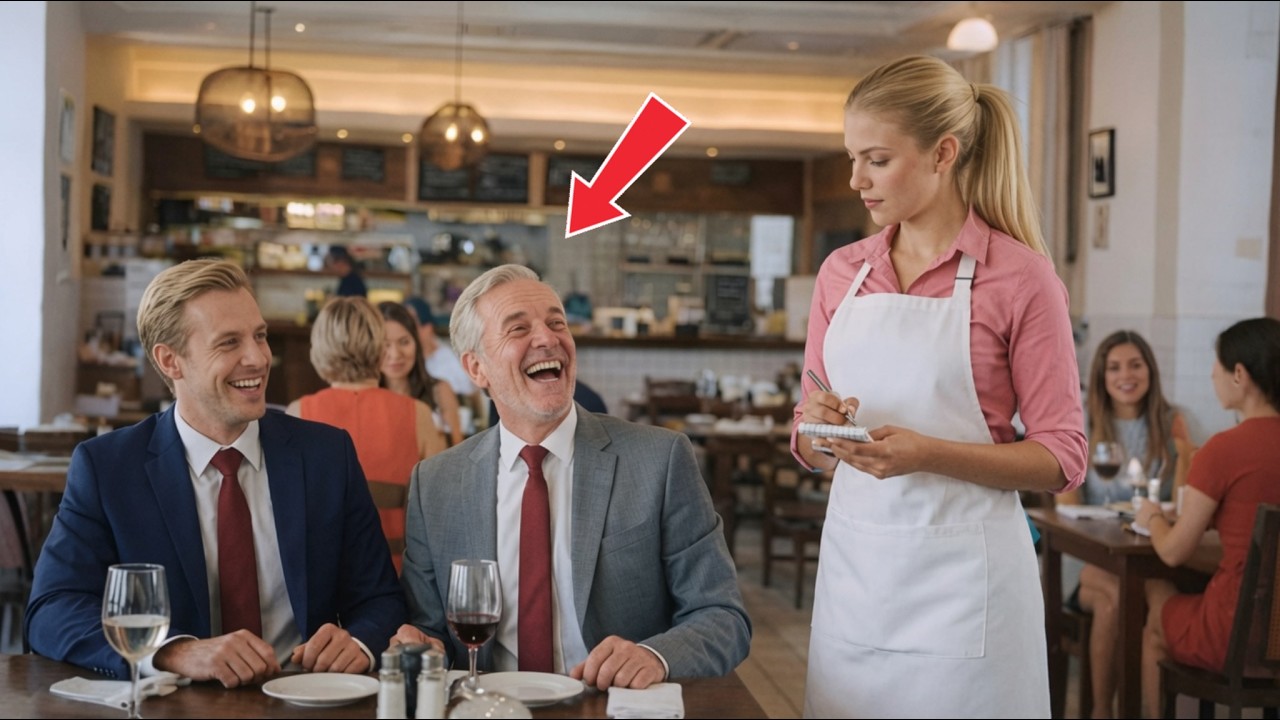
She moved through the room with a practiced grace, balancing a heavy tray on her right hand. She kept her back straight and her face perfectly neutral. The customers rarely looked at her. To them, she was part of the scenery, as invisible as the ornate wallpaper.
Her colleagues, some of them, whispered about her being nothing but a quiet girl who never complained, and the tips she got were small because she was too proud to laugh at their jokes or pretend to enjoy their company. The truth of why she stayed silent was something she kept buried deep. She had come to Copenhagen with nothing but a promise to herself, and this job was all that stood between her and the cold, unkind street. Every night, she returned to her tiny rented room, her feet aching and her eyes burning, and she told herself the same thing.
This was temporary. She was saving for a better life, not for herself, but for what she carried inside her. A secret that was slowly becoming the only thing she had left. In the kitchen, the head chef, a man named Gert, slammed down a pot and shot her a look through the steam.
“Ida! Table seven has been waiting for ten minutes. ”
“I’m going,” she said, her voice low and even. Gert had a soft spot for her, a rare thing for a man as gruff as him.
He had seen her come in early one morning to scrub the prep table until it gleamed, and he had watched her count her meager earnings at the end of her shift. He knew she was different from the others. She had depth, and she had a past you could see in her tired eyes. “Go on then,” he said, his tone softening just a fraction.
“But if the big boss comes sniffing around, don’t let him push you around. You hear me? ”
“Yes, Gert. ”
The main doors of the restaurant sighed open, carrying with them the crisp night air and the unmistakable presence of importance.
A middle-aged man with a perfectly groomed silver beard walked in, his tailored suit fitting him as if it had been sewn onto his skin. Beside him, a younger man, perhaps in his early thirties, carried himself with an air of inherited rightness, as if the world was a buffet and he had been born with the golden ticket. The maitre d’ snapped to attention. “Baron Løvenskjold!
And Master Kaspersen. Welcome. Welcome back. ”
The older man, Baron Løvenskjold, gave a brief, gracious nod.
Anders Kaspersen barely looked at them. His eyes swept the room, assessing it, judging it, and finding it wanting. Ida’s stomach tightened. She had served the baron before.
He was a man of old money and new cruelties, and she had learned to keep her head down around him. But tonight, Mette, her supervisor, caught her eye from across the floor. She was gesturing towards the baron’s table, and Ida’s heart sank into her polished work shoes. No.
Not him. Not tonight. “Oh, no,” she whispered under her breath, but Mette was already walking towards her. “Ida, the gentlemen at table six need a server.
They requested someone who speaks German,” Mette said, her voice tight with urgency. “You speak German, don’t you? You have such a gift for languages. ”
It wasn’t a question.
The baron and his companion represented the kind of power that made her skin crawl. She had worked so hard to be invisible, to not be noticed, and now her only advantage, her quiet competence, was being thrown into the spotlight. She nodded, her mouth dry, and smoothed down her apron as she walked across the room, feeling everyone’s eyes on her. She reached the table where the two men sat, already deep in conversation in rapid, loud German.
“Abend, meine Herren,” she said, her voice steady even though her heart was racing. She was grateful for her fluency, a gift from her father, who was a teacher before the world had taught him how small it could make a man feel. “Willkommen zum Goldenen Stern. Mein Name ist Ida, und ich werde Sie heute Abend bedienen.
”
The younger man, Anders Kaspersen, didn’t even look at her. He just waved a dismissive hand, the diamond on his pinky catching the light. But the Baron’s gaze fixed on her for a moment, a flicker of amusement in his cold, pale eyes. He then turned to his companion and spoke in rapid German, his tone dripping with contempt.
“Have you seen the state of this place lately, Anders? It’s becoming positively provincial. But I suppose that’s what you get when you have to employ women with no education. They’re cheap, but they need constant supervision, wouldn’t you agree?
”
Anders laughed, a sharp, unpleasant sound. “It’s true. They have their uses, of course. A good pair of hands to carry a tray, a pretty face to look at.
But anything more than that, and their minds simply cannot cope. ”
Ida’s hands trembled as she placed the wine on the table. The baron wasn’t just drunk or rude, he was deliberately, cruelly cruel. He wanted to see if she would break, if she would flinch or cry.
She had heard stories about him, about how he treated staff at his own estates, a man who still believed he was living a century ago. She knew he was testing her. But his words crawled under her skin. Anders took a sip of his wine and nodded.
“I agree completely. They’re like children, really. You have to tell them exactly what to think and how to feel. They should be flattered we even notice them.
”
That was it. The comment was directed at her. By him. Ida’s entire body went cold.
She had sworn she would never let men like this speak to her that way, not again. Years ago, she had decided that she would rather starve on the street than let a man make her feel small. But the memory of her empty fridge and the eviction notice pinned to her door back in her hometown made her bite her tongue. One mistake, one word of backtalk, and Mette would have her fired in a second.
She uncorked the bottle of wine, her movements stiff and precise. Her hand slipped. Or perhaps it was his fault. The Baron had moved his arm just as she poured, and a dark red gush flooded across the white tablecloth, splattering onto the thread of his trousers like a wound that would not stop bleeding.
The Baron exploded from his chair with an ugly curse, his face turning an ugly mottled red. “Unverschämtheit! You clumsy, useless girl! Look at what you have done!
This suit cost more than you will make in a year! ”
The whole restaurant went quiet, forks frozen halfway to open mouths. Ander’s laughter was sharp in the silence, the loudest sound in the room. The plastic vulture, Ida thought, watching his shoulders shake.
“So sorry, sir,” she heard herself say, her voice a strange, calm whisper. “Let me get some help. ”
But the Baron wasn’t done. He stood up, his face inches from hers.
“You are sorry? Do you have any idea who I am? Do you have any idea what I could do to you? ” He spat the words with a venom that was all the more effective for its quietness.
“You’re a nobody. You are nothing. You will be out on the street before the night is over. You will be begging at my doorstep for work.
I’ll make sure of that. ”
Every eye in the room was on them now. The silence was complete, broken only by the faint tinkle of a piano from the far corner. In that silent space, the words of the Baron hung in the air.
Ida could feel the weight of everyone’s gaze, the mix of pity and cruel entertainment. She stood there for a moment, her knees trembling, but more than the fear, she felt a sudden, sharp snap. It wasn’t courage exactly, it was more than that. It was a decision.
A line was crossed in her mind, a new person stepping forward. The words slipped out before she could stop them, quiet and clear, in perfect German. “Sie wissen, dass andere regelmäßig über Sie sprechen, nicht wahr? ” You do realize that people regularly talk about you, don’t you?
The Baron’s eyes widened. He didn’t understand the words, but he clearly understood the tone. Before he could say a word, she continued, her voice growing in confidence, the grammar in the language of her ancestors flowing smoothly, the dialect she had learned from her own grandparents back in their hometown. Not the textbook languange, but the living, breathing dialect of the border.
“They talk about your little problems in the Hamburg office. The money that seems to vanish to a company in the Bahamas. The young woman who is suing you for sexual harassment. Do you want me to continue?
I can tell them about the building project in Bucharest, the one you told the board was a complete failure to lower the share price. ”
When she looked at his face, all the mockery was gone. The mouth fell slightly open and she saw a flash of panicked recognition in his eyes. He stared at her, truly looked at her for the first time, his eyes searching his face, trying to recognize the threat.
For a long moment, the world was completely silent. Then, Ida smiled, a slow, cold smile that did not reach her eyes. “You should watch where you step, Baron,” she said in perfectly accented German. “The last time I checked, you still owe me a drink from Berlin.
”
She didn’t wait for an answer. She turned on her heel, placed the napkin with her order pad on the table of the head server, and walked out. She walked past the incredibly shocked faces of her coworkers, past the realization coming over them. She walked out through the swinging doors of that expensive restaurant, out the service entrance, into the cold evening air.
She pulled her thin coat around her and walked, her heart hammering against her ribs. She was shaking, but she wasn’t afraid. She was free. She was carrying something out with her, something that had been hidden for years.
She was probably going to get fired. She was probably going to starve. And she didn’t care. It felt so good to finally say it.
Twenty minutes later, she was sitting on a park bench near the harbor, staring at the black water, her body still buzzing with energy. The name on the card she was clutching read: “Lundqvist & Associates – Rhys Lundqvist. ”
She walked into the law firm the next morning without an appointment. The receptionist looked down her nose at her, but before she could even open her mouth, Ida spoke.
“I need to see Mr. Lundqvist. I have information about the Kastrup Construction case. And I work for it, not for the money.
”
She was shown into a large office that overlooked the water. The man behind the desk, the man she recognized from the papers, looked up from a file, his eyes sharp and assessing on her for a moment, looking for something in her face. “There’s a lot of you looking for deep secrets in these files. Over worked, I’m sure,” he said, though there was no hostility in it.
“I’m the reason your main witness is even alive enough to testify,” she said, pulling out a folded USB drive from her pocket. “And I have access to his bank records. ”
Lundqvist’s eyebrow rose. “And who are you, exactly?
”
“My name is Ida Jensen,” she said, her voice clear. “And I’m the one who’s going to help you put Anders Kaspersen away for tax fraud and money laundering. ”
The next few weeks were a blur of interviews with the police, meetings in Roskilde’s industrial district, and late nights reviewing documents. The information Ida had was a golden ticket.
Anders had been siphoning money through a web of shell companies for years, and with her translations and sharp eye for legal loopholes, she became invaluable to the lead investigator, a driven, tired woman named Inspector Larsen. Ida’s own life seemed to spin faster and faster, caught up in a world of financial crimes she had only read about in books. Then the day came. The Baron’s grand estate.
The fucking nerve of that man. She thought of her mother, the woman who had never had a chance, who worked her fingers to the bone until they were raw. This was for her. The image of her mother’s hands, coarse from cleaning other people’s houses, was what she saw as the jury walked back into the courtroom.
Anders Kaspersen’s confident sneer had long since vanished, replaced by the pale, wide-eyed look of a trapped animal. She saw the foreman stand, the paper trembling in his hand, the courtroom holding its breath, and she heard the words that changed everything. “On the charge of fraud, we the jury find the defendant… guilty.
”
The thud of the gavel echoed in the silent room, a sound of perfect, resounding justice. Anders Kaspersen swayed on his feet, his face contorting with rage and disbelief as the bailiffs closed in on him. Ida didn’t stay to see the rest. She stood outside the courthouse, the gray morning air feeling fresh and clean on her face, a different kind of wind.
Eight months ago, she had been a waitress with a hidden past, invisible to the world. Now she was the quiet interpreter from the justice department who could understand every lie a rich man told. The job had come after the trial, a recommendation from the prosecutor who had been impressed by her poise and her razor-sharp knowledge of three different legal systems. She had the scars to prove it.
She looked down at her phone. A text from her sister, the one she had sent away years ago to keep her safe. “Is it true, Ida? They got him?
”
“All of it,” she typed back, a genuine smile finally breaking through. “He’s going away for a very long time. ”
A car door clicked open behind her. Her boss, Daniel, a kind man with gentle eyes, gave her a soft smile.
“You ready to go over the new contract for the Geneva project, Ida? ”
She looked back at the imposing courthouse, a kind of freedom she had never known settling over her. She thought of her grandmother, the warm kitchen in Prague, and the piles of old letters. Of Daniel, who had been the one to pull her out of that small apartment with nothing but an offer to work, but who had also stolen from her the one thing that could have ended her misery, her last piece of hope.
But then she looked at the city around her, at the life she had built, not despite her pain, but in spite of it. She thought of the woman she had been, a scared girl who had carried a secret so heavy it threatened to break her. The pain was still there, a deep ache in her bones, but it was no longer the only thing she was. Her anger was a weapon she had sheathed, and she was free from that endless, gnawing desire for vengeance.
Her phone buzzed again. It was a message from an unknown number. She was about to ignore it when she saw a preview of the content. It was a picture.
It was a selfie of her and her mother from years ago, taken before it all went wrong. Her mother’s smile was radiant, and young Ema’s eyes were full of terrible, innocent joy. The message was short. “I know who you are.
”
Ice shot through her veins. The fear was familiar, a cold, protective wave that had been with her for the entire time she had spent in this city. She had kept her head down, made a quiet life, but the past was always there, waiting under the surface. Ida looked back at the picture.
It wasn’t the camera that was waiting. It was the ghost of the last night she spent with her mother. The fear was replaced by a quiet, freezing anger. She typed a response, her thumbs steady against the glass screen.
“Yes. And I know who you are. ”
Breathing in shakily, she pocketed her phone and walked over to Daniel. “Always something, huh?
” he asked. “Seems like it,” she said, her voice steady. “So, where do we start? ”
Daniel smiled and said, “I was thinking we’d start in London.
”
The helicopter blades were starting to whirl overhead as they walked toward it. She had finally learned that the best way to survive was not to run away from your nightmares, but to become the echo in their walls. And she would never be silenced again. As the engine’s roar filled the air, her phone buzzed one last time.
She knew, without looking, that it was a message from Anders, trying to find a way back through her defenses. All the threats he had made in their youth, they had followed her all these years. But now, she was finally ready to face him. She looked out the window at the receding skyline of the city that had almost broken her.
But this wasn’t a city of the past, it was the city of her new beginning. She was Ida. She was not a victim. She was her own keeper, a warrior.
A smile touched her lips as they rose into the gray above, the roar of the engines a promise of a new horizon. She was moving to London. She was going to work for a firm that specialized in exactly the kind of legal and financial accountability the world needed.
She had a whole life ahead of her, and for the first time, she was ready to live it.