The woman in the back of the black limousine lowered her documents and froze. Through the tinted glass, across the hotel driveway and onto the public pavement, her gaze had landed on a glint of metal. It was not the man she saw that held her attention. It was the small round brooch pinned to his filthy jacket, a central ruby surrounded by hand-filed silver threads.
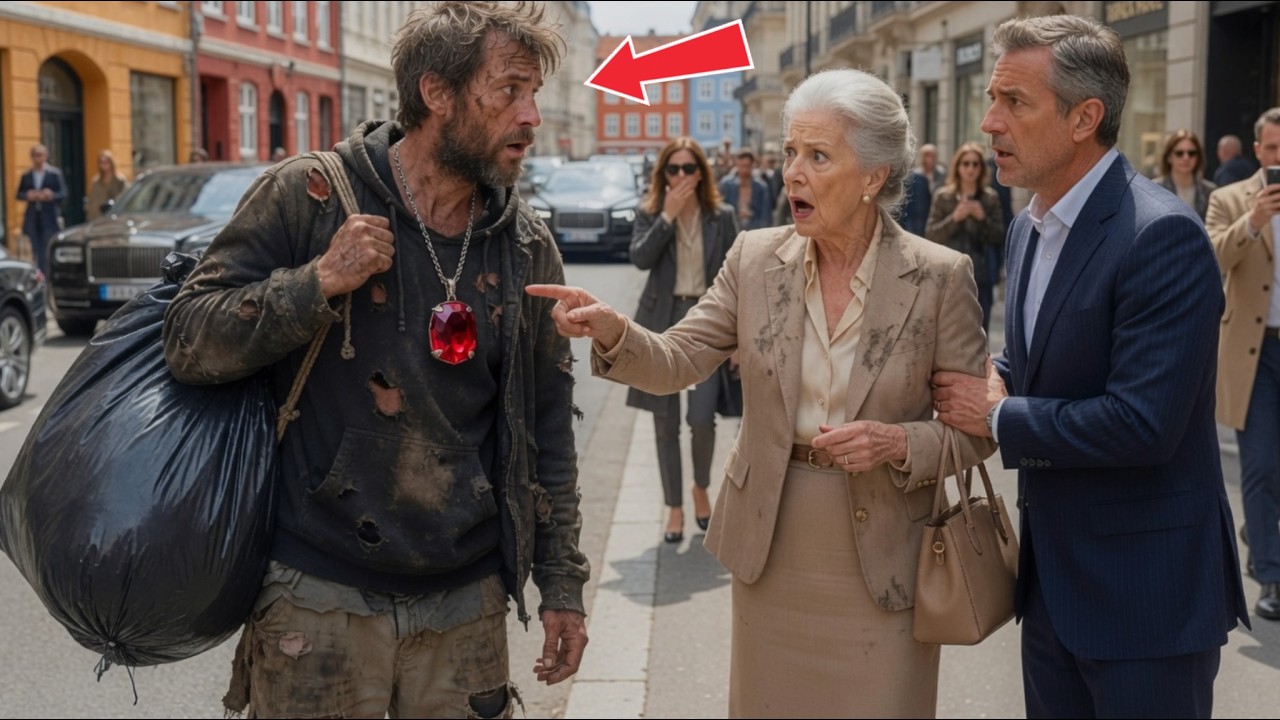
A brooch she had ordered from the goldsmith Arne Ditlevsen in his workshop on Frederiksberg exactly eight years earlier. A brooch designed only once, for only one person. Her son, Alexander. The man wearing it was young, no older than thirty, though it was hard to tell.
The street had carved years into him. His face was unshaven, his hands rough and crusted with old dirt. He wore torn jeans, a black jacket with frayed sleeves, and dragged a black plastic bag full of cans and cardboard boxes. He walked with the heavy, resigned rhythm of someone who had nowhere to be and no reason to hurry.
And right there, over his heart, pinned to the grimy lapel, sat the impossible brooch. “Stop him,” said Dagmar Jensen. Her voice came out low, but it cut through the car’s interior like a blade. The bodyguards in the front seats exchanged a glance.
They had worked for her for years, and they had never heard that tone. “Frue? ” asked the driver. “Stop him.
Now. ”
The car had already stopped at the hotel entrance, but now the doors opened with purpose. Dagmar Jensen was seventy-two years old. She owned a real estate empire valued at over four billion kroner.
She had built it from nothing, had out-negotiated men twice her age, had stared down politicians and partners alike. But as she stepped out onto the pavement, her hands were trembling. Not from cold. The young man noticed the three large men in dark suits approaching him.
He stopped, not because he understood what was happening, but because there was nowhere to go. They surrounded him in silence. One of them raised a hand, palm out. The message was clear.
“Hey, I haven’t done anything,” said Rasmus. His voice was rough, like sandpaper. He lifted his hands instinctively. The black plastic bag swung from his fist.
“What’s the problem? ”
Nobody answered. He heard a car door close behind him. Then footsteps.
Short, firm, deliberate steps that sounded like nails being driven into the asphalt. He turned his head slightly, just enough to see the woman approaching. She was dressed in a dark blue suit, pearl earrings at her lobes, her white hair pulled back into an impeccable knot. Behind her tortoiseshell glasses, her dark honey-colored eyes did not leave him.
She stopped two steps away. She looked at his face. He looked at hers. Neither spoke for a long moment that felt much longer than it was.
“That brooch,” said Dagmar quietly. Her calm was more frightening than any shout. “Where did you get it? ”
Rasmus frowned.
He looked down at the brooch as if seeing it for the first time. In a way, he always saw it that way. It was one of those things you carry around without asking yourself why. He had found it.
It was beautiful. He had pinned it to his jacket because it gave him a vague, foolish feeling of protection. “I found it,” he said. “Where?
”
“In the trash. ”
Dagmar closed her eyes for a second. When she opened them, something had changed in them. A decision.
“Get him in the car,” she ordered, without turning to her bodyguards. Rasmus took a step back. His street instincts, sharpened through years of survival, told him that nothing good could come from getting into a rich woman’s vehicle. “I’m not going anywhere with you,” he said.
“I haven’t done anything wrong. If you want to call the police, call them. ”
“I don’t want to call the police,” said Dagmar. “I just want you to tell me where you got that brooch.
” She pointed at it with a shaking finger. “Please. ”
It was the “please” that disarmed him. It wasn’t the tone of someone giving an order.
It was the tone of someone asking, over and over, for something from someone who couldn’t hear her. Rasmus was not a trusting person. He had fallen far, lost too much, and distrusted the world for reasons he no longer fully understood. But that simple word cut through him in a way he didn’t expect.
“Okay,” he said at last. “But I haven’t broken into anything, and I haven’t stolen anything from anyone. That has to be clear. ”
“It is clear,” said Dagmar.
The bodyguards opened the door, and Rasmus climbed into the back of the limousine. The seats were soft leather, the air smelled of expensive perfume and old paper. He sat stiffly, clutching his plastic bag, looking out the window as the car pulled away from the hotel. Dagmar sat across from him, not looking at him, not speaking.
The silence was heavy. She had a folder on her lap. Slowly, as if moving through water, she opened it and pulled out a photograph. She held it out to him without a word.
Rasmus took it. His hand was shaking more than he wanted to admit. The photo showed a young man, maybe twenty years old. He was laughing, squinting into the sun, his arm around a woman who was clearly Dagmar, younger, softer, her hair loose around her shoulders.
The young man wore a suit. On his lapel, clearly visible, was the brooch. “That was Alexander,” said Dagmar. Her voice was steadier now.
“My son. He disappeared twelve years ago. He was twenty-four years old. He walked out of the apartment one morning and never came back.
No note. No call. Nothing. The police searched for months.
We searched for years. And then I stopped. I had to. Because I couldn’t live with the not-knowing and the hoping at the same time.
”
Rasmus looked at the photo, then at the brooch, then at her. “I found it in a dumpster behind the old textile factory on Refshalevej. About two weeks ago. I was looking for bottles.
It was wrapped in a piece of cloth. ”
Dagmar’s breath caught. “Two weeks ago,” she repeated. “Yeah.
Is it… is it his? ”
“It’s mine,” said Dagmar. “I gave it to him on his eighteenth birthday.
He never took it off. Not ever. He wore it in the shower. He wore it to sleep.
He told me once it was his lucky charm. I used to tell him he didn’t need luck, he had me. ” She laughed, but it was a hollow, broken sound. “And then he disappeared.
And the brooch disappeared with him. For twelve years, I’ve carried the guilt of that day. The last conversation we had. I was angry at him.
He had dropped out of university without telling me. We argued. I said things I didn’t mean. And then he walked out.
And I always thought… I always thought he would come back. Because that’s what sons do. They come back.
Even when they’re angry. ”
She stopped. Rasmus didn’t speak. “Two weeks ago,” said Dagmar again, as if testing the words.
“Are you sure it was two weeks ago? ”
“I’m sure. It was a Tuesday. I remember because I nearly got run over by a bus that morning.
I thought it was going to be a bad day. But then I found the brooch. It was… I know it sounds stupid, but it made me feel like I was being watched over.
Like someone was looking out for me. ”
Dagmar looked at him with an expression he couldn’t read. Then she reached out, slowly, and touched his hand. Her fingers were cold.
“That’s not stupid,” she said. “That’s not stupid at all. ”
The car pulled up outside a police station. Dagmar did not move.
She looked at the building, then back at Rasmus. “I need you to tell them everything,” she said. “About the dumpster. The date.
The time. Everything you remember. ”
“Why? What does that have to do with anything?
”
“Because either you found that brooch in a dumpster two weeks ago, which means someone threw it away after all these years. Or you found it somewhere else, somewhere clean, and you’re lying to me. ” Her eyes were sharp now. “And I need to know which one it is.
Because if my son is alive somewhere, if he’s out there and he lost that brooch, I need to know. And if someone has hurt him, I need to know that too. ”
Rasmus held her gaze. “I’m not lying.
I found it in the dumpster. I don’t know anything else. ”
Dagmar stared at him for a long time. Then she nodded.
“I believe you,” she said. “But I want you to remember one thing. That brooch was with my son the last time anyone saw him. If it’s been sitting in a dumpster for twelve years, that means the dumpster hasn’t been emptied in twelve years.
Which means no one’s been there. Which means… which means I might still have a son who is alive. Do you understand what I’m saying?
”
Rasmus nodded slowly. “You want me to help you find him. ”
“Yes. ”
“Why me?
”
“Because you found the brooch,” said Dagmar. “And I don’t believe in coincidences. ”
The police took Rasmus’s statement. He gave them the exact location of the dumpster, the date, the time, everything he could remember.
He did not expect anything to come of it. But two weeks later, the detective in charge of the case called Dagmar with news that made her drop her coffee cup. “We found him,” said the detective. “Or at least, we think we found him.
There’s a man living in a shelter in Nørrebro. He doesn’t know who he is. He’s been there for about ten years. Doesn’t speak much.
Doesn’t remember anything. He fits the description. Same age, same height. He was found with a scar on his left arm.
A distinctive scar. Looks like an old burn. ”
Dagmar’s hand flew to her mouth. “Alexander had a burn scar on his left arm.
He got it when he was six years old, playing with his father’s lighter against my wishes. ”
“We’ll need you to come in and identify him,” said the detective. “But I have to warn you, Frue. He’s in a bad way.
He’s not going to know you. He might not react to his name. Is that something you can handle? ”
“Yes,” said Dagmar firmly.
“Whatever he looks like, however he reacts. He’s my son. I’ll handle it. ”
She went to the shelter the next day.
Rasmus came with her. She hadn’t asked him to, but he had come anyway. He said it was because he had nowhere else to be. She knew it was because he wanted to see.
The man they found in the small, bare room was thin and gray, with overgrown hair and a vacant expression. He sat on the edge of the bed, rocking slightly, staring at his hands. Dagmar stood in the doorway, her heart pounding so hard she could feel it in her throat. She looked at his left arm.
There it was. The scar. A faded, puckered burn mark that had been there since he was six years old. “Alexander,” she whispered.
He didn’t look up. She walked closer, her footsteps soft on the linoleum. She sat down on the bed beside him. She didn’t touch him.
She just sat there, letting the silence settle around them. “I’m sorry,” she said. “I’m so sorry. I should have been there.
I should have found you. I should have… I don’t know. I never stopped looking, not really.
Even when I told myself I had. I always thought you’d come back. And you were here. All this time.
You were here. ”
The man looked up. His eyes were clouded, distant, like he was looking at something far away. But for a moment, just a moment, his gaze focused on her face.
“Mor? ” he said, his voice a dry rasp, barely audible. Dagmar began to cry. She couldn’t help it.
The tears came hot and fast, and she didn’t try to stop them. She reached out, slowly, and took his hand in hers. He didn’t pull away. “I’m here,” she said.
“I’m here, Alexander. Mor is here. ”
Behind her, Rasmus stood in the doorway, watching. He felt like he was intruding on something sacred.
He started to back away, but Dagmar’s voice stopped him. “Wait,” she said. She turned to him, her eyes red and swollen. “You found him.
If it weren’t for you, I might never have known he was alive. ”
“I just found a brooch,” said Rasmus. “That’s all. ”
“No,” said Dagmar firmly.
“You found a thread. And you pulled it all the way here. I owe you something I can never repay. ”
“You don’t owe me anything.
”
“I want to help you,” she said. “Whatever you need. A place to stay. A job.
Money. Just name it. ”
Rasmus thought about it. He thought about his empty apartment, his empty pockets, his empty days.
He could have said yes. He could have taken the money. And for a moment, he wanted to. But then he looked at the man on the bed, and at the woman holding his hand, and he knew that some things couldn’t be bought.
“Give him the help,” said Rasmus. “Not me. He needs it more than I do. And maybe…
maybe just promise me you’ll be there for him. That you won’t leave him again. ”
Dagmar looked at him, her eyes filled with wonder. “I won’t,” she said.
“I never will again. ”
Rasmus nodded. He turned and walked out of the room, down the corridor, out of the shelter, into the cold morning air. He walked for a long time, not knowing where he was going.
And for the first time in years, he felt something he had almost forgotten existed. He felt at peace. Months later, a letter arrived at the shelter where Rasmus sometimes slept. It was from Dagmar.
She had found him a room in one of her buildings, a small but clean room with a bed and a window. There was a job waiting for him if he wanted it, a simple job, maintaining the building’s gardens. And in the envelope, wrapped in tissue paper, was the brooch. Rasmus pinned it to his jacket.
He looked at it for a long time. Then he smiled, put on his coat, and walked out the door to start his first day of work.