The rain had stopped hours earlier, but the water was still rising in places where the levees had failed. I stood on the hood of a Humvee, my boots caked in mud that had dried and cracked against my skin, and I watched my team fan out across what used to be a street. Grand Isle, Louisiana, looked like a war zone that had been through another war. Splintered lumber, overturned cars, a child’s doll floating face-up in a brown puddle that used to be someone’s living room.
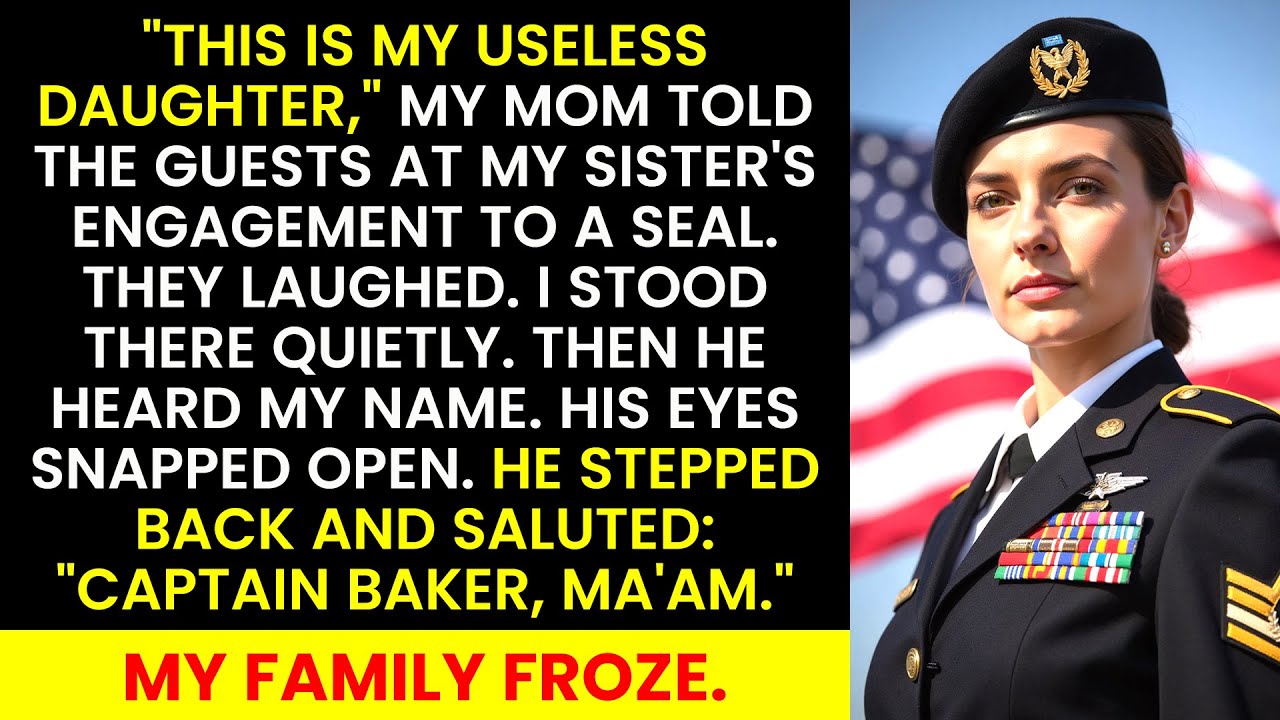
The air was thick with diesel and rot and the raw, suffocating smell of the bayou itself. For thirty-six hours, we had been pushing through the aftermath of Hurricane Cronus. My face was raw from wind and rain that had come at us sideways in sheets. My combat uniform was a second skin, stiff with dried sweat and filth.
My body ached with a bone-deep exhaustion that made every step feel like a choice. But I was in command. That was what I did. I gave orders, I made decisions, I kept people alive.
A few minutes earlier, I had pulled a family of four out of an attic. The water had been creeping up through their floorboards, and the structure had been groaning in a way that I knew too well. My sergeant, a kid named Miller who still called me ma’am too many times in a row, had watched my face as I made the call to cut through the roof. I saw a little girl, maybe six years old, her eyes wide and unblinking with fear, and I told her we were going to play a game.
I told her to close her eyes and count to twenty, and when she opened them, she would be outside. She had believed me. That was the part that stayed with you. The trust.
The weight of it. I jumped down from the Humvee and landed hard on the pavement, my knees protesting. I had a thermos of coffee in my hand that had gone cold hours ago, but I drank from it anyway. I needed the ritual more than the heat.
Behind me, someone had planted a small American flag on a pile of rubble that had been a diner. It snapped in the wind, defiant and a little ridiculous, and I found myself staring at it longer than I meant to. This was my world. It was loud, messy, dangerous, and completely real.
I was good at it. I had spent years becoming good at it, earning every stripe, every command. I had led soldiers through ambushes in Afghanistan, coordinated supply lines through hostile terrain, and made split-second decisions that meant the difference between a squad going home and a squad not going home at all. But none of that mattered in my mother’s living room.
None of that had ever mattered there. My phone vibrated in my breast pocket. I pulled it out and saw my sister Annie’s name on the screen. I almost didn’t answer.
But she was my sister, and I was a soldier, and soldiers didn’t ignore the people they loved just because it hurt. “Hey,” I said, keeping my voice level. “Alicia. ” Her voice was bright, a little too bright, the tone she used when she was performing.
“Listen, I know you’re busy with your… thing, but I wanted to talk to you about the engagement party. ”
“My thing. ” I repeated the words flatly. “You know, your work thing.
The flood thing. Whatever. ” She laughed, a light, tinkling sound that didn’t have an ounce of weight behind it. “Mason and I are going to do it at the estate.
Mom thinks the garden will be perfect in October. I was thinking something elegant, understated, you know? A string quartet, maybe. White roses.
”
I leaned against the Humvee, feeling the heat rolling off the metal. “That sounds nice. ”
“It will be. And I want you to be there.
No army talk, okay? No war stories, no mud on the floor. Just be normal for one night. ”
“I know how to be normal, Annie.
”
“I know. I just mean, like, don’t dominate the conversation with all that hero stuff. Mason’s family is very… refined. Keep it light.
”
I said nothing. The silence stretched, and I could feel her filling it with the shape of my ingratitude. “Anyway, Mom wants you to stay for the weekend. She has someone she wants you to meet.
”
“I don’t need to meet anyone. ”
“Alicia, you’re thirty-four. You’re not getting any younger. ” She paused, and I could hear the smile in her voice.
“I just want you to be happy. Like me. ”
“Congratulations,” I said, and I hung up before she could say anything else. Miller walked over, holding a tablet slicked with rain.
“Ma’am, we got the structural report on the bridge. ”
I pushed the phone back into my pocket and took the tablet from him. The screen showed a live feed from a drone circling the overpass. The water had already climbed over the lower supports, and along the main pillar, I could see the beginning of hairline fractures working their way through the concrete like dark veins.
“This is bad,” I said. “Yes, ma’am. The engineers are saying the whole thing could go if the water keeps rising. ”
My jaw tightened.
Earlier that day, I had made an unorthodox call. I had rerouted the entire convoy, sending three trucks of supplies and a medical team around the main bridge and through a secondary route that added two hours to the drive. Two hours was a long time in a crisis. Too long.
Someone higher up had questioned it, and I had cut them off with a flat, professional edge that I had learned to use like a scalpel. The bridge collapses in forty minutes, or less. That route buys us time. That route saves lives.
The words had come out calm and certain, and they had been. Now I was looking at the feed and watching the fractures spread. “Miller,” I said, “get me a secure line to command. ”
“Yes, ma’am.
”
I stepped away from the Humvee as he made the call, the weight of command settling back onto my shoulders like a familiar coat. This was why I was good in the field. The noise, the chaos, the impossible decisions—it all made sense. It had rules.
It had logic. The rest of the world, the one with birthdays and engagement parties and mothers who looked at me like I was a guest in my own family, had none of that. By the time Miller came back with the confirmation that the bridge had held, that the evacuation had succeeded and no lives had been lost, I felt a deep, quiet calm spread through my chest. I slept for four hours in a cot in a Red Cross shelter, woke up, and gave the order to redeploy north.
There was a town further up the coast that needed us. That was my job, and I was good at it. A week later, I was driving through Nebraska. Endless fields of late-summer corn rolled past my window, straight and flat and stretching all the way to the horizon.
The storm was behind me. The mission was over. But I wasn’t going home. I was going to my sister’s engagement party.
I had tried to tell myself it was because I owed it to her, that family was family, that I could show up, smile, and disappear before the cake was served. But as the miles unspooled beneath my tires, I knew I was lying. I was going because I still hoped. Some small, stubborn part of me, the part that had never quite learned how to stop wanting her family’s approval, thought that maybe this time would be different.
Maybe my mother would look at me and see me. Maybe Annie would ask about my life and actually want to hear the answer. The estate was as grand as I remembered—white columns, manicured lawns, long gravel drive. I pulled up in my rental car, a modest sedan covered in dust, and I could feel the eyes on me before I even got out.
The beaded dresses, the seersucker suits, the champagne flutes held with studied ease. I had worn dress blues, the one uniform that could pass for formalwear, and it still felt like armor. Annie was standing near the front steps, her hand resting on the arm of her fiancé Mason. She was glowing, genuinely radiant, and when she saw me, her smile barely flickered.
“Alicia,” she said, her arms open wide. “You made it. ”
We embraced. She felt small and delicate against me, and she smelled like expensive perfume.
“I told you I would. ”
“I know. I just—” She pulled back and looked at me, her eyes surprisingly sharp. “You look tired.
”
“It’s a long drive. ”
“Well, come on. Mom’s been waiting all day. She wants you to meet Mason’s aunt—she works in Washington, very important.
I told her you two would have a lot to talk about. ”
She led me through the house, past the flower arrangements and the hired waitstaff, out onto the back terrace where the garden was laid out in perfect geometric beds. My mother was holding court under a white canopy, her silver hair perfectly coiffed, her pearls catching the late afternoon light. She looked up when she saw me, and the first thing I saw in her eyes wasn’t love.
It was irritation. “Alicia, dear,” she said, offering me her cheek. “I was starting to think you wouldn’t come. ”
“I’m here.
”
“So I see. ” She looked me up and down, taking in the uniform. “That’s very… professional. ”
“Thank you.
”
She nodded, already scanning the crowd for someone else to talk to. The conversation turned to Annie and Mason, and I stood there, sipping champagne I didn’t want, small talk washing over me in waves. I caught snatches of conversation about the wedding, about the weather, about a hurricane that had been on the news—a hurricane I had just come from. “Did you hear about the flooding?
” someone asked. “Terrible, just terrible. ”
“I heard the military had to evacuate an entire town. ”
I opened my mouth, but before I could say anything, my mother laughed, a light, tinkling sound.
“Oh, that’s nothing,” she said, waving her hand dismissively. “Our Annie could have handled it. She’s always been the clever one. ”
Annie beamed.
I felt something in my chest go very, very still. “Actually,” I said, my voice cutting through the chatter like a blade, “the evacuation was a success. They got everyone out before the bridge collapsed. ”
Silence.
My mother blinked at me, her smile frozen. “Excuse me? ” she said. “The evacuation of Gulfport.
The one the news was covering. It went smoothly, all things considered. ”
“How do you know about that? ” Annie asked, her voice pitched a little too high.
I looked at her. I looked at my mother. And for the first time in thirty-four years, I didn’t try to soften the truth. “Because I was there,” I said.
“I commanded the operation. ”
The temperature in the room seemed to drop. My mother’s smile hardened into something brittle. “Alicia, don’t be dramatic,” she said, the same words she had used a thousand times before.
“You do administrative work. There’s no shame in that. ”
“I lead a battalion of the Army Corps of Engineers. I was in command of a rescue and recovery operation during Hurricane Cronus.
I pulled a family out of a flooded attic with my own hands. ”
“That’s enough. ” My mother’s voice was sharp, final. “This is Annie’s night.
I won’t have you trying to steal her thunder with your stories. ”
“They’re not stories. They’re my life. ”
“Your life?
” Annie laughed, but it was hollow. “That’s your life. All that time you spend away, risking your neck for what? I’m the one who stayed.
I’m the one who built something real. You just… run off and play soldier and then come back expecting everyone to bow down. ”
“I don’t expect anyone to bow down. I just expect you to know who I am.
”
“I know exactly who you are,” Annie said. “You’re the daughter Mom always had to worry about. The one who could never just fit in. ”
The words hit me like a physical blow.
I stood there, suspended in the silence, and I heard my own voice speaking from somewhere far away. It was calm, professional, the voice I used when I was giving orders under fire. “You’re right,” I said. “I don’t fit in.
And I’m done trying. ”
I set my glass down on a table and walked away. Annie called my name, my mother called my name, but I didn’t stop. I made it to the car, got in, and closed the door.
My hands were shaking as I put the keys in the ignition, but my voice was steady when I said, out loud, to no one, “Go to the hotel. ”
I drove for an hour before I pulled over on a quiet stretch of road. The sun was setting, painting the sky in shades of orange and pink, and I sat in the car and stared out at the cornfields and felt the grief wash over me in waves. Not anger.
Not sadness, exactly. Grief for the daughter I had never been. Grief for the mother who would never see me. Grief for the sister who had never known how to love me.
I pulled out my phone. I wasn’t sure who I was going to call, but my thumb found Miller’s name before I could stop it. He answered on the second ring. “Ma’am?
You okay? ”
“I’m fine. ”
“You don’t sound fine. ”
I almost laughed.
“I’m good, Miller. I just—I wanted to say thank you. For trusting me. In the field, back at the bridge.
You followed my order when you had questions. ”
“Ma’am, you made the call. You were right. ”
“I know.
But it matters that you trusted me anyway. ”
Silence on the other end. Then, softly, “You ever need anything, you have my number. For real.
”
“I know,” I said. “Thanks. ”
I hung up and let the phone rest in my lap. I thought about the bridge, about the little girl from the attic, about the flag snapping in the wind.
I thought about all the soldiers who had told me, in one way or another, that I mattered. That what I did mattered. I thought about the old wound, the one that had been festering for thirty-four years. I had spent my whole life trying to be seen by people who had made up their minds about me before I could walk.
I had tried to be smaller, quieter, easier. I had let them shrink me to fit their expectations. But I was done shrinking. I started the car and pulled back onto the road.
I drove all night, not sure where I was going, but knowing I would recognize it when I got there. It took me two days to finally turn the car around, and when I did, I didn’t go to the estate. I didn’t go back to my mother’s house. I went to a small town on the coast, a town that was still rebuilding, and I walked into a community center where a group of volunteers was sorting through donations.
I signed my name on a clipboard and asked for a high-visibility vest. I spent the next week there, doing the work I knew how to do. I helped coordinate supplies. I answered questions.
I led a team that cleared a road that had been washed out. The people there didn’t know me, not really, but they trusted me. They looked at me and saw someone who could help, and for the first time in as long as I could remember, I saw myself that way too. When it was time to leave, a woman came up to me, her hands streaked with dirt, and she asked, “Where are you from?
”
“All over,” I said. “I’m in the army. ”
“The army. ” She nodded, taking it in.
“You look familiar. Were you on the news? The hurricane stuff? ”
“Yeah,” I said.
“I was there. ”
She smiled. “I thought so. You have that look.
”
“What look? ”
“Like you’ve seen things. ” She squeezed my arm. “Like you survived.
”
I didn’t have an answer for that. I just nodded and got back in the car. On the drive home, my phone buzzed. I glanced at it.
A message from my mother. We haven’t heard from you in two weeks. Everyone was really shaken up by your little display. I think you owe us an apology.
I stared at the message until the screen went dark. Then I texted Avery, a woman I’d met in the Gulf, a survivor. We had become a little closer than either of us expected. I didn’t tell her about my mother.
A week later, my phone buzzed again. This time it was Avery. She’d just received orders to deploy to Florida for a training exercise, and she was excited, nervous, and scared. I told her I was proud of her.
The words felt honest. I waited for my mother’s anger to make me feel something. I waited for the guilt. But it didn’t come.
I stared at my coffee, black and bitter, and tried to figure out what this hollow feeling was. It was strange, that quiet. I drove away from the last traces of the storm, and I thought about the day I had been standing in the rain, my heart pounding, and I knew the evacuation team was gone, and I was alone. I wasn’t alone then, and I wasn’t alone now.
I had built something worth keeping. I pulled into my driveway, killed the engine. I didn’t know what came next. There was no more bridge to cross, no more ground to hold.
The fight was over, but the war I had been fighting my whole life wasn’t the one on the news. It was the one in my own head, the one that had kept me small. I was tired. I was so tired.
But for the first time in a long time, I wasn’t angry. Standing in my kitchen, hand still resting on the counter, I realized the silence wasn’t lonely anymore. It was quiet. It was space.
It was freedom. And for once, I wasn’t looking for permission. Then my phone lit up. A new message from Avery.
I’m scared. I could have deflected the conversation. Part of me wanted to, the part conditioned to stay safe, to stay small. But I thought about the little girl I’d pulled from the attic, how she’d listened to the soldier telling her she would be okay, and as the morning sun spilled through my kitchen window, I typed my reply.
You can do this. I’ll be here when you get back. I owed it to her. I owed it to myself.
I hit send, and for the first time, I let myself believe I was worthy of the woman I had become.