The morning began with something shattering on the first floor. Rasmus Christensen didn’t move. He lay still, staring at the ceiling, listening to the sounds of his own home. That crash was probably a vase.
Something expensive, most likely. What was the point of checking? It was 6:45 in the morning, and the war had already begun. He heard Mats giving orders in that sharp, commanding voice.
Lasse screamed in pure rage. David ran down the hallway. And little Troels started to whimper, which meant the crying would come next. Rasmus closed his eyes.
There was a time when Helena would have been in the kitchen by now, humming as she made coffee, bringing him a cup in bed, kissing his forehead and saying something that always made him smile. That was a different life. A different man. That man no longer existed.
He dragged himself out of bed, dressed, and walked downstairs. The kitchen looked like a bomb had gone off. Cereal everywhere. Spilled milk across the table.
Four dirty plates left where the children had abandoned them. The nanny was already gone. Her name was Sara. Sofie.
Whatever. Her resignation letter lay on the table next to the car keys. He picked it up, already knowing the words by heart. “Dear Mr.
Christensen. I really tried, but I can’t do this anymore. Your children need more help than I can give them. Please don’t contact me again.
”
That was the twenty-second one. Rasmus folded the letter slowly and placed it in the drawer with all the others. The drawer of failures. The drawer full of people who had looked at his children and decided they weren’t worth the fight.
He couldn’t even get angry anymore. He was just tired. Deeply, bone-achingly tired. The children were in the living room.
Mats sat in the sofa like a little king, arms crossed, watching Rasmus with cold, calculating eyes. Lasse paced back and forth, looking for something to destroy. David had already hidden himself under the stairs. Troels sat in the corner, rocking gently, with that look on his face that promised a meltdown was coming.
“Where is she? ” Mats asked. It wasn’t a question. It was an accusation.
“The nanny left,” Rasmus said quietly. “Good. She was terrible anyway. ”
“She wasn’t terrible, Mats.
You put a worm in her bed. ”
“It was just a worm. ”
“It was alive. ”
Mats shrugged.
No guilt. No regret. That scared Rasmus more than any tantrum ever could. These were four small children who had learned a terrible lesson: if you push people away first, they can’t hurt you when they leave.
His phone vibrated. A meeting in an hour. Another video call. Another day of pretending he had everything under control while his entire home fell apart.
He looked at his children. He really looked at them. Mats. Helena’s eyes, but a heart that had closed itself off completely.
Lasse. A bomb waiting to explode. David. Hiding from everyone, even himself.
And Troels. The littlest one. Still so young. Still so scared.
Rasmus had everything. He was one of the richest businessmen in Copenhagen. Hotels. Construction companies.
Restaurants. He had built an empire from nothing. But he couldn’t control his own children. He couldn’t bring peace to his own home.
What was the point of all that money if he couldn’t buy back the family he’d lost? The twins were seven now. They had been four when Helena left. Four years old, and she had left them with nothing but a note on the table.
“I can’t do this anymore. ” And then she was gone. She left four small children and a husband who drowned in a grief he didn’t know how to fix. For three years, he had tried.
Twenty-two nannies in seven months. Twenty-two trained professionals. All of them quit. The children lied.
They hid things. They screamed for hours. They broke everything they could reach. They weren’t bad children.
They were hurt children. And hurt children hurt others. The home didn’t look like a home anymore. It looked like a battlefield.
No joy. No laughter. Only pain in every corner. Until one day, a woman showed up at the door.
Susanne Henriksen. Sixty-one years old. She had worked in cleaning for years. She had no education in childcare.
No special experience. Just an old Bible and a calm voice. She said God had told her to come. Rasmus wanted to say no.
He didn’t need a religious old woman. He needed a professional. But something inside him, something exhausted and desperate, made him say yes. “Three days,” he said coldly, as if testing her.
“If they break you, you go. No notice. No extra pay. ”
Susanne smiled gently.
“Three days will be enough. ”
The children started testing her from the first minute. They hid her glasses. They put worms in her bed.
They screamed at her. They ignored her. They did everything they could to drive her away. But she didn’t break.
She didn’t flee. She just stayed. And on the third day, something happened. Something that changed everything.
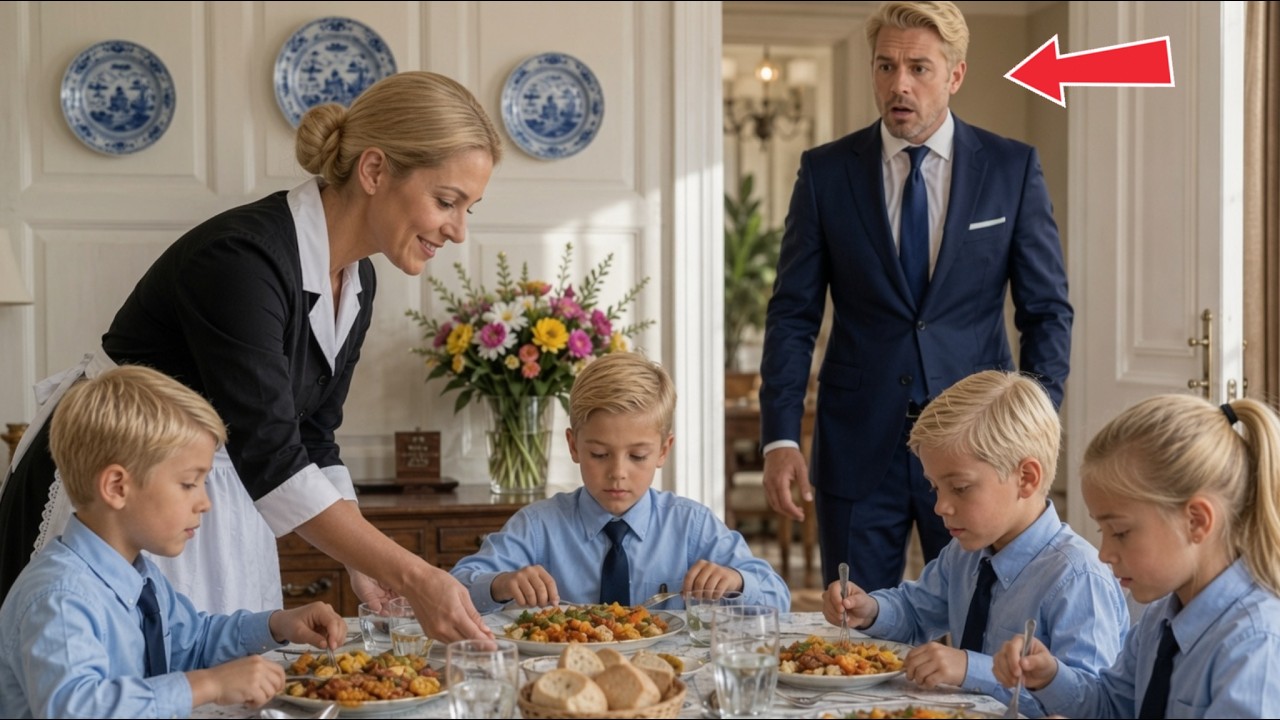
Rasmus came home early that afternoon. The house was quiet. Too quiet. Then he heard soft voices coming from the dining room.
His heart started to pound. What was she doing to them? What were they doing to her? He walked through the door, and what he saw stopped him dead in his tracks.
His four children were sitting around the dining table. They were holding hands. Their heads were bowed. They were praying.
Rasmus stood frozen. He couldn’t move. He couldn’t breathe. When was the last time he had seen something like this?
Three years. Three years since Helena left. Three years of chaos and anger and broken glass. And now, his children, his wild, angry, broken children, were sitting calmly with a woman he had hired to clean his house.
“Dear God,” Susanne was saying, her voice soft and warm. “Thank you for this day. Thank you for the food we are about to eat. Thank you for this family.
Please bless these children. Please heal their hearts. In Jesus’ name, amen. ”
“Amen,” the children said together.
Then they opened their eyes and saw him standing there. “Dad! ” Troels ran to him and hugged his legs. The other three looked away, embarrassed.
But they didn’t run. They didn’t scream. They just sat there. Rasmus looked at Susanne.
She smiled calmly, as if she had expected him. “Would you like to join us for lunch? ” she asked. Rasmus didn’t know what to say.
He didn’t know what to feel. He just nodded and sat down at the table. Days turned into weeks. Susanne came back every morning.
She cleaned the house, made the meals, and spent time with the children. She didn’t try to control them. She didn’t raise her voice. She just talked to them.
She listened to them. She saw them. The first real breakthrough came when Lasse threw a tantrum in the kitchen. He was screaming, throwing things, kicking the cabinets.
Susanne just sat down on the floor and waited. When he was done, exhausted and crying, she opened her arms. “Come here,” she said softly. Lasse hesitated.
No one had ever offered him comfort after a tantrum. His mother was gone. His father was always working. The nannies just yelled at him or called his dad to complain.
But Susanne just sat there, her arms open, patient. Lasse walked over and collapsed into her arms. He cried for a long time. She held him and rocked him gently.
“It’s okay,” she murmured. “It’s okay to be angry. It’s okay to be sad. You don’t have to hold it all in anymore.
”
Rasmus watched from the doorway, his throat tight. He had never seen his son cry like that. He had never seen anyone hold him like that. Later that week, Susanne asked if she could take the children to church on Sunday.
Rasmus hesitated. He hadn’t been to church in years. He didn’t believe in God. But something in her gentle, patient eyes made him say yes.
On Sunday morning, he drove them all to a small church on the edge of town. The children wore their best clothes. They grumbled, but they came. And as they walked in, Rasmus saw the looks on people’s faces.
Surprise. Pity. Disapproval. They knew who he was.
They knew about his reputation. He sat in the back row, watching his children sing along to songs they had never heard before. Mats stood stiffly, uncomfortable. Lasse looked around, curious.
David hid behind Susanne. And Troels sang with his whole heart, his little voice carrying through the church. Rasmus felt something crack inside him. He didn’t know what it was.
He just knew he couldn’t hold it back anymore. The next week, Susanne asked if the children could come to a Bible study group on Wednesday nights. Rasmus agreed. He would have agreed to anything that kept his children happy and calm.
And Susanne, he was beginning to realize, was the only person who could do that. Then came the night of the accident. David had been hiding in his room, as usual. Rasmus had asked him to come down for dinner, and David had thrown a tantrum, screaming that no one loved him.
Rasmus, exhausted and frustrated, had slammed the door and walked away. That night, Susanne came to him. She sat down across from him at the kitchen table, a cup of tea in her hands. “David asked me tonight if I thought his mother loved him,” she said quietly.
Rasmus felt his heart clench. “What did you say? ”
“I told him the truth. I said I didn’t know his mother’s heart, but I knew that his father loved him very much.
”
“I don’t show it very well,” Rasmus admitted. “You don’t have to show it perfectly. You just have to show it. ”
He looked down at his hands.
“I don’t know how. ”
“Then let me help you. ”
Over the next few months, Susanne became a part of the family. She wasn’t just the nanny anymore.
She was the grandmother they never had. She taught them how to bake bread. She taught them how to pray. She sat with them when they were scared and sang to them when they couldn’t sleep.
Rasmus started coming home earlier. He started eating dinner with his children. He started learning how to be a father again. The change in the children was remarkable.
Mats, once cold and calculating, started to soften. He would help his little brothers with their homework. Lasse, once so angry, found an outlet in sports. He joined a soccer team and practiced every day.
David, once so quiet and withdrawn, started coming out of his shell. He made friends at school. And Troels, the littlest one, finally started acting like the carefree child he was always meant to be. The day the judge granted Susanne official custody as a guardian, Rasmus felt a weight lift off his shoulders.
He couldn’t have done it alone. He knew that now. He needed help. And Susanne had been the answer to a prayer he didn’t even know he was praying.
“Thank you,” he said to her as they stood in the driveway. “For everything. ”
Susanne smiled. “You don’t have to thank me, Rasmus.
I just did what God told me to do. ”
“Really? God told you to come to my house? ”
She laughed.
“He told me there was a family who needed help. I just didn’t know it was going to be yours. ”
Rasmus shook his head. “I don’t know what I did to deserve you.
”
“Maybe you didn’t do anything. Maybe that’s the point. Grace isn’t something you earn. It’s something you receive.
”
Years later, Rasmus would think back on that day. The day his children had been sitting at the table, holding hands, praying over a meal. The day he walked in and saw something he hadn’t seen in his home in years. Peace.
He wasn’t the same man he had been. He was softer now. More patient. He learned to listen instead of shout.
To hug instead of hide. And every Sunday, he would take his children to church. And every night, they would gather around the table and hold hands, and he would give thanks. For the woman who had saved them.
For the family he almost lost. For the grace that had found him in his darkest moment. The children were never the same. But this time, it was a good thing.
They learned to love again. They learned to forgive. And they learned that even the most broken family can be healed. Susanne stayed with them for the rest of her life.
She watched them grow up, graduate, get married, have children of their own. And every Christmas, they would all gather at Rasmus’s house, and she would lead them in prayer. And Rasmus, who had once been one of the richest men in Copenhagen with nothing to call his own, would look around the table at his children, his grandchildren, his family, and realize he was the richest man in the world. The story of the Christensen family was not one of tragedy.
It was one of redemption. A story about a father who almost lost everything, and a simple woman with an old Bible and a calm voice who showed him the way home. In the end, it wasn’t the money that mattered. It wasn’t the empire he had built.
It was the love he had found. And he had found it in the most unexpected place. At the bottom of his own brokenness.
Because sometimes, when we feel like we have lost all hope, that’s exactly when God shows up.