The brooch was her son’s. She was sure of it. The moment she spotted it through the tinted window of the limousine, everything else stopped. It wasn’t the smell of the street or the movement of the crowd that caught her attention.
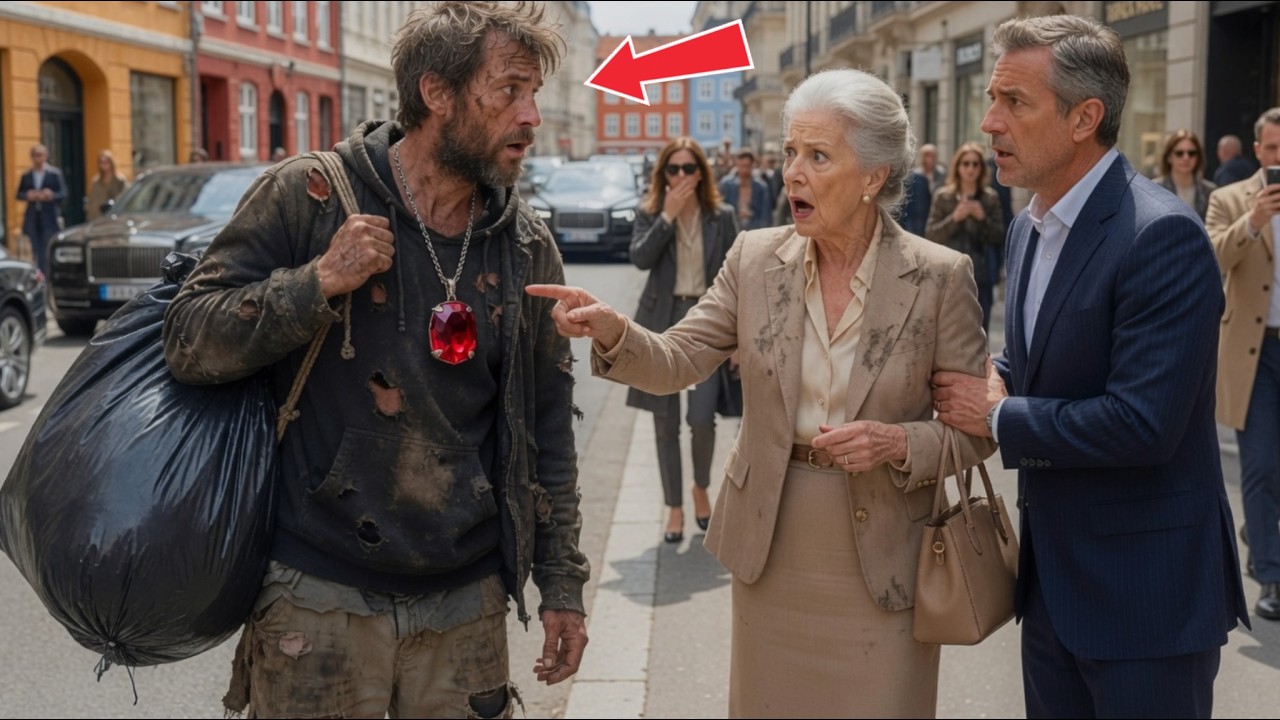
It was the glint. A small round brooch with a central ruby surrounded by hand-filed silver threads. She had ordered it from the goldsmith Arne Ditlevsen in his workshop on Frederiksberg exactly eight years earlier. A brooch designed only once, for one person.
Her son, Alexander. And now it was pinned to the ragged chest of a homeless man. Stop him, she shouted, and her voice carried a tremor her employees had never heard before. It wasn’t anger.
It was something older and deeper. The sound a mother makes when something she thought was dead suddenly moves again. Rasmus stopped, not because he understood what was happening, but because three large men in dark suits suddenly blocked his path. One of them extended an arm without a word.
The message was clear. Hey, I haven’t done anything, Rasmus said, his voice rough like sandpaper. He raised his hands instinctively. The black plastic bag hung from one fist.
What’s the problem? The bodyguards simply surrounded him. The limousine door opened, and Dagmar stepped out without waiting for anyone to offer her a hand. She wore a beige suit and pearl earrings.
Her white hair was pulled back in a tight knot. She walked toward Rasmus with short but firm steps, as if her heels were nails sinking into the ground. Her dark honey-colored eyes behind tortoiseshell glasses did not leave the brooch. Two steps away, she stopped and looked at his face.
He looked at her. No one spoke for a moment that felt much longer than it was. That brooch, Dagmar said quietly, with a calm more frightening than any shout. Where did you get it?
Rasmus frowned. He looked down at the brooch as if seeing it for the first time. In a way, he always saw it like that. It was one of those things you carry without asking yourself why.
He had found it. It was beautiful. He had pinned it to his jacket because it gave him a vague, foolish feeling that it protected him. I found it, he said.
Where? In the trash. Dagmar closed her eyes for a second. When she opened them again, something had changed in them.
A decision had been made. Get him in the car, she ordered without turning to her bodyguards. Rasmus took a step back. His street instincts, sharpened through years of survival, told him nothing good could come from getting into a rich woman’s vehicle when she was looking at him like he was a ghost.
I’m not going anywhere with you, he said. I haven’t done anything wrong. If you want to call the police, go ahead. I won’t call the police, Dagmar said.
I just want you to tell me where you got that. She pointed at the brooch with a trembling finger. Please. It was that please that disarmed him.
It wasn’t the tone of someone giving an order. It was the tone of someone begging for something from a person who couldn’t hear her. Rasmus wasn’t a soft man. He was a man who had fallen very deep, who had lost too much, who mistrusted the world for reasons he didn’t fully understand.
But that please cut through him in an unexpected way. Okay, he said finally. But I haven’t broken into anything and I haven’t stolen from anyone. That needs to be clear.
It is clear, Dagmar replied. The other man traveling with her, Søren, a thin man with a tense jaw and eyes that calculated everything with cold precision, watched the scene from a few meters behind the car without moving. His hands were in his pockets. His expression was impenetrably neutral, but his knuckles inside those pockets were completely white.
No one noticed. Fifteen minutes later, Rasmus sat in the back of the limousine, smelling of the street and defeat, watching the city slip away from the world he belonged to. The black bag with his cans had been left on the sidewalk. No one picked it up.
Dagmar didn’t speak to him during the drive. She only looked at the brooch. Her hands were crossed in her lap and didn’t stop moving. Fingers intertwining, loosening, tightening, relaxing, as if searching for something to hold on to.
Rasmus didn’t know where they were taking him. He didn’t know who the woman was. He didn’t know why a piece of metal with a red stone could provoke such a reaction. What he knew with the dark certainty that sometimes comes before thought was that his life had just changed.
He didn’t yet know whether for better or worse. The limousine took the Reformatorvej, then drove up toward the higher areas. The houses grew larger, the gardens quieter, the walls higher. Søren, sitting across from him, observed him with an expression Rasmus couldn’t read.
It wasn’t curiosity. It wasn’t sympathy. It was the assessment a man makes when measuring another and deciding whether he poses a threat. What’s your name?
Søren asked. Rasmus. Just Rasmus? Søren nodded slowly, as if confirming something he already suspected.
He looked out his window again and asked no more questions. Dagmar said nothing either. She just kept looking at the brooch. The Vejlegård estate sat behind a four-meter wall of gray stone topped with neatly trimmed hedges.
From the outside, you couldn’t see anything. People with that kind of fortune don’t need to show what they have. The electric gate opened silently. The courtyard was enormous, symmetrical, with palm trees along both sides of the driveway and fountains murmuring with that constant elegant sound that only exists in houses where silence is a price you can afford.
Rasmus stepped out and looked up. The house was three stories, modern colonial style with large windows and wrought-iron balconies. It wasn’t flashy in a vulgar way. It was powerful in a calm way, which is the worst kind of power because it doesn’t need to justify itself.
A butler in his fifties came over, looked at Rasmus with trained discretion that didn’t quite hide his discomfort. The library, Dagmar said. And bring water and something to eat. The butler nodded, cast one last look at Rasmus, at his torn shoes, at his dirty jacket, at the brooch still glinting on his chest like a traffic sign in the middle of the night, and went back into the house without saying more.
The library smelled of old wood and well-kept money. Walls covered with shelves reaching the ceiling, books that seemed to have been genuinely read, others with cracked spines, several with paper markers sticking out between the pages. A mahogany desk in the center, two armchairs in tobacco-colored leather facing the cold fireplace. Rasmus sat down.
On the sideboard, someone had left a tray of sandwiches and fruit. He ate. There was no point in pretending otherwise. He was hungry.
He had been since the day before. Dagmar entered alone ten minutes later. She had changed out of the suit into a cream silk blouse and held a glass of water she never touched. She sat across from him, crossed her hands in her lap, and looked at him for a long moment without saying anything.
It was a kind of silence Rasmus recognized. The silence of someone gathering courage for a question they’re not sure they want answered. How long have you been on the street? she asked finally.
Years, he said. I don’t know exactly how many. Six, maybe more. Do you have family?
Not that I know of. Dagmar blinked. It was a strange answer. Not no, I don’t, but not that I know of.
The difference was small, but she caught it immediately. What does that mean? Rasmus set down his half-eaten bread on the tray. He looked at his own hands for a moment, as if the answer were written there between the grime under his nails.
It means I don’t remember, he said. I woke up on a beach near Bornholm without knowing how I got there. Without papers, without knowing my last name, without knowing where I came from. The first weeks I thought it was temporary, that my memory would return on its own.
It didn’t. Or it returned in bits that didn’t always fit together. There are things I know. I can talk.
I can read. I know the names of cities on a map. But I don’t know who I was before that beach. Dagmar listened without moving.
Her lips were slightly parted, her eyes wide, receiving information her body processed faster than her mind. And the brooch? she asked, her voice barely a whisper. I found it at a landfill near the harbor.
Must have been three or four years after I woke up on the beach. It was lying between trash bags, wrapped in a piece of fabric. I cleaned it and kept it. He shrugged.
It was beautiful. And it made me feel… something. I don’t know what. Something like what?
Rasmus looked at her. It was a strange question. Not what someone would ask if they only wanted their jewelry back. Like it was mine, he said.
Like it had always been mine. He paused. I know it sounds ridiculous. A homeless man saying an expensive piece of jewelry was always his.
But you asked. Dagmar gripped the water glass with both hands. At that moment, the library door opened and Søren walked in. He didn’t knock.
He never knocked. It was one of his ways of reminding everyone, quietly but constantly, that he believed this house belonged to him as much as anyone else. May I ask what’s going on here? he said, his tone that of someone who already knows the answer and is only asking to register his formal objection.
We’re talking, Dagmar said without turning. So I see. Søren stepped into the room and stood behind his mother’s armchair, arms crossed, looking at Rasmus with an expression anyone from the street would have recognized instantly. The look of a man assessing a threat.
Have you asked him where he stole the brooch? I didn’t steal it, Rasmus said, his voice steady. Of course not, Søren said with a smile that didn’t reach his eyes. Homeless people always find expensive jewelry in the trash.
Happens all the time. Søren, Dagmar said, and in that name lay an unmistakable warning. Mother, we need to be realistic. This man shows up with Alexander’s brooch and says he found it.
That’s not a story. That’s an alibi. The difference, Rasmus said calmly, is that I have no reason to lie to you. I don’t know who you are.
I don’t know who she is. I don’t know who Alexander is. I was just walking, and suddenly three men stopped me in the street. Søren studied him for a long moment, then turned to his mother.
Have you told him who Alexander is yet? No? Good. Because before we do, I think we should call the police and check whether this person has a past.
We’re not calling the police, Dagmar said. This time she turned to face him. And in her eyes was something Søren knew well, something that usually stopped him. The absolute will of a woman who had been making decisions without asking anyone’s permission for over forty years.
I’m going to talk to him. I’m going to listen to him. And then I’ll decide what happens. You can stay or leave, but you won’t interrupt me again.
Søren crossed his arms, nodded with the calculated slowness of someone yielding in form but not in substance. He walked to the armchair on the other side of the fireplace and sat down, still watching Rasmus with the calm, dangerous expression of an animal that has decided to wait. Who is Alexander? Rasmus asked, turning back to Dagmar.
She hesitated a moment, then stood and walked to the fireplace mantel. She picked up the photograph that stood there, held it in both hands for a few seconds, looked at it, then turned it toward Rasmus. It was a photo of a young man, maybe twenty-seven or twenty-eight years old. Smiling, dark-haired, with light hazel eyes that contrasted with his dark skin.
He stood in front of what looked like a country estate with horses in the background, wearing a white linen shirt with rolled-up sleeves. He looked happy in the way only those who don’t yet know happiness ends can look happy. And in the pocket of the white shirt, barely visible at the corner of the image, was a ruby brooch. Rasmus looked at the photograph.
He looked at it for a long time. Something happened in his face that he couldn’t have described. It wasn’t recognition. Not exactly.
It wasn’t the clear cinematic moment when everything suddenly returns. It was something more unsettling. The feeling of looking into a broken mirror where some parts of the image fit and others simply aren’t there. The young man’s eyes in the photo, the angle of his jaw, the way he held his body slightly crooked with his weight on his left leg.
Who is that? he asked again. But now his voice had a different texture. My son, Dagmar said.
Alexander Jensen Møller died five years ago in a car accident. His car went off the cliffs of Bornholm. We never found the body. The silence that followed was so thick Rasmus felt it physically, like pressure on his chest.
Bornholm, he repeated. Bornholm, Dagmar confirmed. Neither of them said anything more for a moment. It wasn’t necessary.
The word had said enough, and the silence said the rest. Søren, from his armchair, observed them both. His expression hadn’t changed. His hands rested on the armrests with a perfect, almost artificial stillness.
The stillness of someone who has long practiced appearing calm. This proves nothing, he said softly. A geographical coincidence is not proof of identity. No one said it proves anything, Dagmar replied without looking at him.
I just want us all to be realistic, Søren said, rising from the armchair and straightening his jacket with a precise, habitual gesture. If you want to know more about him, the correct thing is to do a formal verification. Documents, background, a medical examination. Not a coffee chat.
You’re right, Dagmar said. We’ll do all of that starting tomorrow. Søren nodded. He cast one last quick look at Rasmus, the same assessing look he had already given him twice.
Then he left the library without saying goodbye. Rasmus kept looking at the photograph. May I keep looking at it for a moment? he asked.
Dagmar, who had been hard her whole life because she’d been given no other choice, felt something loosen inside her that hadn’t opened in years. You can keep it tonight, she said. If you want. Rasmus didn’t reply.
He just kept looking at the young man’s hazel eyes in the photo, searching the broken mirror for something with a name, something with a shape, something that might answer, even a little, who he had been before he woke up on that beach without a past and without a name. Outside in the marble corridor, Søren took his phone from his pocket and dialed a number he hadn’t saved in his contacts. He waited through the rings. We have a problem, he said quietly.
I need you to make some calls tonight. He hung up before anyone in the library could hear him. The next morning, in Frederiksberg Have, Rasmus sat on a bench facing the fountain. An old habit from someone who sleeps under the open sky.
Always facing where danger could come from. Hope arrived precisely at ten, alone as she had promised. No driver, no big bag. A gray coat that made her look like any elderly woman taking an early walk.
Only someone who knew her closely would notice the stiffness in her shoulders. Thank you for coming, she said. You summoned me, Rasmus replied. Could you not have come?
Could have. Hope looked at the fountain for a moment. Last night Axel spent two hours trying to convince me you’re a fraud. He came with a folder, police records, dates, a complete argument.
I listened to it all. She paused. When he was done, I asked him why Frederik followed you if he was so sure you weren’t important. Rasmus said nothing.
Axel always knows what to answer. He’s had forty-five years of practice. When he doesn’t answer, it’s because I’ve surprised him. And if I surprised him with that question, it’s because Frederik shouldn’t have been there.
Who is Frederik? A man who has done dirty work for many years. I used him once for something I’m not proud of. Axel uses him more often.
She paused. What worries me this morning isn’t Frederik. It’s that Axel already knows I was at the lab with you, or suspects it. And if he suspects it, he’s already acted.
Hope looked at the fountain again. There’s something I didn’t tell you yesterday, she said suddenly. What? The document from Rigshospitalet didn’t come alone.
It came with a letter. She took a folded envelope from her coat’s inner pocket and placed it on Rasmus’s knee. I never knew who sent it. But the letter says something I couldn’t tell you yesterday because I didn’t know if I could still trust you.
Rasmus opened the envelope. The letter was short, two paragraphs of dense handwriting with no signature on white, unstamped paper. The patient from file number 0447196 was transferred to St. Hans psychiatric hospital on November 3, 1996.
Admitted unnamed, with no registered family, with severe memory loss secondary to cranial trauma, he was hospitalized for four years. Upon discharge in 2000, he was handed over to a social institution in Valby. Rasmus stopped reading. Continue, Hope said softly.
The child born at Rigshospitalet on October 15, 1966, Rasmus read, his eyes scanning the second paragraph. Correction. The child born at Rigshospitalet was registered as found and transferred to the Solstrålen orphanage in Valby in January 1997. If you’re looking for Rasmus Vejlegård, don’t look for the man.
Look for the child he left behind. Rasmus held the paper without letting go. The park was the same. The trees, the fog, the sound of the water.
A dog crossed in the distance, pulling at its leash. Everything was the same, and yet. Rasmus had a son, he said. His voice sounded strange, as if from another place.
Before he died. Or before he lost consciousness. According to this. Hope had her hands clasped in her lap, knuckles white again.
A child born the same day he was admitted to the hospital. A child who came to Valby, who arrived at age three because he spent his first years with his father before the father was discharged. The dates don’t fit, Rasmus said. It can’t be three years at the psychiatric hospital.
Discharged in 2000. A three-year-old child at an orphanage in Valby in 2000, Hope said slowly, aloud. A child without a complete file, without a family name, who had a pendant put around his neck at some point, and no one knows where it came from. That would mean I’m the grandson they never knew existed.
The silence that followed was different from all the previous ones. It wasn’t the silence of shock or fear. It was the silence of something enormous landing silently, the way things that are too big to make sound land. If this is true, Rasmus said, Axel knows.
Yes. Axel knows his brother didn’t die. That he had a son. That that son ended up in an orphanage.
And that that child is now here. And yet he never looked for him. No. Nor for the child.
Where is my father? Rasmus asked. Hope hesitated. I don’t know.
The trail stops in 2000 when he was discharged. Then nothing. No records, no address, no name. A man without identity who left a hospital and vanished into a city of people.
Or they made him disappear. I need the DNA result, Rasmus said. I know. That’s why I came.
Hope reached into her pocket and pulled out a card. This woman is Dr. Conny Riber. She’s a physician, a geneticist.
She’s been carrying something for twenty-eight years that weighs too heavily on her. She worked at Rigshospitalet in 1996. She was on duty the night the unnamed patient was admitted. Why hasn’t she spoken before?
Because she was afraid. Because they told her that if she spoke, she’d lose her license, her job, everything. Someone very powerful made sure she didn’t speak. And when I sent her a message yesterday, she replied in ten minutes.
Why now? Because she’s also been waiting twenty years for someone to show up so she could talk. Dr. Conny Riber lived in an apartment on Nørrebro, third floor.
Rasmus arrived shortly before noon with the card in his hand and something strange happening in his chest that he couldn’t classify. He rang the bell. A lock clicked. The door opened just barely, still on its chain.
A woman around sixty, short hair, round glasses, a face like someone who hasn’t slept well in a long time, looked at him through the gap. She studied him from head to toe, then removed the chain and opened the door. I knew you would come, she said, her voice barely trembling. I’ve been waiting for you for twenty years.
Her apartment smelled of old coffee and paper. Boxes stacked, folders on the floor labeled by hand. A library built on the fear that throwing anything away would mean throwing away the only proof she wasn’t crazy. Conny poured two cups without asking and sat across from him by the window.
I was twenty-nine in 1996, she said without preamble. I’d been working six months at Rigshospitalet’s emergency room. October fifteenth, I had the night shift. Around two in the morning, an unidentified man was admitted.
Unconscious, severe cranial trauma, extensive burns. No wallet, no papers. We stabilized him. He wore a pendant.
A silver chain with a red stone. We took it off to clean the burns and put it in an evidence bag as protocol. Three days later, someone broke into the storage and took it. The access log was deleted.
Rasmus touched the pendant under his shirt. The man was in intensive care for two weeks. When he regained consciousness, he remembered nothing. Name, family, history.
Nothing. The trauma had erased everything. The psychiatrists evaluated him and transferred him to St. Hans.
Two weeks after he was transferred, a man came to the emergency room asking about the unidentified patient. He said he was family. He wanted to know where he’d been sent. What did he look like?
Young, around forty. Dark suit, square jaw. Spoke with the calm of someone used to getting answers. Conny lowered her voice.
I described him to Hope three years ago when she contacted me, and she said it sounded like Axel Vejlegård, twenty years younger. What did he get? Nothing. At that time we didn’t have permission to give patient information to people who weren’t verified direct family members.
The doctor handling him was firm. The man left. Two weeks later, that doctor lost his license due to an anonymous complaint of malpractice. The investigation lasted two years and ultimately led nowhere, but the damage was already done.
What did you hide? Rasmus asked. Conny looked at him, then stood without a word and went into the back room. Rasmus heard the sound of a box, then another, then footsteps returning.
Conny placed a sealed plastic bag, the kind used for medical procedures, on the table with a label written in ink yellowed by time. Inside was a folded manila envelope. I hid this that night, Conny said, before they came to inspect. The man had marks on his right wrist, like from a bracelet or chain that had burned into the skin.
Among the residue, I found this. Rasmus opened the bag carefully, opened the envelope. Inside was a small photo, burned at the edges, the image almost faded but not entirely. A photo of two young people, a man and a woman.
She was pregnant, he had his arm around her shoulders, both smiling with the sun in the background, a street that could be any street in any city. The man wore the pendant around his neck, the red stone visible even in a photo that size. Rasmus held the photo with both hands. The pregnant woman, he said with that strange voice from before.
That’s your mother, Conny said. Or that’s what I’ve always believed. A young woman who was with him when it happened. She never came forward to claim him.
No one ever asked after her. Rasmus looked at the picture as long as he could. The man’s face was too small and burned to recognize, but the pendant was unmistakable. He folded the photo carefully, placed it back in the envelope, sealed the bag.
I have to take this with me. That’s why I kept it for you. He stood to leave. Conny stood too.
There’s something else you need to know, she said before he reached the door. Yesterday afternoon a man came to the clinic where I work now. He said he was a new patient. He asked strange questions, things that had nothing to do with medicine.
He wanted to know if I had work archives from the nineties. Conny hugged herself slightly. It’s not the first time someone like that has been sent to me. But this time I was more afraid than usual.
Why this time? Because this time I know you exist. What I have is yours, she said. But once you have it, I have nothing protecting me.
Do you have any family, friends, someone you can stay with for a few days? A sister in Aarhus. Leave today. Conny nodded slowly.
She was already thinking about it. Rasmus tucked the sealed bag into the inner pocket of his jacket and walked out. The meeting happened that same afternoon. It wasn’t planned.
It was inevitable. Rasmus arrived at the Vejlegård estate unannounced, and this time the gate opened because Hope was waiting for him, even though he hadn’t told her he was coming. She led him into the main room, the large one with portraits and dark furniture and afternoon light falling diagonally through the windows. Axel sat there with the same calm, as if he had calculated exactly that this would happen today and had arrived early to be installed when the other man entered.
Rasmus, he said, as if they had known each other their whole lives. Axel. Hope stood between the two of them. Good, she said.
Now that you’re both here, we talk. Axel crossed his arms. Rasmus remained standing. I found something, Rasmus said directly.
What a surprise, Axel replied. A photo of a young man with this pendant. Rasmus pulled it out from under his shirt, visible, without taking it off. A photo that was in the possession of a doctor from Rigshospitalet who treated an unidentified patient on the night of October fifteenth, 1996.
A day after Rasmus Vejlegård’s accident. The name Rasmus in his mouth sounded different than before. Both of them noticed. Axel didn’t move.
That proves nothing. The patient’s file was transferred and then deleted. The treating doctor has kept copies for twenty-eight years because someone made it clear that speaking had consequences. Rasmus held his gaze.
The doctor who refused to give information that month lost his license two weeks later. Doctors lose licenses for negligence, Axel said. It has nothing to do with me. Hope’s voice was flat.
Of course not. A pause. Did you know Rasmus survived the accident? Silence.
The first one Axel didn’t fill immediately. One second. Two. Three.
No, he said. Hope looked at him with an expression Rasmus couldn’t quite read, but which had something of a mother who has known her son for forty-five years and knows exactly when he’s lying. I don’t believe you, she said simply. Axel stood.
Mother, this man arrived four days ago from the street with a pendant and has already convinced you that your dead son survived, that he had a secret child, and that I’m responsible for all of it. His voice was still controlled, but something at the edges was beginning to crack. Don’t you think it’s too perfect? What I think, Hope said, is that when I asked you if you knew Rasmus survived, it took you three seconds to say no.
You’ve spent forty-five years answering questions in less than a second. Axel and his mother looked at each other. Rasmus said nothing. It was a moment where words were superfluous.
I want a meeting with the family lawyer tomorrow, Axel finally said, with both of you present. And I want this man to bring all the evidence he says he has with a verifiable chain of custody. Otherwise it has no legal value. Agreed, Rasmus said.
Axel looked at him. The look lasted less than two seconds, but in those two seconds Rasmus read something that needed no translation. You won’t make it to that meeting. Tomorrow at ten, Axel said, and left the room.
The meeting with the lawyer never took place. At seven in the morning, two hours before the meeting, Rasmus received a call from an unknown number. A nervous young man’s voice. Is this Rasmus Hansen?
Yes. I’m Mats Iversen from Gen Pedrosa laboratory. A pause. Breathless breathing.
I have to tell you what happened. I was offered money to destroy your sample and erase the file. I accepted it, but afterwards I couldn’t. Another pause.
The analysis actually exists. I stored it on a server before I erased it from the system. I have a copy. Rasmus gripped the phone.
Where are you? At home. But I’m afraid to stay here. The man who contacted me wasn’t just anyone.
He had information about my family, my debts, things no one should know that quickly. I need that result, I know. That’s why I called. But I need your guarantee that if I hand this over, someone protects me.
I can’t guarantee that, Rasmus said, his voice firm but not cruel. What I can guarantee you is that if you don’t hand it over, you’re the only one who loses. Silence. Okay, Mats said finally.
There’s a café on Vesterbrogade and Frederiksberg Allé. One hour. The line went dead. Rasmus dressed quickly and left.
He never reached the café. Two blocks from the meeting point, two men stopped him on a side street. They drew no weapons, said nothing threatening. They simply positioned themselves on either side.
The bigger one placed a hand on his shoulder with a specific pressure that left no choice. A van pulled up behind them. Rasmus got in without resisting. He knew that struggle would change nothing.
The ride lasted twenty minutes in silence. When the van stopped, Rasmus recognized the area. Hellerup. Large houses with high walls, the kind of neighborhood where neighbors pretend they heard nothing.
They led him into an office in the basement of a house that had no exterior sign of what it was used for. Axel was waiting for him, sitting on the other side of a small table. No visible bodyguards. Two cups of coffee on the table.
Sit down, he said. Rasmus remained standing. As you like. Axel picked up his cup.
I’m not going to hurt you, if that’s what you’re thinking. I’m a businessman, not a movie criminal. Then why did you bring me here to talk without my mother present? You and I, alone, without acting.
What kind of conversation. An honest one. The kind you don’t have in front of lawyers. He leaned back in his chair.
I know what you’ve found. The photo, the document, the doctor. I know Conny Riber has already left for Aarhus, and I know a lab technician is about to hand you a DNA analysis. Rasmus didn’t blink.
How much do you want? Axel asked. The silence lasted three seconds. Excuse me?
Money. How much do you need to disappear and not come back? His voice was completely practical, as if he were closing a supplier contract. I’m not insulting you.
I’m being honest. You have something valuable, and I’m willing to buy it. Rasmus looked at him. It has no price.
Everything has a price. You know Rasmus Vejlegård survived the accident. Axel didn’t answer. You were at the hospital.
You asked about him. And when you didn’t get information, you made sure the doctor paid the price. Rasmus spoke slowly, his voice calm. You left your brother in a psychiatric hospital without a name, without family, without anything.
And when he was discharged, you let him vanish into the city because it suited you better that he was dead. That’s a very serious accusation without verifiable evidence. I have the photo. I have the documents.
I have the testimony of a direct witness. A witness who hasn’t spoken for twenty-eight years because she knows that what she says has no legal value without backup. Axel stood. He no longer had the relaxed posture from before.
Listen carefully, Rasmus. I don’t know who you are. You might be my mother’s grandson, maybe not. But at this moment it doesn’t matter.
What matters is that you either leave this city rich enough not to sleep on a bench again, or you leave it with nothing, because what you think you have will disappear. Just like the hospital file disappeared. Just like the things that shouldn’t exist disappear. Rasmus held Axel’s gaze without moving.
I’m not leaving, he said. Axel nodded slowly once, like someone accepting the result of a bet he had already calculated. Then it will be that way. The two men who had brought him led him out of the house with the same efficiency they had brought him in.
They left him on the street six blocks away. The van drove off. Rasmus took out his phone and called Mats Iversen. No answer.
He called three more times. Nothing. What happened in the following eight hours was fast and systematic, with the precision of someone who has sufficient resources to move many pieces at once. First, the analysis disappeared.
Mats Iversen deleted the external server and stopped answering calls. Rasmus went to the lab, and they told him the technician had resigned that morning. No file under the name Rasmus Hansen existed in the system. Then the newspapers came.
Not all of them, only the most widely read in the city, the ones people read in the metro, at the hairdresser’s, in company canteens. In the police section, a three-paragraph note with an archive photo. Rasmus Hansen, twenty-three years old, without fixed address, arrested in 2001 for theft at a public market. Investigated in 2003 for alleged fraud against elderly people in Valby.
Currently linked to a new report of attempted fraud against a prominent business family. The article didn’t name the family. It didn’t need to. Rasmus read the article at a newsstand on Vesterbrogade and felt something he hadn’t felt for a long time.
Shame. Not about what the article said, but about what it would do to Hope. He called Hope. Five rings.
Voicemail. He called two more times. Nothing. He went to the estate.
The gate didn’t open. The intercom didn’t answer. Standing on the gray stone pavement in front of the wall, he understood that Axel had done exactly what he said he would. Not with violence.
Without violence, only with money and contacts and the patience of someone who knows time works for those with the most to lose. At three in the afternoon, he received a short message from Hope with no punctuation. Need time. Don’t come.
Rasmus read the message four times, saved it, and walked away. That night he slept in the same alcove on Vesterbrogade where he had slept before all this began. The old blanket, the sick orange sky, the city noise that never stopped. Everything was the same, as if the last days had been an interruption.
And now the world was returning to its natural position. He took out the pendant and looked at it in the dark. The red stone without light didn’t shine. It was just a translucent stone on a silver chain that needed polishing.
He thought of the burned photograph, the unrecognizable face of the young man, the pregnant woman at his side who never came looking for him. He thought of a three-year-old child at an orphanage in Valby who arrived with a pendant, without a name, with no one asking for him. He thought of Axel, who had known everything from the beginning and chose silence because silence gave him power. And he thought of Hope, who had said don’t come, with a sentence that wasn’t indifference but the kind of wound that protects itself by going hard.
At two in the morning, he took out his phone and wrote a message to a number he had saved without knowing why. Dr. Riber, it’s Rasmus. I’ve lost everything.
The sample, the witnesses, access to Hope. All I have left is the photo and the physical documents you gave me. I need to know if there’s anything else you didn’t tell me. He waited.
After ten minutes, the answer came. There is more. I recorded everything for three years. Every time someone sent me a strange person for consultation, I turned on a tape recorder.
I have names, dates, conversations. I hid it somewhere that is neither my home nor my consultation. Rasmus sat up on the bench. Why didn’t you tell me this before?
The answer took longer this time. Because if I’d told you before, and they’d caught you, you would have lost it. I waited until you lost everything to give it to you. When you have nothing left to lose, you’re the hardest person to destroy.
Rasmus read that sentence. Strange, Dr. Riber. A nun at the orphanage in Valby, twenty years ago.
The one with nothing left to lose is the hardest to destroy. He closed his eyes, opened them. Where are the recordings? This time the answer was immediate.
In an envelope. At the notary office Schmidt & Son, Østerbro. It’s in your name, Rasmus Hansen. You can pick it up tomorrow from ten o’clock.
Rasmus put the phone away, looked at the pendant one last time, hid it under his shirt, and for the first time in four days closed his eyes with something that resembled a plan. He went to the notary office at ten o’clock on the dot. The receptionist was young, efficient, with the face of someone who has learned not to ask about the contents of the envelopes she guards. Rasmus Hansen, he said.
She typed something, nodded, went to the office at the back, and returned with a thick manila envelope sealed with his name written in black ink on the front. Do I need to identify myself? Rasmus asked. The woman who deposited it left instructions to hand it over to whoever asked for the name.
She said the person who came to collect it wouldn’t have formal identification. Rasmus took the envelope, walked out into the street, walked three blocks before opening it. Inside was a USB stick, three handwritten pages with dates and names, and a note from Conny Riber in the same dense handwriting as the letter. On the USB stick there are sixteen audio recordings.
The most important ones are from March 7th and September 22nd of last year. In both cases, a man identifying himself as a legal representative of the Vejlegård corporation offered me money to destroy my file and sign a statement that I had no relevant memory of the patient’s case from 1996. I refused both times. In the September 22nd recording, the man explicitly mentions Axel Vejlegård’s name as the one approving the payment.
He doesn’t know it, because the phone was in my pocket, and he never saw me recording. Take care of yourself. Rasmus read the note twice. He tucked everything into his jacket’s inner pocket along with the burned photo and the hospital documents.
Then he took out his phone and searched for Hope’s number. He didn’t call yet. He thought first. Axel had built his defense on a single base, that Rasmus had nothing that could legally hold up.
The newspaper article, the destroyed DNA, the bought witness, the closed gate. Everything pointed to a fraud that had never existed. If Rasmus now arrived with a recording where Axel was mentioned by name, Axel would claim it was fabricated, that Conny Riber was a witness with an agenda, that the chain of evidence was contaminated. He needed the recording to reach someone before Axel knew it existed.
Someone who couldn’t be bought, or someone too expensive to buy even for Axel. He thought for fifteen minutes, standing on the corner of Strandvejen and Nordre Frihavnsgade with the traffic rushing past as if the world had nothing urgent to solve. Then he went to an internet café on Amagerbro, paid for half an hour, and copied the sixteen recordings to three different email addresses. One to his own new address, one to the editorial desk of a national investigative media outlet he found in ten seconds, and one to a civil rights law firm he had seen advertised on a billboard weeks earlier and whose name he remembered without knowing why.
Then he left the café and called Hope. This time she answered on the second ring. Rasmus. Her voice sounded different.
Tired, older than it had been in the park three days earlier. I need to see you today. Axel showed me the article. That article is fake.
The fraud investigation never existed. You can verify it in the public register. Any lawyer can do it in twenty minutes. Silence.
I know, Hope said. Rasmus hadn’t expected that. I know. I had it verified yesterday afternoon.
My personal lawyer, not Axel’s. There’s no active or past report in your name for that accusation. Then you know the article is a lie. And you know Axel fabricated it or bought it.
Her voice wasn’t angry. It had something worse in it. The calm of someone who has finished understanding something she didn’t want to understand. I have the recordings, Rasmus said.
Long silence. What recordings? Dr. Riber recorded Axel’s emissaries for three years.
In one of them, they mention his name explicitly. He paused. I’ve already sent them to an investigative media outlet and a law firm. If Axel destroys them now, it’s too late.
The silence that followed was different from all the previous ones in this story. It wasn’t the silence of fear or shock or doubt. It was the silence of a mother who has just lost something that wasn’t her dead son. She had already lost that twenty-eight years ago.
It was something else. The living version of that son. The son she had raised and who had betrayed her in a way no mother wants to say aloud. Come, Hope finally said.
But not to the estate. Axel is here. Where? At my lawyer’s office.
I’ll send you the address. The office was in the Old Town, fourth floor, a discreet building with no logo on the facade. Hope was already there when Rasmus arrived, sitting at a large desk with the manila envelope from the park in her hands and an expression that didn’t ask for comfort. The lawyer’s name was Fuentes.
He had the face of someone who has spent decades seeing things he can’t mention at family dinners. Rasmus handed over the USB stick. The most relevant recordings are from March 7th and September 22nd of last year. In the second one, the authorizer’s name is mentioned.
The lawyer plugged in the USB without a word. He listened to fragments, took notes. His face didn’t change, but his notes became faster. This is enough for a formal complaint, he said after ten minutes.
Enough for obstruction of justice, witness intimidation, and depending on what comes out of a broader investigation, possibly patrimonial fraud if it’s proven that Axel Vejlegård deliberately concealed from his mother information he knew legally belonged to her. The room went still. Hope didn’t cry. She didn’t tremble.
She looked at the desk with the gaze of someone processing a truth she had been moving toward for weeks and which had finally arrived. Can you also trace what happened to Rasmus Vejlegård after his discharge? Rasmus asked. With those documents and a court order, we can reopen the psychiatric hospital’s file and trace the discharge.
There’s a trail, but someone has made sure to bury it. Hope nodded. Then she looked at Rasmus. She looked at him in a way he had never seen before.
It wasn’t the gaze of a benefactor. It was the gaze of someone finding something she wasn’t looking for and which, in some way, is more genuine than what she was looking for. The photo, Rasmus said. He took it out of his jacket.
The sealed bag, the manila envelope, the burned image at the edges. Hope took it with both hands. She looked at it slowly. Very slowly.
And then something happened that Rasmus didn’t expect. The woman who had crossed an entire street without hesitating to confront a homeless man because of a brooch. The woman who had disarmed her son with a single question. That woman closed her eyes and shed two tears with the same efficiency with which she did everything else.
That bracelet, she said. She pointed at a detail on the right wrist of the man in the photo, invisible due to the damage to the image. That leather bracelet, I gave it to him for his eighteenth birthday. He wore it every day.
Rasmus looked. There was a dark leather band around the man’s right wrist, so small he had looked three times without seeing it. This is him, Hope said. This is Rasmus before 1996.
She was still holding the photo when Rasmus’s phone vibrated. A message from an unknown number. The recordings have reached editorial. The editor will publish tomorrow.
Do you approve? Rasmus looked at the message. Then at Hope. Do I approve?
he asked her. Hope didn’t hesitate. Approved. Yes, Rasmus replied.
The article was published at six in the morning the next day, not on paper but digitally, which was worse for those who wanted to control it. Paper could be stopped. Digital could not. The headline ran: Son of an industrial magnate concealed his brother’s existence for twenty-eight years.
Within four hours, the article had twelve times the usual number of readers, and the country’s largest news portal had republished it. Rasmus didn’t read it in real time. He was at the lawyer’s office signing the documents for the formal opening of an investigation when the lawyer showed him the phone screen with the rising numbers. Rasmus looked at the numbers.
He looked at them without euphoria, without relief. How does it feel? the lawyer asked. Strange, Rasmus said.
And it was the most honest answer he could give. Axel Vejlegård issued a press statement through his PR office at ten in the morning. He denied everything. He spoke of a smear campaign, of fabricated evidence from a unscrupulous person who had manipulated his aging mother.
The statement was well-written. It was the kind of text that works when there’s nothing to contradict it. But something existed. At one in the afternoon, the civil rights law firm Rasmus had sent the recordings to presented a formal complaint for obstruction of justice, witness intimidation, and patrimonial fraud to the prosecution authorities.
The USB stick, the hospital documents, the witness statements, everything went in. Four police officers arrived at Axel’s house the following morning. They found him sitting on the terrace with a glass of whiskey, as if he had calculated that fleeing was worse than waiting and had chosen to wait with dignity. He was arrested without incident.
Rasmus learned about it from a message from the lawyer while walking through the city with no fixed destination, as he always did when he needed to think. He read the message, put the phone away, and kept walking. The DNA result arrived twelve days later. Rasmus opened it at the lawyer’s office, with the sheet in his hands and the lawyer sitting on the other side of the desk without saying anything, waiting.
The probability of kinship with Hope Jensen Møller was 99. 97 percent in a direct line from grandparents to grandchild. Rasmus read the number. He read it again.
He folded the sheet carefully and put it in his jacket’s inner pocket along with the burned photo. Do you want me to call Mrs. Jensen Møller? the lawyer asked.
No, Rasmus said. I’ll go myself. The estate had the same facade as always. The gray stone wall, the cameras in the corners, the black iron gate.
Everything was the same. But this time the gate opened before he pressed the intercom. Hope was waiting for him in the garden, standing in her gray coat. Rasmus walked up the path.
They stopped a meter apart. Neither of them spoke first. Rasmus took the sheet out of his pocket and handed it to her. Hope took it.
Read it. Her hands didn’t shake. Her eyes didn’t blink more than normal. She folded it and gave it back.
I already knew, she said. How long? From the bench in the park. From when you told me about the orphanage.
A pause. The paper only confirms what the body already knows. Rasmus didn’t know what to do with that sentence. He kept it.
Hope looked at him with that direct gaze he already knew. It’s not a question, she said. What do you need? The question surprised him.
It wasn’t what he expected. He expected a declaration, a hug, something with more ceremonial weight. But Hope Jensen Møller wasn’t for ceremonies. She was for direct questions.
I don’t know yet, Rasmus said honestly. That’s fine. You have time. They stood in silence for a moment.
The garden smelled of damp earth and flowers he could never identify. Are you going to look for Rasmus? he asked. We’ve already started.
The lawyer has the court order to reopen the St. Hans file. Hope looked toward the house. If he’s alive and wants to come back, he has a place here.
But if he doesn’t want to come back, he doesn’t have to. She said it without drama, with a serenity that wasn’t resignation but something more difficult. I’m not going to force anyone to be what they don’t want to be. I’ve already wasted too much time wishing people were what I needed them to be.
Rasmus looked at her. I don’t know if I can be what anyone expects, he said slowly. I expect nothing, Hope said. I’m offering you something.
That’s different. What are you offering? A name. A history.
A place in the family that is your right, even if you didn’t ask for it. She paused. You don’t have to decide today. You don’t have to decide anything quickly.
Take all the time you need. Rasmus nodded slowly, turned, and walked toward the gate. Hope didn’t call after him. She let him go the way you let someone who already knows the way back go.
Three weeks later, a letter arrived for Rasmus at the lawyer’s office, the only address he had given to anyone who wasn’t Hope. The handwriting was irregular, as if written by someone who writes slowly, making sure of each word before putting it on the paper. The postmark was from Oaxaca, Mexico. The letter was from Rasmus Vejlegård.
He was alive. He had rebuilt his life in Mexico. He had a hardware store in Oaxaca. He wrote about the woman who had found him on the street in 2002 and given him a name, about the memories that returned slowly, first the smell of his mother’s perfume, then the sound of her voice, then Valeria, the young woman who had been with him on the cliffs, who had disappeared after the hospital, whom he had never found.
He wrote about how he had seen the newspaper photos and recognized himself before recognizing his own face. He wrote that he loved his mother but had been too afraid of Axel to come back. He wrote that he had chosen not to return because he thought it was better that way. He wrote that the leather bracelet in the photo had been a gift from his mother and that he had worn it until the accident.
Some things survive everything, he wrote. Rasmus folded the letter. He folded it twice, carefully, with the same precision he had used folding the burned photo weeks earlier. He put it in his jacket’s inner pocket next to the photo, next to the DNA result.
He sat on the bench in Frederiksberg Have for a long time, not measuring the time. The pigeons kept walking in circles. A child on a swing asked to be pushed higher. An elderly man folded his newspaper and stood with the patience of someone with nowhere to rush to.
Rasmus took out the pendant from under his shirt, held it in his open palm. The red stone in the afternoon sun glinted differently than in the dark. With depth. With layers.
He thought of everything the pendant had carried. A man who loved a woman named Valeria. A doctor who hid everything out of fear for twenty-eight years. A three-year-old nameless child who learned to carry the burden without knowing where it came from.
He put the pendant back around his neck, stood, and went to see Hope that same afternoon. He didn’t call first. The gate opened when he pressed the intercom and said his name. He no longer needed to wait.
Hope was in the living room with the lawyer and two people Rasmus didn’t recognize. Lawyers in the case against Axel, which was slowly moving forward as these things do when there is money on both sides. She said something quietly to the lawyers, and they gathered their papers with the efficiency of people who understand when a meeting is over. Sit down, Hope said when they were alone.
I have something to show you, Rasmus said. He unfolded the letter and held it out to her. She took it, put on her reading glasses, and read. A long, silent reading.
Only her eyes moved, with that absolute concentration she had for the things that mattered. When she finished, she didn’t fold the letter. She held it for a moment longer, as if keeping it close before giving it back to the world. He’s alive, Hope said, in a voice that was neither loud nor weak.
He’s alive. Yes. She repeated the phrase slowly, as if testing its weight. And he chose not to come back because he was afraid of Axel.
He doesn’t have to be afraid of Axel anymore. He can come back whenever he wants. The nightmare is over. Hope looked at the letter again, then at Rasmus.
Your grandfather writes like you, she said. The way you form your letters. Some things don’t change. Rasmus didn’t speak.
Neither of them did for a moment. It wasn’t an uncomfortable silence. It was the kind that only exists between people who understand each other. You know, Hope said after a moment, I’ve spent twenty-eight years walking the gardens of this house, knowing that something was missing.
It wasn’t just a son. It was the truth. Now I have the truth, and it’s not what I expected. But it’s more than I hoped for.
Rasmus sat across from her. For the first time in weeks, he felt something settle in his chest. Not resolution, not happiness. Just the absence of the constant weight he had carried so long he had stopped noticing it.
Hope stood and walked to the window that looked out over the garden. The afternoon sun cast long shadows across the lawn. She stood there for a moment, then turned back to him. You asked me once what I was offering.
A name. A history. A place in this family. I meant it then, and I mean it now.
Nothing more is required of you. Just be here, if you want to be. That’s all. Rasmus looked at her.
Then he looked down at his hands in his lap. Hands that had slept under bridges. Hands that had sorted trash for bottles and cans. Hands that had survived.
Slowly, he stood and walked to where she stood by the window. He didn’t know what to say. He didn’t have words for this. So he just stood beside her, looking out at the garden, and let the silence be enough.
That night he slept in a room on the second floor of the Vejlegård estate, in a bed that smelled of clean linen and lavender. He lay awake for a while, looking at the unfamiliar ceiling, listening to the sounds of a house he didn’t yet know. The creak of the wooden floors. The distant hum of the city.
The wind in the garden moving something against the window. On the nightstand, the pendant lay on its silver chain, the red stone dark and opaque without light. He thought of a hardware store in Oaxaca, of a woman named Valeria who had vanished, of a nun in Valby who had once told him that the one with nothing left to lose is the hardest to destroy, and of Axel who slept somewhere in a detention center, waiting for his lawyers. He closed his eyes.
And before sleep, a question passed through the edge of his consciousness. Not anxious, just present. The kind of question that doesn’t need an immediate answer. The kind you carry with you for years.
He let it settle. And for the first time in his life, he let himself stay.