Lars Hansen had noticed something wrong with Mette for three weeks before he let himself name it. It wasn’t a specific thing. Not a mistake in the kitchen, not a smudge on the silver, not a complaint. Not a delay.
It was something about Mette. Something that was draining out of her, the way light drains from a room when someone leaves a window open and the flame gutters low before going out. Her hands were the first sign. He saw her serving breakfast to the triplets one Monday morning and stopped in the kitchen doorway, because Mette’s hands were red, cracked, the skin split at the knuckles, as if she had been plunging them into freezing water for hours.
She served the three bowls of fruit with the same precision as always. Banana sliced thin for Emil, the pieces cut so they wouldn’t annoy Victor, the pear without seeds for Ida. But her hands shook when she set down the spoon, and her fingers closed stiffly, like something that hurt just to move. Then it was her eyes.
The dark circles. Mette had always had the normal shadows of a working woman. But they had become something else, something deeper, darker, like the color of a bruise that never heals. Her eyes themselves had sunk into her face, as if her skull was absorbing whatever was left of her.
And her clothes. The same clothes under her uniform, always the same. A gray blouse and black trousers that grew bigger every week, because Mette was shrinking into them like a tree losing its leaves in a season that wasn’t autumn. Lars said nothing.
Not because he didn’t care, but because he didn’t know what to say. How do you ask the woman who cleans your house if she’s okay? With what words? And what right?
He paid her a salary. A good salary, or so he thought. She showed up on time and left on time. The triplets were bathed and fed, and the house was spotless.
And that was all Lars needed to know. Or all he wanted to know. All he allowed himself to know. It was a Thursday at eleven in the morning when Mette’s body decided it couldn’t go on.
She was in the kitchen preparing Ida’s baby bottle. The triplets were four years old, and Ida still drank warm milk before her nap, because she was the youngest of the three by minutes. And because Mette knew that warm milk helped her sleep better, even though no one had asked her to know it, or remember it, or prepare the bottle at exactly the temperature Ida liked. Mette stood at the stove, stirring the milk with one hand while she gripped the counter with the other, because her legs had been shaking since morning and the kitchen floor was moving under her like the house was on a ship.
The baby bottle fell first. Then her knees. Then her whole body. The sound Mette made when she hit the kitchen floor was a dry, muffled sound.
The sound of someone collapsing without putting out her hands, because her body no longer had the strength to protect itself from the fall. The milk spilled across the tiles. The bottle rolled to the leg of the counter, and Mette lay on the floor with her eyes closed and her face the color of ash, her uniform covering a body that weighed less than any woman her size should have. Lars found her moments later.
He knelt down, touched her forehead. It was burning. He lifted her easily, too easily, and carried her to the car. She weighed nothing.
He drove across the city, east, past Frederiksberg, through Vesterbro, and for every kilometer the streets grew narrower, meaner. He thought she would wake up, but she didn’t. At the hospital they told him she was severely malnourished, dehydrated, exhausted to the point of collapse. They kept her for observation.
Lars didn’t tell the triplets what was wrong. He told them Mette was sick and resting. He told them she would be home soon. But at night, when the house was quiet and the triplets were asleep, Lars sat in his study with the door closed and thought about the woman who had cleaned his house for two years.
He had known her name. Mette. He had known she had three children, because she mentioned them once, and because the triplets had played with her daughter Freja once at a birthday party. He had known she was a single mother.
He had known almost nothing else. The following Monday, Mette came back. She looked better, slightly. The color had returned to her cheeks, and she had gained a little weight, but her eyes still had that hollow look.
Lars wanted to say something. He wanted to ask if she was okay, if there was anything he could do, but the words stuck in his throat. He was afraid. Afraid of the answer.
Afraid of what she might tell him. And because he was afraid, he said nothing. He just nodded and went to his study. A few weeks passed.
Mette worked with the same quiet efficiency as before, but Lars couldn’t shake the feeling that something was different. She seemed lighter, but not in a good way. It was as if she had given up on something. Something important.
Then one night, Lars woke up at three in the morning. He couldn’t sleep, so he went to the kitchen to get a glass of water. The house was dark and silent. He was about to go back upstairs when he noticed a light coming from the laundry room.
That was strange. No one should be up at this hour. He walked over and pushed the door open. Mette was standing at the washing machine, folding the triplets’ clothes.
She was wearing her coat. Lars froze. She had her back to him, and she was folding a small blue sweater with movements so slow, so careful, so full of grief, that Lars felt his heart clench. She brought the sweater to her face and pressed it to her cheek.
Then she folded it again and placed it in a bag at her feet. There were already other clothes in the bag. Children’s clothes. The sweater.
A pair of small trousers. A jacket. Lars stepped into the room. Mette spun around, her eyes wide with fear.
She clutched the bag to her chest, backing away. Lars held up his hands. It’s okay. It’s okay, Mette.
I’m not going to hurt you. But she kept shaking her head, and the fear in her eyes turned to something else. Shame. She tried to walk past him, but Lars gently touched her arm.
Mette. Please. Tell me what’s going on. And then, slowly, with her voice barely above a whisper, Mette told him.
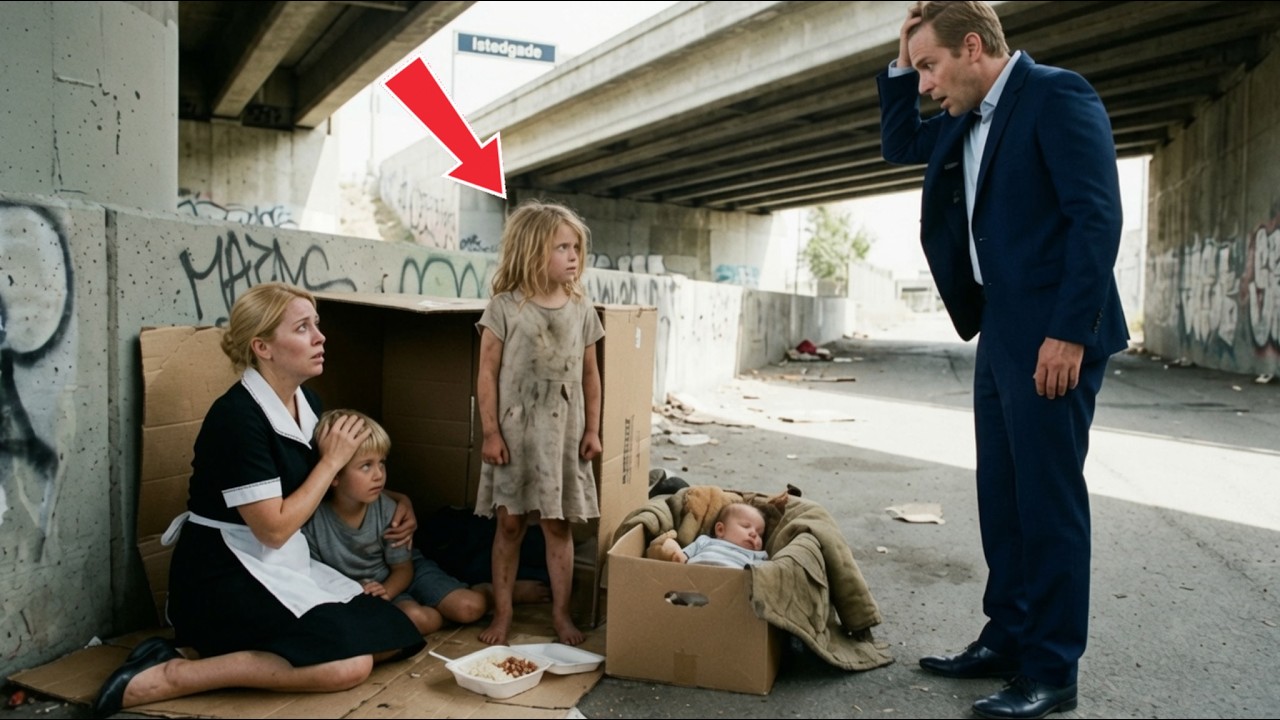
She told him everything. About her husband who had left her with three small children. About the apartment they had lost because she couldn’t pay the rent. About the night she spent under the bridge with Freja and Lukas and the baby.
About the cardboard boxes and the plastic sheeting and the rain that soaked through no matter what she did. About the 87 nights. Eighty-seven nights of holding her children under a bridge, of telling them stories to drown out the sound of traffic, of pretending everything was fine because if she didn’t pretend, she would shatter. She had been working for him for two years.
She cleaned his house twelve hours a day. And at night, she took her children and walked to the bridge, and they slept on cardboard under a concrete overpass. She couldn’t afford the deposit on an apartment. She couldn’t save enough.
She was trapped. Lars listened. He didn’t interrupt. He didn’t ask questions.
He just listened. When she finished, she was crying silently, tears running down her face, and she was holding the bag of children’s clothes so tightly her knuckles were white. She thought he would fire her. She thought he would call the police.
She thought he would tell her to leave and never come back. But Lars didn’t do any of those things. Instead, he asked her to show him. He asked her to show him where she lived.
Mette shook her head. Please. Don’t make me go back there. I’ll give you the keys to my other car, Lars said.
The van. It’s yours. Take it. But I’m not going to make you live under a bridge.
Not anymore. Mette stared at him. She didn’t understand. Lars took out his phone and made a call.
He spoke in a low voice for a few minutes, and then he turned to Mette. There’s an apartment in my building. Two bedrooms. It belongs to my cousin, but he’s moving out.
You can have it. Rent-controlled. I’ll cover the deposit. Mette’s legs gave out.
She sank to the floor, and Lars sat down next to her, and he let her cry. He let her cry until she had no tears left. And then he told her about his own life. About how his wife had died five years ago, leaving him alone with the triplets.
About how he had hired Mette because he couldn’t cope. About how he had been so lost in his own grief that he hadn’t seen her. He hadn’t seen her suffering because he had been so busy with his own. He told her about the night he woke up and saw her in the laundry room, and how he had known in that instant that he had to do something.
Not because he was a good man, but because he was a man who had finally opened his eyes. Mette moved into the apartment the next week. Lars helped her carry her things. She didn’t have much.
A few boxes of clothes. Some pots and pans. The children’s coats. But she didn’t need much.
She had her children. And for the first time in a long time, she had hope. The first winter in the apartment was hard. Money was tight.
Lars paid her the same salary, but she was paying rent now, and utilities, and food for three growing children. She learned to stretch every kroner. She learned to make soup that lasted a week. She learned to sew patches on elbows and knees.
But her children had a warm bed to sleep in, a roof over their heads, and a door that locked. They still went to bed hungry some nights, because a growing child is always hungry, but they never went to bed cold. And that was something. Lars watched from a distance.
He wanted to help more, but he was afraid of overstepping. He was afraid of making her feel like a charity case. So he watched, and he waited, and he helped when he could. He drove Freja to school when she was late.
He gave Lukas a job doing yard work. He brought the triplets over to play with Mette’s children. And slowly, painfully, something shifted. Lars started to see Mette.
Not as the woman who cleaned his house, but as the woman who survived. The woman who had held her children together with nothing but sheer will. The woman who had been knocked down again and again, and who kept getting back up. He saw her laugh, one day, a real laugh, and he felt something in his chest crack open.
Freja started calling him “Uncle Lars. ” Lukas asked him if he knew how to fish. Ida, the baby, would reach for him when he walked into the room. And Mette would smile at him, a small, shy smile, and Lars felt like a young man again.
It was a Sunday afternoon, three months later, when Lars walked into the courtyard and saw Mette sitting on the steps, her face in her hands. She was crying. He sat down next to her. What’s wrong?
She shook her head. I can’t do this anymore. Do what? This.
Pretending I’m okay. Pretending I’ve got it all figured out. I don’t have it all figured out, Lars said. Look at me.
I’m a widower with three kids who can barely boil an egg. I hired a housekeeper because I couldn’t cope with my own life. Mette laughed through her tears. You’re doing better than you think.
I don’t feel like it. None of us do. That’s what I’m trying to say. We’re all just stumbling through, trying to do our best.
She looked at him. Why are you being so kind to me? Because I see you, Mette. I see you, and you’re amazing.
And I’m not just saying that. You’ve been through more in the last two years than most people go through in a lifetime. And you’re still here. You’re still fighting.
I don’t know how you do it. Mette was quiet for a long time. Then she spoke. I do it because I don’t have a choice.
I do it because my children need me. And because… She paused. Because I’m starting to think that maybe I don’t have to do it alone anymore.
Lars felt his breath catch. You don’t. She looked at him, and in her eyes he saw the same fear he felt. The fear of hoping again.
The fear of letting someone in. It’s scary, he said. Yes. I’ve been scared every day for two years.
But I’m tired of being scared. Me too. He reached out and took her hand. She didn’t pull away.
They sat there in the courtyard, two broken people holding on to each other, until the sun went down. The wedding was small. A civil ceremony in the city hall. The triplets were the flower girls and ring bearer.
Freja was the maid of honor. Lukas held the rings. And Ida, who was no longer the baby, cried the whole way down the aisle. Lars’s mother was in the front row, dabbing her eyes with a handkerchief.
Mette’s mother was next to her, holding her hand. And when Mette walked down the aisle in a simple white dress that she had bought at a secondhand store, Lars forgot how to breathe. She was the most beautiful thing he had ever seen. The reception was held in the courtyard, which had been strung with fairy lights.
There was a buffet and a cake and too much champagne. And when the toasts were over, and the children were running around with sticky fingers and tired smiles, Lars took Mette in his arms and danced with her under the stars. Thank you, she whispered. For what?
For seeing me. For not looking away. He pressed his forehead to hers. I will never look away again.
They lived in the house with the big kitchen. Mette still made breakfast for the children every morning, but now there were six of them at the table. Freja had her own room. Lukas had a desk by the window.
Ida had a canopy bed that Lars had built with his own hands. And at night, when the house was quiet, Mette would lie in bed next to Lars and listen to the wind outside, and she would remember the nights under the bridge. The cardboard boxes. The plastic sheeting.
The sound of rain on concrete. And she would remember the way she had wrapped her children in her old coat, the only coat she had, and the way she had held them through the dark. It was a part of her. It had made her who she was.
And she would never be ashamed of it again. One night, she found Lars in the attic, going through a box of her things. He held up the old coat. The one with the missing buttons.
The one that smelled like the bridge. You kept this? She took it from him, ran her fingers over the fabric. I kept it because it reminded me of what I was fighting for.
She folded it carefully and put it back in the box. But I don’t need it anymore. Because I already have everything I need. She reached up and pulled his face down to hers and kissed him.
And in the house across the courtyard, Freja was teaching the triplets a card game, and Lukas was showing them a magic trick, and Ida was laughing. And the old coat sat in the box in the attic, a reminder of where they had been. But they would never have to go back.
Because they were home.