Her name was Connie Watanabe, and she had been invisible for so long that she had stopped expecting anyone to see her. “I’ll give you a hundred kroner if you serve me in Japanese. ”
The millionaire laughed. The cleaning lady made everyone go quiet.
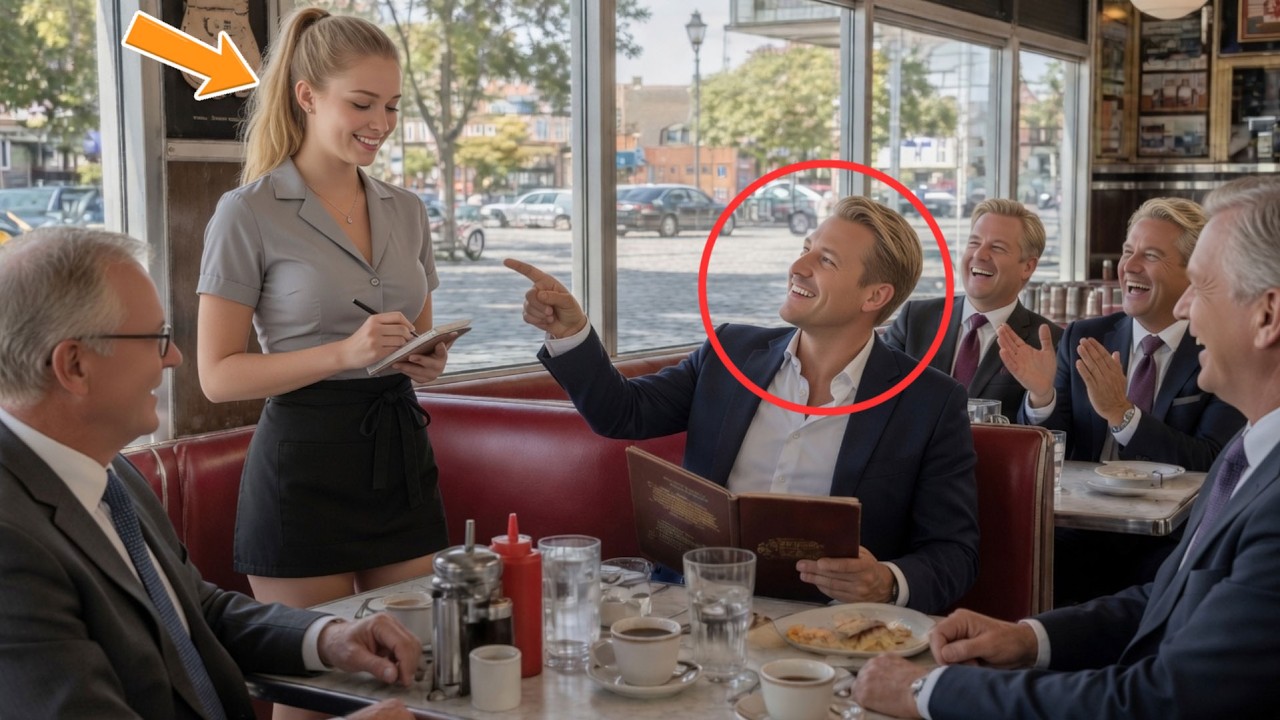
The bill flew across the freshly washed gold mosaic and landed right in front of her knees. A hundred kroner if you serve me in Japanese, Flemming Albertsen said without lifting his eyes from the menu. My partners want to see if anyone in this country can do anything besides wash gold. The three men with him burst out laughing.
The two Japanese businessmen at the other end of the table did not laugh. One of them, the one with the greying hair and the dark grey suit, lowered his eyes to his glass of water. Connie Watanabe did not stand up. She finished washing the last piece of gold mosaic, slowly rolled the mop around its handle, and picked the bill up from the gold.
She folded it four times. She put it in her apron pocket without saying a single word. “Hey, did I ask you something? ” Flemming said, now looking directly at her.
No, she replied quietly. You didn’t ask me anything. And she continued toward the kitchen. So simple.
So quiet. So invisible. The restaurant at Hotel D’Angleterre in Indre By was one of those places where silence costs money. Linen tablecloths with weight, windows facing Kongens Nytorv, as if the world outside were merely decoration.
The kind of place where the waiters smile with the right part of their face, and the guests speak quietly. Not because they have anything private to say, but because they have learned that speaking softly is another way of showing that you belong. Flemming Albertsen came two or three times a month, always with important people, always with the same expression of a man who knows the table is ready before he asks for it. This Tuesday he had a meeting that was, in his own words, worth 380 million dollars.
The company Tanaka Import AS had this year been the bridge between Japan and Europe in the distribution of sake, handmade ceramics, and luxury distillates. Flemming wanted an alliance. For months he had courted Mr. Kenji Tanaka with emails, with invitations, with bottles of wine that arrived in Tokyo with handwritten notes, and now Tanaka had come.
That was already something. What Flemming did not understand—because he had never needed to understand—was that Japanese people observe before they speak, that silence is not discomfort. It is evaluation. Connie knew that.
She had learned it from her grandmother. She was forty-one years old and had worked at the hotel for eight months. Before that she had cleaned offices in Gladsaxe. Before that, a clinic in Valby.
Before that, a fitness centre in Værløse, where the smell of chlorine never left her hair. Always cleaning, always invisible, always with the same pair of white sneakers that she bleached every Sunday with toothpaste, because there wasn’t money to buy new ones. There were evenings when she returned to her room on Nørrebro with aching knees and raw hands from all the cleaning chemicals and sat on the bed without the strength to take off her shoes. But the next day she got up.
She always got up. Her hotel badge said Connie Watanabe – Cleaning Department. No one asked what Watanabe meant. No one had ever asked her mother, either.
Bodil, who worked in reception, had been a nurse at Nørrebro. Her father, Hiroshi Watanabe, had come to Denmark at twenty-six with a suitcase, an already well-thumbed Spanish-Japanese phrasebook, and a quiet conviction that something good was waiting for him in this country. They had been happy together—that discreet kind of happiness that doesn’t need witnesses. Connie remembered the smell of rice, the way he folded the newspaper into perfect rectangles before throwing it out, the letters he wrote to his mother in Osaka every other week in dense, even handwriting.
And she remembered the day he didn’t come home for dinner. She was nine years old. She never heard from him again. “Are you okay?
”
Yes, Connie said, and hung the mop on its hook. The kitchen fell quiet. That small victory of making someone hesitate. Her father had been a quiet man with a restrained smile, who believed that honest work had its own kind of dignity, who believed that good things came slowly, but they came.
He had taught her that. She had spent her whole life trying to believe it. There were six metal lockers, a wooden bench with peeling paint, and a narrow mirror bolted over the sink. It was in this room, on her first day, that she had hung her coat on a hook that still held a yellow post-it note from a previous employee: “Smile.
You are being watched. ” She never took it down. Hiroshi Watanabe was forty when that picture was taken. There was something patient about the way he sat, the way he looked at the camera as if he had all the time in the world.
As if he knew something she didn’t. There was something perverse about not having a concrete date to remember. Her grandmother Yuki had continued to teach her over the phone, by letter, with the sheer stubbornness of an eighty-year-old woman who refused to let her granddaughter lose the only thing that connected this family spread across an ocean. Japanese was her heritage, her father’s voice, the only thing that made her feel like she had a past.
It doesn’t matter what they say, Brand. She picked up the cloth, folded it over the cart, and walked toward the door with normal steps. Twenty minutes later, when she reached the lobby, Ib was standing at his usual place by the main entrance with the posture of a man who had seen too many things happen at this hotel to be surprised by anything. He was the night doorman, a retired navy man with a thick moustache and a soft spot for stray cats and underdogs.
He nodded at her, and she nodded back. That was their whole relationship. That and the fact that he always saved her a piece of the morning’s bread if there was any left. Her archive of things that had no price.
She had a folder. It was thin, dog-eared, hidden in a box under her bed. In it: a photograph of her father on the ferry from Malmö, a letter from her grandmother in Osaka, and a newspaper clipping from 1995 about a Japanese import company that had gone bankrupt. She didn’t know why she kept it.
She only knew that some things you don’t throw away, because they are the only proof you have that something was real. So quickly that Connie almost didn’t see it—like a shadow passing over the water and disappearing before you could be sure you had seen it—the man in the dark grey suit glanced at her. Just once. Just for a second.
But it was enough. She knew that look. She had seen it in her father’s eyes when he thought no one was watching. It was the look of a man who had learned to survive by seeing everything and saying nothing.
At 6:13 PM, when Connie was about to finish her shift, Jens Møller called her over the intercom. “Connie, you’re wanted in the lobby. Guest request. ”
She felt her stomach drop.
Guest requests were never good. They were usually complaints—a smudge on a mirror, a towel left in the wrong place, a bar of soap not replaced. She walked to the lobby with her heart hammering in her chest, ready to apologize for something she hadn’t done. The man in the dark grey suit was standing by the window, looking out at the lights of Kongens Nytorv.
He turned when she approached and gave her a small, formal bow. “Miss Watanabe,” he said. “My name is Kenji Tanaka. I wonder if I might have a word with you.
”
She stopped. Her name. He had said her name. “I don’t understand,” she said slowly.
“Is something wrong with the room? ”
“No, no,” he said quickly. “Please, everything is fine. I just—I wanted to apologize.
For what Mr. Albertsen did earlier. It was not right. You should not have been treated that way.
”
She stared at him. No one had ever apologized to her for anything. Not the guests who threw wet towels on the floor, not the managers who scheduled her shifts at impossible hours, not the men who made jokes about her name. “It’s fine,” she said.
“I’m used to it. ”
“That does not make it acceptable,” Tanaka said. He paused, and something flickered in his eyes. “May I ask you something, Miss Watanabe?
”
“Yes. ”
“Your name. Watanabe. It is a Japanese name.
”
“Yes,” she said. “My father was Japanese. ”
“Was? ”
“He disappeared when I was nine.
I never saw him again. ”
Tanaka was silent for a moment. Then he said, very quietly, “What was his name? ”
“Hiroshi.
Hiroshi Watanabe. ”
The silence stretched between them like a wire pulled taut. Tanaka’s face did not move, but she saw his hands tighten at his sides. “Do you know where he went?
” he asked. “No,” she said. “He just never came home. The police said it was probably an accident.
A drowning, or something. But I never believed them. He wasn’t the type to fall in the water. He was too careful.
”
Tanaka looked at her for a long time. His eyes were the kind that no longer got surprised by anything, but could still recognize when something important had just happened. “Miss Watanabe,” he said, “I think we should talk somewhere more private. ”
They sat in a small café on Nyhavn, away from the hotel, away from the noise.
Tanaka ordered green tea for both of them, and they sat in silence for a long time before he spoke. “You said your father disappeared when you were nine. That was thirty-two years ago. ”
“Yes.
”
“And you never heard from him again. ”
“No. ”
Tanaka took a sip of his tea. “What if I told you that he didn’t choose to leave?
”
“What do you mean? ”
“I mean,” Tanaka said carefully, “that I worked for your father. ”
Connie felt the world tilt. “You—what?
”
“I was a junior accountant at his firm in Tokyo. Tanaka Import AS was my first job. I was twenty-four years old, fresh out of university, and I worshipped the ground your father walked on. He was a good man, Miss Watanabe.
An honest man. And that was his mistake. ”
“I don’t understand. ”
“Your father had discovered something.
A discrepancy. A set of numbers that didn’t add up. He brought it to the attention of his business partners, and they killed him. ”
Connie felt the word land like a physical blow.
Killed him. Killed him. She had spent thirty-two years not knowing what to think, half hoping he had simply started a new life somewhere, half fearing the worst. “Who?
” she managed. “You don’t want to know. ”
“I do,” she said, and her voice was harder than she had ever heard it. “Tell me.
”
Tanaka was silent for a long time. Then he reached into his jacket and pulled out a folded piece of paper, worn at the edges, covered in dense Japanese handwriting. “I knew who you were the moment I saw your name badge,” he said. “I have been waiting for you to come to Japan.
I never thought you would be here, in Copenhagen, working in a hotel. ”
He handed her the paper. She unfolded it with trembling hands. It was a letter, written in Japanese, in her father’s handwriting.
“He wrote this the day before he disappeared,” Tanaka said. “He gave it to me for safekeeping. He told me that if anything happened to him, I was to give it to his wife. But I never found her.
And then you were just… gone. ”
Connie read the letter. It was short. It said:
My darling family.
If you are reading this, I am not coming home. Do not look for me. Do not grieve for me. I have made enemies of powerful men, and this is the price.
Please know that I loved you more than I ever knew how to say. Tell Connie that I think of her every day. Tell her that I am proud of her, and that I know she will grow up to be a woman who changes the world. Tell her I am sorry.
Tell her I am sorry. Tell her I am sorry. Your loving husband and father, Hiroshi. Connie read the letter three times.
Then she folded it carefully and put it in her pocket. “Why are you telling me this now? ” she asked. Tanaka leaned forward.
“Because your father was not the only one who discovered the truth. I have spent thirty-two years gathering evidence. I have it all, Miss Watanabe. The emails, the bank transfers, the contracts.
Everything. But I am a cautious man. I wanted to be sure before I acted. And then, when I saw you today, cleaning that floor, and I saw what that man did to you—I knew I couldn’t stay silent any longer.
”
“You want me to help you expose them. ”
“I want you to come to Japan. I want you to testify. I want you to help me take down the men who murdered your father.
”
Connie looked at him. Her father’s letter felt heavy in her pocket, a weight she had been carrying her whole life without knowing it. “I have a job,” she said. “You have a job cleaning floors in a hotel,” Tanaka said gently.
“Your father did not risk his life so that you could live invisible. ”
She felt the truth of it like a physical ache. She had spent her whole life being invisible, and where had it got her? Nowhere.
She had spent her whole life accepting things she shouldn’t have accepted, and what was the point? “I don’t have a passport,” she said. Tanaka smiled. “Then we will get you one.
”
Three weeks later, Connie Watanabe sat in a small, windowless room in the Tokyo Metropolitan Police headquarters, her hands wrapped around a cup of green tea that had long gone cold. Opposite her sat Detective Yuki Tanaka—no relation to her father, despite the shared surname—and a small, stooped man in an expensive suit who had been introduced to her as the Deputy Commissioner. She was wearing a navy suit she had bought at a department store in Shinjuku. It cost more than she had spent on clothes in the last ten years combined.
But standing here, she could almost hear her father’s voice. Tell Connie I am proud of her. “Miss Watanabe,” the Deputy Commissioner said, “you understand that what you are about to do is very serious. These men are powerful.
They have friends in high places. They have ruined lives before and they will not hesitate to ruin yours. ”
“I understand. ”
“And you understand that we cannot guarantee your safety.
Even with our protection, there is a risk. ”
“I understand. ”
He studied her for a long moment. “Then let us begin.
”
The trial lasted four months. Connie sat through every day of it. She listened as the prosecutor laid out the evidence: the bank transfers, the shell companies, the signed contracts with dates that didn’t match the official record. She listened as Kenji Tanaka testified, his voice steady and clear, telling the court how her father had discovered the fraud, how he had been killed to keep him silent.
She listened as the defense lawyers tried to break her on the stand. They called her a liar, a gold-digger, a woman with a grudge and a made-up story. They showed her photographs of her father’s signature on contracts and asked her if she recognized the handwriting. She said yes.
They asked her if she knew how much money was involved. She said she didn’t. They asked her how she could be sure the letter was real. “Because he was my father,” she said.
“And I would know his voice anywhere. ”
In the end, they were convicted. All of them. Flemming Albertsen was sentenced to twelve years for fraud and money laundering.
His partners got similar sentences. The Japanese executives who had ordered her father’s murder were extradited and tried separately. But the one who got the longest sentence was the one who had actually done it—a man named Jens Møller, her former manager at the hotel, who had been in Flemming’s pocket for years. He had been the one who made sure her father’s disappearance was never investigated.
He had been the one who made sure she never got promoted beyond the cleaning department. He was convicted of being an accessory to murder. He got fifteen years. After it was over, Connie went back to her hotel room in Tokyo.
She sat on the edge of the bed and looked at the small, thin folder on the table in front of her. Her archive of things that had no price. Now it was a folder full of documents, witness statements, and newspaper clippings about the trial. She opened the letter from her father and read it one last time.
Tell Connie I am proud of her. She folded it carefully and put it back in her pocket. She had never felt so tired. Or so free.
On her last night in Tokyo, Kenji Tanaka took her out to dinner. They ate at a small restaurant that served the kind of food her father used to make—rice, fish, pickled vegetables, the simple food of home. They talked about her father, about the man he had been, about the small things she remembered. The way he folded the newspaper.
The way he hummed while he washed the dishes. The way he always left a little bit of his food on his plate, a habit he said he had learned from his own mother. “What will you do now? ” Tanaka asked.
“I don’t know,” she said honestly. “I’ve never been free before. I don’t know what it’s supposed to feel like. ”
Tanaka smiled.
“That’s the best part,” he said. “You get to find out. ”
The next morning, Connie went for a walk in the park near her hotel. It was a beautiful spring morning, the cherry blossoms just starting to fall.
She walked along the path, feeling the sun on her face, breathing in the air that smelled of new grass and fresh earth. She thought about her father, about the letter he had written, about all the years she had spent invisible, just surviving, just getting by. She stopped in the middle of the path and closed her eyes. And for the first time in thirty-two years, she allowed herself to grieve.
For her father. For the life they should have had. For the little girl who had waited at the window every night, watching for a man who was never coming home. A man in a business suit walked past her and accidentally brushed her shoulder.
He apologized, and she opened her eyes. “Sorry,” she said automatically, a reflex from a lifetime of being invisible. “My fault. ”
But she didn’t move aside.
She didn’t lower her eyes. She stood there in the middle of the path, in the middle of a park in Tokyo, and she let the world see her. Her name was Connie Watanabe. Her father had been a good man, and a clever man, and a man who had made enemies of powerful men.
And he had loved her, and he was proud of her. She was not invisible. She had never been invisible. She had just been waiting for the right moment to be seen.
She took a deep breath, and she started walking. The hotel where she worked was not far from the courthouse. It was an old building, built before the war, with a red brick façade and a green copper roof. The manager, a kind woman named Mrs.
Takahashi, had offered her a job as an interpreter, and Connie had accepted. It wasn’t cleaning. It was something better. It was a new start.
When she walked into the lobby, the receptionist looked up and smiled. “Miss Watanabe! You’re early. ”
“I know,” Connie said.
“I wanted to see the place before my shift starts. ”
She took the elevator up to the top floor, where the hotel manager’s office was located. Mrs. Takahashi was waiting for her at the door.
“Connie, there you are. I have someone I’d like you to meet. ”
She stepped aside, and Connie saw him. A man was standing by the window, looking out at the skyline of Tokyo.
He was tall, with broad shoulders and dark hair that was starting to grey at the temples. He turned around when she entered. “Connie,” her father said. She had imagined this moment so many times.
She had imagined screaming at him, crying, throwing things. But now that she was here, all she could do was look at him. He was older. Of course he was older.
He was in his seventies now, with deep lines around his eyes and a stoop in his shoulders. But his eyes were the same. They were the eyes she had seen every day of her childhood. “It was you,” she said slowly.
“You were alive. All this time. ”
“I’m sorry,” he said. “I know I have no right to ask for your forgiveness.
I have spent my whole life trying to do something right, and I have failed at everything I ever loved. ”
“Why? ” she whispered. “Why didn’t you tell me?
”
He looked at her, and she saw that his eyes were wet. “Because I was a coward,” he said. “I was so afraid of what would happen if I went back. I was afraid that if I tried to explain, they would kill you too.
And I could not live with that, Connie. I could not live with losing you the way I lost your mother. ”
“My mother died of a broken heart,” she said. “She never believed you were dead.
She told me to wait, that you would come back. And I waited. I waited for you my whole life. ”
“I know,” he said.
“I know. And I am so, so sorry. ”
They stood there in the silence, the old man and the woman who had once been a little girl, separated by thirty-two years and an ocean of secrets. “I have spent my whole life being invisible,” she said.
“I have spent my whole life believing that I was not worth seeing. Do you know how much that hurts? Do you know what it’s like to grow up feeling like you are nothing? ”
“I am sorry,” he said again.
“Sorry is not enough,” she said. “Sorry will never be enough. ”
She turned and walked out of the office. She didn’t run.
She didn’t cry. She walked down the hall, took the elevator to the ground floor, and walked out of the hotel into the bright morning light. She stood on the street for a long time. The city hummed and bustled around her, and she felt the weight of thirty-two years finally begin to lift.
Her father was alive. He was alive, and he had made his choices, and they had not included her. But that was okay. Because she had made her choices too.
She had chosen to be invisible, to hide from the world, to believe that she was not worth seeing. But that was over now. She looked up at the sky, and for the first time in her life, she let herself feel the pain. She let it wash over her like a wave, and she let it carry her out to sea.
She was Connie Watanabe. She was a survivor. And she was finally ready to live.