Nobody in the village of Himmelbjerg could have imagined, in the spring of 1933, that a widow who could barely feed her daughter was about to save the life of the region’s richest man, without having any idea that he had voluntarily given up his fortune to discover whether true love could still exist for him. For years, Baron Henrik of Valdemar had watched how people smiled at the size of his estate before they smiled at his face. He had been a widower for eight years and had begun to ask himself whether anyone would ever be able to love the man, once he no longer appeared as a wealthy landowner. Not far from there lived Kirsten Jensen, a woman who knew all too well the weight of work, absence, and poverty.
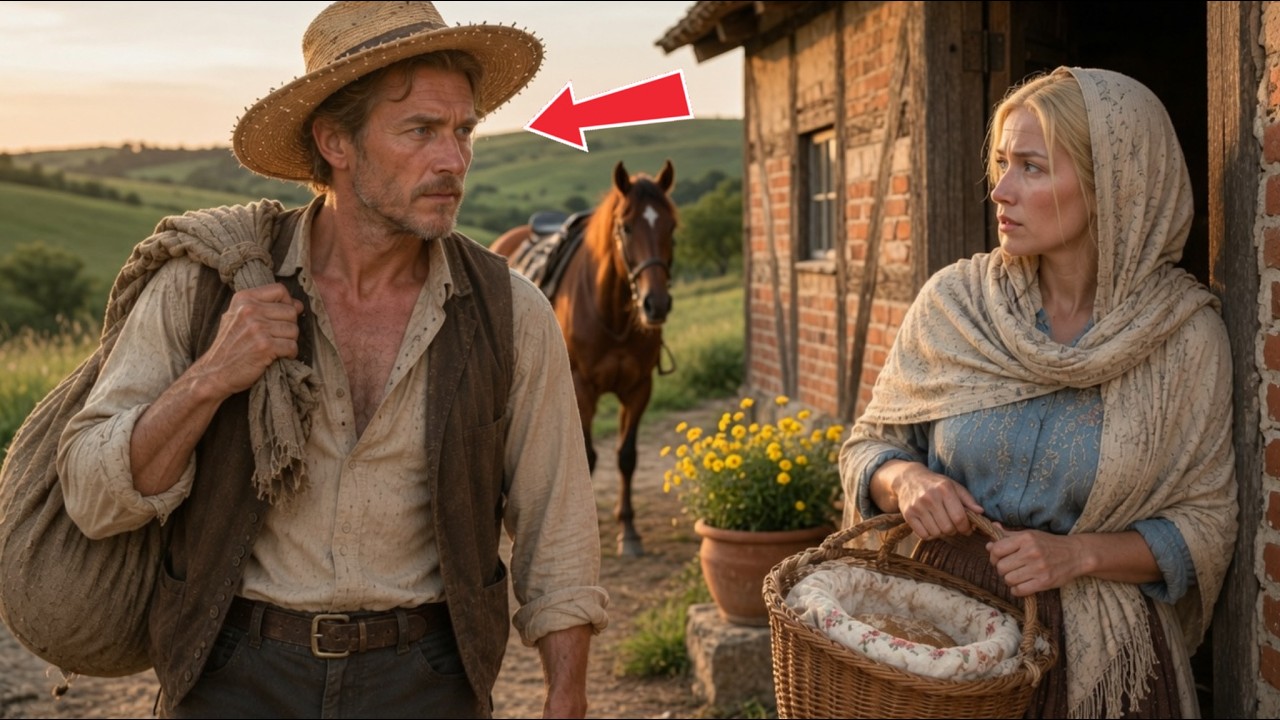
A widow and mother to a young girl, she worked as a seamstress, a baker, and a washerwoman whenever the need arose. A woman who had learned that dignity was worth far more than any coin. She did not know that within hours she would have to make a decision that would change both their lives forever. That very afternoon, she would find a wounded stranger at the bottom of a slope, and she would have to decide whether to help a man who apparently had nothing, even though she herself had almost nothing to offer.
What Kirsten never imagined was that this stranger carried a secret that would test her heart, challenge one of the region’s most powerful men, and forever change the fate of her small family. The sun had not yet fully risen over the hills near the Limfjord when Kirsten Jensen already had her hands in cold water. She was washing the only good shirt her daughter had left. Outside the little house, the air smelled of damp earth from the soil and of burning firewood from the neighbor’s stove.
Kirsten did not lift her eyes from the washbasin. She did not need to. She knew every crack in those hands, every callus that sewing and washing had left on her fingers. And she knew that if she stopped too long to look at them, she would end up feeling sorry for herself.
And she had promised herself she would never allow that. Little Lise was still wrapped in a patched shawl, her cheek resting on her arm, unaware that her mother had been awake for two hours counting how many loaves she would have to sell that week to pay the rent on the small plot of land where three generations of the Jensen family had lived. Kirsten finished the shirt, laid it over a rosemary bush, and stood for a moment looking down the gravel road that led from the village to the fields. That green and golden stretch, extending as far as the eye could see, belonged to the region’s richest man.
A man she had never exchanged a single word with, a man she knew only through what all of Himmelbjerg knew. That he was a widower, that he was fair to his workers, and that no one had seen him truly smile in eight years. Three years had passed since they buried Søren, her husband, who had been crushed by a cart full of stones in an accident the whole village still remembered as one of those tragedies that forever marks a small community. Kirsten had been twenty-seven then, with a four-year-old girl who had barely begun to speak clearly.
There was no time for full mourning. Debt does not wait for a woman to finish crying. She learned to sew better than she already could. She learned to make the grain stretch further in ways her mother had never taught her.
And above all, she learned that no one but herself would keep a roof over her daughter’s head. She went inside, stoked the fire in the hearth, and put water on for a little porridge that would be Lise’s breakfast. While she waited, she took from a small wooden box hidden under her bed the silver thimble that had belonged to her mother, and slipped it onto her index finger, as she did every morning before she began to sew. A quiet ritual that connected her to the two generations of Jensen women who had walked before her in the same house, with the same dignified poverty, the same determination never to bow.
“Good morning, Mother,” said Lise, rubbing her eyes from the shawl where she had been sleeping. “Good morning, my treasure. Come, the porridge will be ready soon. ”
The girl sat by the hearth and watched her mother with the quiet attention that only children possess who have learned far too early to notice when something worries their parents.
“Are you thinking about the rent money again? ”
Kirsten smiled, surprised as always by her daughter’s sharpness. “A little. But you must not worry about it, my girl.
That is a grown-up thing. ”
“When I grow up, I will sew just as fast as you, and we will have the whole rent paid months in advance. ”
“I hope so, my treasure. I hope so.
”
No one in the village imagined that, on that same morning, the same man was about to disappear from his own life. In the main building of the estate, Baron Henrik of Valdemar adjusted a worn shirt in front of the mirror, a shirt that had lain hidden at the bottom of a chest for years, a garment that had belonged to a dead farm worker long ago. He ran his hand over his several-day-old stubble, which he had deliberately allowed to gray, and studied his reflection as if he were studying a stranger. “Are you sure about this, Baron?
” asked Mats from the door, arms crossed, still wearing his coat as if he could somehow stop what he knew was inevitable. “I have never been more certain of anything, Mats,” Henrik replied without turning around. “For eight years I have met women who smile at my fortune before they smile at me. Last week I heard the Olesen family discussing in church which of their daughters had the best chance of making me inherit Løvrig Estate, as if I were a lottery prize.
”
Mats sighed. He had known his baron since he was a newly married, happy young man. Very different from the gray man his wife’s death had left behind. “You think that disguised as a farm worker, you will find what you seek?
”
“I think that if someone ever looks at me without knowing that I own all this, I will know whether there is still anything in me worth looking at. ”
Henrik took the old horse, a work animal he had exchanged that same morning for his stallion, and left the estate by the least traveled road. He left twenty years of managing things and an entire identity locked inside, like a man taking off a coat that was too heavy. He did not yet know that a storm that afternoon would throw him down a slope less than a kilometer from the house of a widow named Kirsten Jensen.
Before leaving, however, Henrik stopped for a moment in front of the portrait of his deceased wife, Ingeborg, which still hung in the main corridor of the big house. It was a woman with a calm gaze, painted by an artist from the capital months before her death. And Henrik, who for years had avoided looking at the portrait closely, allowed himself that morning to stand before it for a long time. “I do not know if this is madness, Ingeborg,” he murmured, as if she could still hear him.
“But for eight years I have been a shadow of the man I was with you. And I do not want to die without knowing whether there is still something in me worth loving, for who I am and not for what I have. ”
The silence of the house was the only answer. But Henrik left with a different resolve, as if those words, spoken aloud, had sealed a pact with himself that he could no longer take back.
Mats caught up with him at the main door with a worn leather bag. “Here is some food for the road, Baron, and some money hidden inside, in case things become more complicated than you imagine. ”
“I will not touch that money, Mats. If I cannot survive like any farm worker in this region, then I do not deserve to call myself a landowner.
”
“With all respect, Baron. You have never had to survive with nothing. You do not know what it means to sleep hungry, or what it means to have doors slammed in your face simply because of the clothes you wear. ”
Henrik stood thoughtful for a moment, struck by the unpleasant truth in his steward’s words.
“Then it is time to learn, Mats. Take care of the estate while I am gone. And if I have not returned in a month, you know what to do with the documents I left in my office. ”
“A month is a long time to wander alone on the roads, Baron.
”
“A month is the least I need to know whether anyone can still love me without knowing who I am. ”
The storm came without warning, as the worst things always do in the Mid-Jutland landscape. The sky, crystal clear blue at noon, suddenly closed with slate-colored clouds. By four in the afternoon, the wind was already tearing leaves from the trees and howling between the stones on the road.
Henrik, who had spent the day asking for work at two neighboring farms without ever giving his true name, pushed the old horse along a narrow path that curved along a slope, searching for shelter before the rain fell with full force. He did not make it. The animal, frightened by a thunderclap that echoed as if it were splitting the hills in two, slipped in the newly formed mud and fell on its side, dragging Henrik with it. The impact was dry.
Henrik felt a sharp pain in his right leg, before the pain spread like fire through the whole limb. He lay stretched out among the stones, soaked through, the horse snorting a few meters away, and the rain falling over his face with a persistence that began to feel like a judgment. A cart passed. The man driving it looked down into the slope, hesitated a moment, and drove on, urging his mules forward.
Two riders passed. One of them, seeing the heap lying among the stones, commented something to his companion that Henrik could not hear, but whose tone left no doubt. It was the indifference of someone who has seen too many fallen farm workers on the roads to stop for one more. Henrik, who for twenty years had been greeted with raised hats by every person he met on his way, understood in that moment, lying in the mud with his leg swelling beneath his worn trousers, what it meant to be nobody.
The rain did not distinguish between landowners and farm workers, but people did. And that afternoon, people had left him alone. The sky was beginning to darken when Kirsten and Lise returned from the village square with an almost empty basket, containing only a little salt and a piece of soap they had managed to buy with the remains of the week’s sales. They walked quickly, trying to outrun the storm, when Lise suddenly stopped.
“Mother, there is a man lying down there. ”
Kirsten followed her daughter’s gaze down into the slope and, in the twilight and the now heavy rain, made out the motionless figure of a man beside a horse grazing nervously nearby. She did not think twice. She went down the slippery path, holding Lise by the hand, and when she reached the man, she saw that he was breathing, that he was conscious but pale, and that his right leg, bent at an unnatural angle, prevented him from moving.
“Can you hear me? ” asked Kirsten, kneeling beside him, ignoring the mud soaking her skirt. Henrik opened his eyes and, through the rain, found a woman’s face looking at him without any calculation, only with the direct concern of someone who sees another human being in danger. “I fell,” he mumbled.
“The horse slipped. ”
“Can you walk? ”
“I do not know. ”
Kirsten wasted no time on more questions.
She looked around, calculated the distance to her house, which was shorter than the distance to any other house in the village, and made a decision she would not ask anyone’s permission for. “Lise, hold the horse’s reins. We are taking him home. ”
The journey was slow and painful.
Henrik leaned on Kirsten’s shoulder, and although she was not a large woman, she carried his weight with surprising strength, hardened by years of carrying sacks of grain and bundles of laundry. Lise walked behind, leading the horse with a seriousness that made Henrik smile despite the pain, because it reminded him of a determination he himself had lost long ago. They arrived at the house when it was already dark. Kirsten placed Henrik on the house’s only bed, a wooden bench with a thin straw mattress, and lit the fire to heat water.
“Mother, does he have to pay to sleep here? ” asked Lise in a low voice, with the direct innocence only children have. “We do not ask that, my girl,” Kirsten answered without taking her eyes off the improvised bandages she was preparing. “When someone is in need, you help first.
Then you think about the rest. ”
Henrik, pretending to have his eyes closed from exhaustion, heard every word and felt something stir in his chest, something he had not felt in years. That night, while the storm still hammered against the roof tiles, Kirsten made a soup with the little she had. A piece of pumpkin, some fragrant herbs, and the last piece of dried meat she had saved for a special occasion.
She fed the wounded man spoonfuls, because the fever had already begun to rise and his hands were shaking. “Thank you,” Henrik said between sips. “You did not have to do this. ”
“No one has to do anything,” Kirsten answered with a simplicity that, at that moment, seemed more valuable to Henrik than any speech he had ever heard as a landowner.
“But you do it anyway. Or is it not worth living in a village like this? ”
Kirsten gave up the bed to Henrik and lay down on the floor beside Lise, wrapped in a thin shawl, listening to the stranger’s labored breathing while the storm outside gradually turned into light rain. She did not ask for his full name.
She did not ask where he came from or where he was going. She only asked, before she put out the light, whether he was cold. Henrik, staring at the rusty roof tiles of a hut he had never in his life set foot in, understood that he had found, without really looking for it, the first answer to the question that had driven him away from his own estate. At some point in the early morning hours, between the light fever and the exhaustion after the fall, Henrik remembered the last time someone had cared for him like that, without conditions.
It had been Ingeborg, months before she died, sitting at his side during a bad flu, holding his hand exactly the same way Kirsten had held his arm when they walked toward the hut. The comparison tightened around his chest, not with pain, but with a kind of quiet wonder at the thought that life, after so long a drought, was still capable of offering him something that resembled selfless care. Near dawn, the fever rose a little more, and Henrik murmured in confused dreams some words that Kirsten, waking from the groaning, did not fully understand, except for a name she thought she heard. Ingeborg.
She asked nothing, simply laid a cool cloth on his forehead and kept vigil until his breathing became calm. At daybreak, when the rain finally stopped completely and the sun began to seep gently through the gray clouds retreating toward the hills, Kirsten went out for a moment to check on the horse, which had spent the night tied under a makeshift shelter. The animal greeted her with a snort. And while she stroked it a little, she asked herself quietly who this man really was, who spoke in his dreams with the name of a woman who was no longer there.
And what story lay behind those tired eyes that had looked at her the evening before, with a gratitude that seemed too deep to belong to just any farm worker grateful for a hot soup. The next morning, when the fever had already subsided, Henrik observed clearly for the first time the hands of the woman who had helped him. They were thin but strong hands, fingertips hardened by needle and thread, with a small scar on the left index finger that spoke of years of sewing late by candlelight. It was not these hands that begged.
These hands built, centimeter by centimeter, a life that no one else sustained. And there was something else Henrik noticed, something that would capture his attention in all the days that followed. The way Kirsten moved through her poor house with a straight back, chin slightly lifted, as if lack had no right to bend her body, even though it had tried for years. The following days passed with that particular slowness that marks a recovery.
Henrik, who had introduced himself to Kirsten simply as Henrik, without a surname, without a story, stayed in the house while his leg healed enough for him to lean on it. Kirsten never asked more than necessary. She fed him, changed his bandages, and when he insisted on paying in some way, she simply said that if he wanted to help, he could carry firewood when he could stand. And with that, any debt was settled.
Henrik, who for twenty years of managing the region’s most prosperous estate had never carried a bundle of firewood, discovered in those days a form of work he did not know. The work of those who have no other options. The work that does not expect recognition, because recognition does not pay the rent. It was the fourth day at dawn when Henrik saw her properly for the first time without her knowing.
Kirsten had gone out before sunrise, as every morning, to bake the bread she would later sell in the village. Henrik, half awake because of the pain in his leg, watched her from the curtainless window. He saw her light the oven with movements she had repeated since childhood. He saw her shake the flour from her hands with an almost mechanical gesture.
He saw her stop for a moment with her eyes closed, taking a deep breath before continuing, like someone gathering strength for a day that promised to be as hard as the one before. There was no visible complaint in her, no self-pity. There was instead a quiet determination that Henrik could not quite name. Something he recognized, because he himself had once had it, before fortune and loneliness had gradually torn it from him.
That day, without either of them saying it aloud, something changed in the way they looked at each other when they exchanged words. A day became a week, and the week became two. Henrik, leaning on an improvised walking stick made from a branch, began to help with what he could. Carrying water from the communal well, repairing the fence around the small enclosure where Kirsten kept two skinny hens, chopping firewood clumsily at first and with increasing skill as time went by.
One afternoon, while Kirsten finished some urgent sewing for a neighbor, Henrik found Lise sitting alone in the yard, drawing clumsy figures in the loose soil with a stick. “What are you doing? ” he asked, sitting carefully beside her, still protecting his healing leg. “I am trying to write my name.
The village schoolteacher left last year, and no one teaches letters anymore. My mother knows some, but she does not have time to teach me. ”
Henrik felt a pang of indignation hearing that, because on his estate, only a few kilometers away, there was a small library that no one had used since his wife’s death, and dozens of children in situations like Lise’s who had never had the chance to learn to read. “I can write quite well,” he said, taking the stick from the girl’s hands.
“Would you like me to teach you while I am here? ”
Lise’s eyes lit up in a way Henrik would never forget. “Really? Really?
”
“Let us start with your name. ”
In the following afternoons, while Henrik’s leg healed, it became a habit for him and Lise to sit together in the yard, drawing letters in the soil with a stick, and then on a piece of brown paper that Henrik obtained in the village, until the girl could write her full name, and then her mother’s name, with a clumsy but proud hand. Kirsten, watching from the window during those afternoons while she sewed, felt something move deep in her chest. To see that patience, how a man without any obligation to do so spent whole hours teaching a child who was not his own to read.
No other man, not even Søren, in all their years of marriage, had ever spent that kind of time with Lise. And this silent, constant observation built in Kirsten a trust that no number of years could have built with the same force. “One day I will be able to read whole books, like the ones they say exist in the big estates,” Lise said one afternoon, with that absolute determination children who do not yet know limits possess. “One day you will read all the books you want, Lise.
I promise you. ”
Lise, who had at first looked at him with the natural mistrust children have of strangers, ended up adopting him as if he were part of the family. She showed him the stones she collected in the yard, told him stories she invented along the way. And one afternoon, without warning, she took his hand while they walked toward the well and did not let go.
“Where do you come from? ” the girl asked one afternoon, while he carved a wooden figurine with an old knife, a little horse for her. “You are always sad. ”
Henrik paused, surprised by the directness of the question.
“I am not always sad, Lise. ”
“Yes, you are. I can see it in your eyes when you think no one is looking.
”
The girl returned to her drawing, unaware of the weight of what she had just said, while Henrik felt that this seven-