The words “gross misconduct” hung in the stale, air-conditioned air of the D. C. Superior Court. They weren’t just words.
They were an explosion, a tactical detonation. The noise of the room, the rustling papers, the distant traffic, all of it vanished, replaced by a sharp, unrelenting ringing in my ears. I had trained for pressure. I had worked under fire, fixed disorder, and executed the mission.
But this wasn’t a combat theater in some hostile country. This was a courtroom in Washington, D. C. And the person orchestrating the attack, feeding the information and the ammunition, was my own father.
Richard Cole, my father’s personal attorney, paced the courtroom, his expensive Italian leather shoes squeaking on the polished floor. A caricature of a powerful lawyer, from his carefully styled silver hair to his Savile Row suit. That suit probably cost more than my first car. He pointed at me with a theatrical gesture.
“This is not a matter of misjudgment, Your Honor. This is a fundamental character flaw, a disregard for rules and regulations that jeopardizes everything she touches. ”
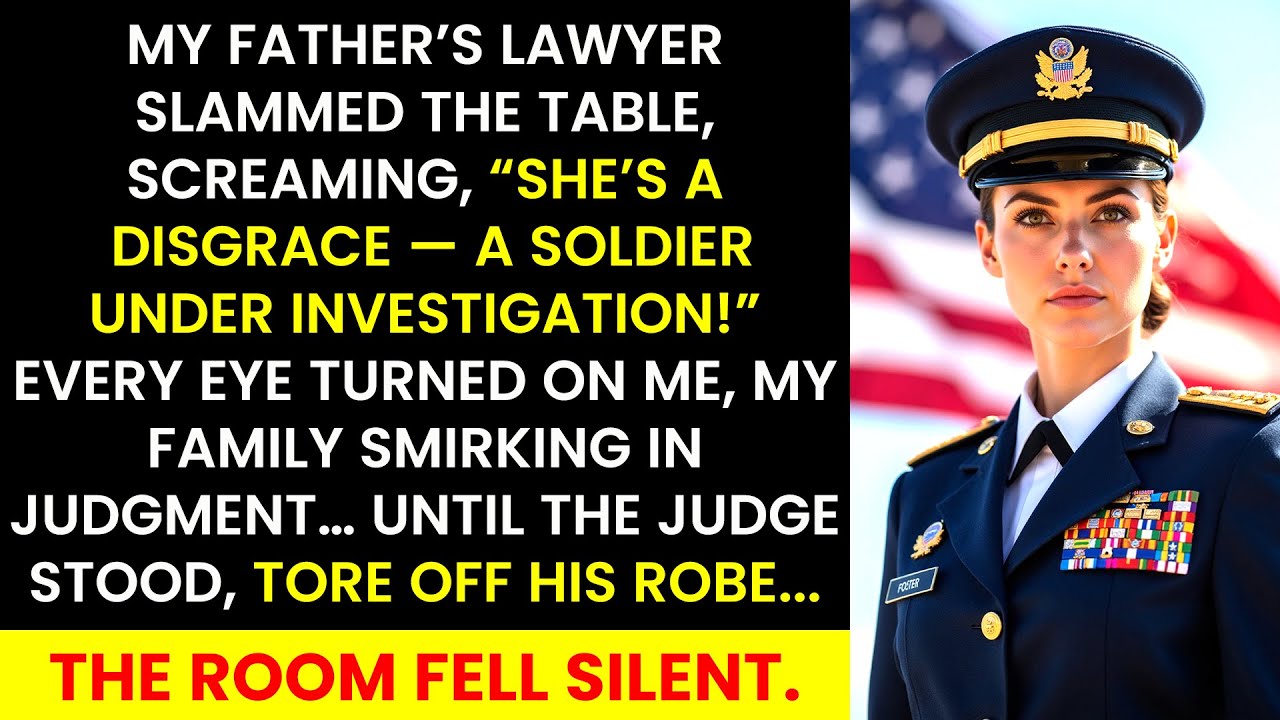
I stood at attention, my hands clasped behind my back. My dress uniform felt like a second skin.
The dark blue coat, the gleaming brass buttons, the ribbons on my chest, they were a silent testament to years of service. A shield built on honor. And they were trying to portray it as the costume of a failure. My father wasn’t just trying to win the ownership of my mother’s lake house.
He was trying to win a decades-long argument. In a public forum, he was finally trying to prove to the world, and to himself, that my entire life had been a catastrophic mistake. That I was a failure. I glanced instinctively at my father.
Robert Foster sat at the plaintiff’s table, the very picture of aristocratic calm. He wore a mask of intellectual coldness that revealed nothing, the same face he’d worn my whole life whenever my world didn’t align with his expectations. I flashed back to the moment I told him about the CID investigation. I went to his book-filled office in his Georgetown brownstone, hoping for a sliver of paternal support, maybe even legal advice.
He listened, his fingers steepled under his chin. When I finished, he didn’t ask if I was okay. He leaned forward and said, his voice a sharp whisper, “What did you do to embarrass this family? ”
My older brother Mark sat beside him now.
Our eyes met for a fleeting moment before he looked away, shaking his head with a practiced sigh of disappointment. Mark, the golden child, the Wall Street hedge fund vice president. He was part of the prosecution team. He and my father were a united front, a fortress built on shared values of wealth and status.
I was on the outside, a soldier defending borders they refused to acknowledge. I forced my gaze away from their toxic disapproval and focused on the only man who mattered in the room: Judge Donovan. He was elderly, in his late seventies, with white hair and calm, intelligent eyes that seemed to miss nothing. He never interrupted Cole’s tirade.
He just watched me, his expression unreadable. He’s assessing me, I thought. Watching the target under pressure. Waiting to see if I’ll break.
Well, I’d stood before three-star generals in the Pentagon and defended billion-dollar strategic operations. I wasn’t about to let a screaming civilian lawyer in a nice suit rattle me. I straightened my posture, my spine rigid, chin high. It was a formal stance of respect, but also of defiance.
A silent declaration that I would not waver. When Cole finally finished and returned to his seat, a heavy silence fell over the courtroom. My father allowed himself a small, triumphant smile. Then Judge Donovan leaned back in his high-backed leather chair.
He looked from Cole to my father, and then his eyes settled on me again. Slowly, deliberately, he reached up and unbuttoned the collar of his black judicial robe. The room held its breath. With one smooth motion, he removed the heavy robe and let it fall over the back of his chair.
Pinned to his starched white shirt was a single, gleaming silver star. The rank insignia of a retired Brigadier General in the United States Army. My breath caught in my throat. My father’s jaw, the picture of overconfidence moments before, went slack.
Mark’s eyes widened in shock. Richard Cole’s face turned a sickly pale. Judge Donovan looked at me directly, not as a judge addressing a defendant, but as an officer addressing an officer. His voice wasn’t loud, but it filled every corner of the room with an undeniable authority.
“Captain,” he said, his gaze steady. “This court will address you with the respect befitting your uniform. ” He raised his gavel, and the sharp, decisive crack echoed through the silent chamber. “This court is adjourned.
”
In the car on the way back to my small apartment in Arlington, crossing Memorial Bridge, I wondered why I still felt surprised. My father’s contempt wasn’t some new weapon unveiled at today’s hearing. It was an ancient monument, a landmark in our family’s history. Its foundations had been laid long ago, brick by brick, in the stifling silence of my childhood home, a classic Federal-style brick house on a cobblestone street in Georgetown.
But inside, behind that glossy black door, the atmosphere was always thin, tense. The most vivid memories were of Sunday dinners. A mandatory ritual. My father, Robert, always sat at the head of the table, presiding over our affairs.
He didn’t ask about our days; he lectured to us. His monologues were an unbroken stream of legal theories, political commentary, and immutable laws of success as defined by him. There was no room for defense. My mother, Ellen, before her illness, was the silent diplomat.
She sat at the other end of the table, a gentle buffer against his harshness. I remember her wringing a linen napkin in her lap, her smile forced. “Robert, dear, don’t be so hard on her,” she’d whisper, barely audible, after he’d dissected a minor failure of mine. A “very good” on a history paper, a moment of hesitation in a school debate.
My father would wave his hand dismissively. “Ellen, she needs to be tough,” he’d say, without even looking at me. “The real world has no place for sensitivity. ” For him, sensitivity was a terminal diagnosis.
Then there was Mark. He was never the subject of those lectures because he was the standard my father had always wanted. Mark was the benchmark I was constantly measured against, and found wanting. He went to Harvard Law, just like my father.
He got a job on Wall Street. Every one of his achievements was treated like a royal decree. When he became a junior partner, my father opened a bottle of Dom Pérignon. He celebrated Mark’s killer instinct.
A few years later, when I called home to announce my first command, a signal company of over a hundred soldiers, my father’s only reply was, “Does the pay improve? ”
In his eyes, my career in the U. S. Army was a strange, prolonged hobby.
It was a rebellious phase I was supposed to grow out of. The most painful memory, the one I could trace like a scar, was from my graduation at West Point. When we threw our caps into the sky, I felt like I had finally accomplished something so important that even my father would have to acknowledge it. That night, my family went to an obscenely expensive restaurant in Manhattan.
I sat there in my dress uniform, my collar a source of comfort. My father barely said a word about the graduation, about the commission, about the oath I swore. Instead, he regaled his guests, his business partners, with stories of Mark’s latest triumph. Mark had just closed a multi-million dollar deal.
I sat there, a captain in the U. S. Army, feeling utterly invisible. It didn’t matter what I did.
I could win a war single-handedly, and my father would only ask if it increased the family’s wealth. My mother was the only one who truly saw me. Before she died of cancer, she did something quiet and radical. She secretly amended her will, leaving me the sole guardian of her small, peaceful lake house in Virginia.
It was our place, our sanctuary. It held the only happy memories of my childhood. Now, my father was trying to rip the last piece of her from me. As I drove on, the truth crystallized into a single, painful thought.
This lawsuit wasn’t about property, or money. My father was suing me for the one crime he would never forgive. He was suing me because I wasn’t Mark. The next morning, at five a.
m. sharp, I was driving through the pre-dawn quiet on the Baltimore-Washington Parkway on my way to Fort Meade, Maryland. I was entering my world now. A world of orders, clarity, and consequences.
My office is a Sensitive Compartmented Information Facility. No windows. The air is always chilled to a precise temperature to keep the servers from overheating. The only light comes from the cold blue glow of hundreds of screens.
It’s the new front line, the digital battlefield of the 21st century, and I am a commander here. I lead a team of what we call hunters in cyberspace. My mission is to find the weak spots in our system. To find the digital fingerprints of foreign intelligence agencies, terrorist cells, and state-sponsored hacking groups trying to breach our networks and steal our secrets.
The responsibility is enormous. But it’s also clear. It’s inevitable. In my world, there are threats and countermeasures.
No room for emotional manipulation. Here, my worth is measured by my performance. I began my morning threat assessment, and an email notification popped up on my secondary screen. The subject line was simply “Congratulations.
” It was from Mark. Attached was a link to a Forbes article highlighting his hedge fund’s record performance. I clicked it open, and my brother’s face filled the screen. “Golden boy Mark Foster does it again,” the headline read.
“Great, Mark,” I muttered to the sterile air. “You use algorithms to make the rich richer. I use them to stop our nation’s enemies from stealing the plans for a next-generation fighter jet. ” The irony was familiar and painful.
It reminded me of a video call we’d had a few months ago. He’d called from his new Porsche. “So, Al, still playing those video games for the government? When are you going to get a real job?
” I stared at his face, speechless. A real job. As if protecting our national defense infrastructure was less real than trading stocks. An analyst on my team, Sergeant Diaz, flagged an anomaly.
“Ma’am, I’ve got a signal. Looks like a phishing attempt against the Pentagon’s logistics network. Very sophisticated. ” My pulse quickened.
The hunt was on. For the next few hours, the outside world ceased to exist. My team and I were locked in. The intrusion was more than just sophisticated.
It was elegant, precise. We recognized the signature of a highly aggressive foreign adversary. “They’re trying to brute-force a secure server,” Diaz said, her voice tight with focus. “They’ll be locked out in 90 seconds.
” “No,” I ordered, my voice sharp. “Don’t lock them out. I want to see where they go. Route them to the Zulu trap.
” We gave them the illusion of success. For the next 48 hours, we barely slept. We tracked them as they delved deeper into our digital labyrinth. We analyzed their tools, mapped their network, and built a complete intelligence picture.
Then, I gave the order. We didn’t just kick them out. We dismantled their entire operation from the inside out. When it was over, my commanding officer, a no-nonsense colonel, came down to the SCIF.
He reviewed the after-action report, then looked at me and gave a sharp nod. “Good work, Captain. ”
In our world, that single nod was a medal. It was real, and it was earned.
That evening, I drove back to my quiet, empty apartment in Arlington. I took a frozen lasagna from the freezer and microwaved it. As I sat on my couch eating that bland meal from its plastic container, I thought, I just helped neutralize a multi-million dollar cyberattack on the Department of Defense, and no one outside that closed room will ever know. I won’t be in the news.
I turned on the TV for some background noise, and there he was. Mark, being interviewed live on CNBC. He was talking about market volatility, looking sharp and powerful. The irony was suffocating.
I spend my life in the shadows, defending the very system of American capitalism that enabled my brother to become a famous millionaire. And he describes what I do as playing video games. The loneliness was heavy that night. But then I remembered I wasn’t entirely alone.
I had Sarah. That Saturday, I drove to Arlington National Cemetery. I didn’t go to my mother’s grave. After her death, my father had erected a grandiose marble monument there, with the Foster name emblazoned in large, bold letters.
It felt less like a memorial to her and more like another plaque announcing his legacy. Instead, I went to Section 60. This part of the cemetery is different. It’s newer, simpler.
It’s the final resting place of the men and women who fell in Iraq and Afghanistan. I walked the familiar path to the grave of Colonel Jim DeMarco, my former commander. He was killed by an IED in Kandahar three years ago. As I expected, Sarah DeMarco was already there.
She was kneeling on the grass, carefully placing a single perfect red rose in the small vase attached to the headstone. She must have heard my footsteps, because she looked up and her face broke into a warm, genuine smile. She stood and opened her arms. I stepped into her embrace, and for the first time in a long time, I felt safe.
She hugged me tight, a hug that was not hesitant or formal. “Alexa, you’re here,” she whispered into my hair. She pulled back slightly, her hands on my shoulders. “You look exhausted, sweetheart.
” It was a simple sentence, but it almost broke me in that moment. There was no judgment, no questions about the lawsuit. Just pure, maternal concern. In that moment, I felt more understood than I ever had with my own family.
“Come on,” she said in a tone that brooked no argument. “You’re coming home with me for dinner. I won’t take no for an answer. ”
Sarah’s house was a modest but warm colonial in a quiet Arlington neighborhood.
As soon as I walked in, the warm, savory smell of roast chicken and rosemary washed over me. The scent of comfort and care. Her kitchen was the heart of the home, a little cluttered with photos of Jim and their sons on the fridge. It was a place that pulsed with life and love.
We sat at her small kitchen table for hours. I talked, and she listened. I told her about the courtroom, the smug look on my father’s face, the cruelty of Richard Cole’s words. The wall I had carefully built around myself, the discipline that kept me standing emotionless in court, finally began to crumble.
I hadn’t shed a single tear in front of my father or the judge. But here, in the safety of Sarah’s kitchen, the tears I’d held back for so long finally came. Silent and hot, they traced paths down my cheeks. “I just don’t understand why he hates me so much, Sarah,” I whispered, my words choked.
“What did I do that was so wrong? ”
Sarah reached across the table and took my hands in hers. She looked at me directly. “Don’t you think for one moment that this is about you, Alexa.
This isn’t hate. It’s a flaw in him, not in you. And you have no idea how proud Jim was of you. ” My breath caught.
“He talked about you all the time,” she continued softly. “He once said to me, ‘Alexa Foster is the moral compass of that unit. She’s our true north. When things get chaotic and mixed up, all you have to do is look at what Foster does, and you’ll know what’s right.
‘ Our true north. ”
The words hit me like a physical blow, but it was a healing blow. It was an affirmation. Everything I’d been fighting for my entire life, given to me in the quiet kitchen of a fallen hero’s widow.
Those simple words meant more to me than all of my brother’s hedge fund money. They were a compass, pointing me back to myself. But there was a bitter, painful irony I couldn’t escape. That decision, the one I knew Colonel DeMarco would have been proud of, was the same one my father and his lawyer were publicly labeling as gross misconduct.
It happened six months ago. The operation was codenamed “Night Circle. ” For weeks, my team had been tracking a highly skilled cell of foreign military hackers. They were ghosts, precise, disciplined.
They’d already breached two small defense contractor networks, and we knew they were aiming for a much bigger target: the main supply network for all U. S. forces in the Pacific theater. They were too good to catch with conventional defenses.
They anticipated every move, every firewall. So, I made a command decision. The only way to catch them was to let them win. It wasn’t misconduct.
I made the difficult, risky choice to deliberately violate a minor security protocol. I created a vulnerability, a flaw in our system that would look like a major blunder to hackers of their caliber. It was an irresistible target. The cheese in the trap.
And they took the bait. But the goal wasn’t to stop them immediately. It was to let them believe they were succeeding. For 72 straight hours, my team and I lived in that SCIF, watching them, tracking them, mapping their every move as they explored our honey pot.
We collected their tools, their methods, their entire network. When they realized they’d been caught in a trap, it was too late. The intelligence we gathered reportedly led to the rescue of at least three field agents who were about to be compromised. It was an undeniable, massive win for U.
S. Cyber Command. But in the military, there are rules. Any breach of protocol, even an intentional strategic one, automatically triggers a formal CID investigation.
It’s a routine, non-negotiable administrative procedure. It was an investigation I knew was coming, and I fully expected it to conclude with my name being cleared. The problem was timing. The investigation was officially on record, but the final report clearing me hadn’t been published yet.
And somehow, through the well-connected and morally flexible channels of the D. C. legal world, Richard Cole got wind of that crucial piece of information. “Captain Foster is under investigation by the CID.
”
I remembered the day I learned they knew. I went to my father’s law office on K Street. I stood before his massive mahogany desk, feeling like a child. “Dad,” I began, trying to keep my voice steady.
“I know what Cole is planning to do with this CID thing. You have to understand, it’s just a formality. It’s an administrative investigation. I had everything under control.
The mission was a success. ”
Robert Foster leaned back in his leather chair, a condescending smirk on his face. “Just a formality? ” he drawled.
“Don’t be naive, Alexa. In the real world, my world, the accusation is the conviction. The phrase ‘under investigation’ is synonymous with ‘guilty. ‘ Perception is reality.
” He leaned forward, his voice dropping to a poisonous growl. “You have embarrassed this family. The Foster name has been built on an unblemished reputation of integrity and success for three generations. What am I supposed to say to my partners?
To my friends at the Metropolitan Club? Oh yes, my daughter, the Army officer, is under investigation by military police. Do you have any idea how that sounds? ”
I stood there, speechless, the blood draining from my face.
He wasn’t listening. He didn’t care about the truth, about the agents I’d saved. All he cared about was the public image, how my service and sacrifice would reflect on him. He walked over to the window, surveying the city as if it were his.
“You chose this path, Alexa. This military adventure. I told you it was a mistake. ” He turned to face me, his eyes cold and hard as stone.
“You’ve been a deep disappointment, and you always will be. ”
His final word, “disappointment,” was more cutting than any insult that had come before. It was a verdict, delivered with the cold, firm finality of a gavel. The final blow didn’t come from my father.
It came from his proxy, his perfect soldier. A week later, my phone rang, and my brother’s name appeared on the screen. “Listen, Al,” he began, his voice carrying that smooth, condescending tone he used when explaining something he assumed was beyond my simple understanding. “I’m trying to help you.
Dad is furious. This lawsuit is bad for the family’s reputation, and frankly, it’s becoming a distraction. We’ll pay you the fair market value for the lake house, in cash. In exchange, you drop the case and deal with your little CID problem quietly.
” Then came the words that broke everything. “Don’t be so selfish, Al. It’s just a house. Think about the family’s reputation.
”
Selfish? The word exploded in my mind. I had just voluntarily stepped into the line of fire on a covert mission, risking my career and reputation to protect national security, and he dared to call me selfish for wanting to keep the only thing my mother had left me? The puzzle pieces finally came together.
They were trying to destroy my honor, that thing built on service and sacrifice, to protect their reputation, something based on money and status. That was it. The soldier’s discipline I’d been trained to maintain, to absorb enemy fire, suddenly received a new set of orders from the core of my being. A counter-attack.
I didn’t scream. I didn’t cry. Instead, I did the one thing they would never expect. I hung up on him.
I simply pressed the red icon on the screen, cutting him off mid-sentence. A strange, cold calm washed over me. The pain vanished, replaced by something harder, sharper. It was the icy resolve of a commander who had just made an irreversible decision.
They had miscalculated. They saw me as the black sheep of the family. They were about to learn that in the U. S.
Army, we don’t raise sheep. We train wolves. I went to my desk and started scrolling through my contacts. I bypassed my personal phone book and went straight to my encrypted military contacts.
My finger stopped on a name. I hit the call button. It rang twice before a clear, professional voice answered. “Major Ortiz?
” I said, my voice steady. “This is Captain Foster. I need your help. ”
Major Lena Ortiz was a sharp-tongued JAG lawyer known for her fierce intellect and loyalty.
We met at a bustling Starbucks in Tysons Corner. “Captain Foster,” she began directly. “You know I can’t represent you in a civilian court. My authority ends at the gates of Fort Belvoir.
” “I know, Major,” I said, leaning forward. “I don’t need representation. I need intelligence. I need your help declassifying a very specific part of a document.
” I slid a piece of paper across the table with one sentence written on it: Operation Night Circle. “I need the executive summary of the commendation report. The conclusion. The part that proves the subsequent CID investigation was purely procedural and resulted in my exoneration.
I need it to introduce as evidence in court. ”
Ortiz’s eyebrows rose. “Foster, that’s a hell of an ask. You’re asking me to kick up a hornet’s nest with Cyber Command.
It could take months. ” “I don’t have months,” I said simply. “The next hearing is in a week. ” She stared at me for a moment, then a slow, determined smile spread across her lips.
“Alright. It’s a long shot, but let me see what I can do. I know some people who owe me favors. ”
Then I told her the second phase of my plan.
“I’ve already filed a motion for a change of venue. I’m asking to move the case to Arlington County District Court. ” Ortiz frowned. “Why?
D. C. is where your father filed. It’s his home turf.
” I replied, “Exactly. His lawyer, Richard Cole, is arrogant. He’s a D. C.
insider. He expects a senior judge and assumes he can win by intimidation and sheer spending. He sees an older judge on the bench and assumes he’s just a local figure. But I’ve seen Judge Donovan’s military record.
Three years ago, he was the commanding general at Fort Belvoir. He’s the one who signed the operational orders for Night Circle. ”
Ortiz’s smile widened as she caught on. “Captain.
You really are a cyber warfare officer. You didn’t just build a defense. You laid a trap. ”
Despite the plan, the days leading up to the hearing were torment.
The night before, I couldn’t sleep. I lay in bed staring at the ceiling as a thousand catastrophic scenarios raced through my mind. At 3 a. m.
, I gave up. I drove to the empty city. I parked near the National Mall and walked through the cold, damp air toward the Lincoln Memorial. I climbed the marble steps alone.
Standing before the great monument, I read the words etched into the stone to my left. The words of the Gettysburg Address. I remembered Colonel Jim DeMarco, lying in his grave just across the river. I remembered the soldiers I’d served with.
I remembered the oath I took at West Point. My father was fighting for a house, for money, for a false prize of reputation. He was fighting for material things. I was fighting for something entirely different.
I was fighting for my honor. And as I stood there, my resolve solidified like steel. I would not let the sacrifice of men like Jim DeMarco be cheapened. I would not let my service be judged by my father’s petty ambitions.
The doubt faded, replaced by a cold, clear certainty. I knew what I had to do. The following day, I walked into the Arlington County Courthouse. This time, I didn’t enter as a defendant bracing for a shock.
I entered as an officer ready to present the facts. Richard Cole, oblivious to the change in atmosphere, stood before the bench, radiating the same overconfidence. He launched into his prepared attack. “Your Honor, today we will present additional evidence that shows a pattern of reckless behavior by Captain Foster, proving conclusively that she is unfit…
”
“Enough, Counselor. ” Judge Donovan’s voice wasn’t loud, but it cut through Cole’s words like a laser. Cole froze mid-sentence, his mouth slightly open. Judge Donovan then turned his calm, assessing gaze from the stammering lawyer to me.
“Captain Foster,” he said, his tone steady and direct. “Mr. Cole has made very serious accusations regarding a CID investigation. Do you have anything you wish to present on this matter?
”
All eyes in the room swiveled to me. Across the room, I saw my father lean back slightly, a small, condescending smile on his lips. This was the moment he’d been waiting for. The moment the little soldier girl would try to defend herself and get tangled up in her own words.
I looked directly at the judge, my posture steady. “Yes, Your Honor, I do,” I said, my voice clear and firm. “At this time, I’d like to submit this document as evidence. ”
The doors of the courtroom at the back of the room opened.
Major Lena Ortiz stood for a moment, silhouetted, before stepping inside, immaculate in her dress uniform. She walked with confident, measured steps down the center aisle, carrying a sealed brown envelope. She ignored me and my father, her focus entirely on the court clerk, to whom she handed the envelope. “This, Your Honor,” I announced, “is the partially declassified executive summary and commendation memorandum directly pertaining to the investigation Mr.
Cole has referred to with such enthusiasm. ”
The change in the room was immediate. Richard Cole’s face, flushed with aggressive confidence moments before, turned a sickly white. My father’s smirk vanished, replaced by a flash of confusion, then panic.
The trap had been sprung. Judge Donovan took the envelope, broke the official seal, and removed the single-page document. He put on his reading glasses and began to read, his expression unwavering. After what felt like an eternity, he raised his head, his eyes settling on Richard Cole.
“Counselor,” the judge said in a dangerously quiet voice. “This document is classified Top Secret, not intended for foreign nationals. Were you, at any point, briefed with the necessary security clearance to access the details of this military investigation? ” Cole stammered.
“Well, no, Your Honor, but the existence of the investigation is a public matter. ” “That was not my question,” Donovan cut him off, his voice turning to ice. The answer is no. So, Counselor, I suggest you stay quiet about matters you know nothing about before you find yourself in violation of federal law.
Cole collapsed into his chair as if he’d been punched. Judge Donovan then turned his full attention to me. There was a glint of something in his eyes, not a smile, but a shared understanding. “Captain Foster,” he said, in a tone of formal respect.
“The last time I saw your name, it was in a commendation summary that landed on my desk following Operation Night Circle. ” My father’s head snapped up. Mark stared, his mouth agape. Judge Donovan handed the document to his clerk.
“For the record, please read the final paragraph. ” The clerk began to read. Her clear voice filled the silent courtroom. “For her exceptional conduct in the performance of distinguished service to the United States, Captain Alexa Foster demonstrated decisive leadership and tactical brilliance under extreme pressure.
Her unconventional and courageous command decision directly led to the complete neutralization of a serious threat to national security. In light of these findings, it is recommended that the procedural CID investigation be closed immediately with the highest commendation possible. ”
The silence that followed was profound. I turned my head slowly and looked at my father.
The blood had drained from his face, leaving it ashen gray. His lips were trembling, and his eyes were wide with pure shock. He stared at me as if he were seeing a stranger. He leaned forward a little, and in a hoarse, choked whisper, audible in the dead silence, he asked a question not meant for the court, but for himself.
“You… you’re the one they called Foster? ”
I rose slowly to my full height, my posture perfect. I looked at the man who was my father, but I addressed my answer to the officer who had once signed my mission orders.
“Your Honor,” I said, my voice quiet but firm. “I always have been. ” Judge Donovan nodded once, a gesture of finality. Then he brought down his mallet once more.
“This case is dismissed with prejudice. ”
As I left the courtroom, a strange emptiness washed over me. No surge of victory, no desire to celebrate. I just felt tired.
A complete, total exhaustion. And beneath the fatigue, a new feeling was taking root. Freedom. Freedom from the weight of trying to constantly prove myself.
My father had already left, his silent lawyer in tow. He didn’t say a word. But my brother, Mark, was waiting for me in the hallway. He looked lost, all his usual Wall Street confidence gone.
“Al,” he began, his voice uncertain. “Al, I… I don’t know… ” I raised my hand, stopping him.
My gaze was steady, my voice empty of anger. “Don’t, Mark,” I said simply. I walked past him, leaving him standing alone in the echoing marble corridor. A month later, an official letter from the Pentagon arrived.
It confirmed the CID investigation was formally closed and that, following a review of the Night Circle operation, I was to be awarded the Distinguished Service Medal for my leadership. I read the letter twice, then placed it on my kitchen table. It felt like a confirmation of a truth I’d already found for myself. The real celebration came that weekend.
Sarah DeMarco insisted. She threw me a small party at her house. No powerful guests or expensive champagne. Just a few close friends, other military spouses, some officers from my unit, and Major Ortiz.
We had a barbecue in her backyard, grilling burgers and drinking cheap beer. For the first time, I felt the warmth of genuine, unconditional pride from the people around me. This was my family. The one I chose, and which chose me back.
A few weeks later, Mark called again. His voice was different this time. The arrogance was gone, replaced by a hesitant, strained tone I’d never heard from him before. “Al, it’s about Dad.
He’s not doing well. He hasn’t left the house since the hearing. He won’t talk to anyone. I thought maybe if you called him, you could talk to him.
” I closed my eyes and took a slow, deep breath. A year ago, this call would have been used as a weapon against me. But I was not the same person. “Mark,” I said in a calm, steady, and firm voice.
“This isn’t your problem to solve, and it’s not mine. It’s his. Don’t call me about this again. ” I ended the call.
The boundary was drawn. That evening, I was having coffee with Sarah, and I told her about the call. She listened patiently, then asked gently, “Do you think you’ll ever forgive them? ” I stared at my coffee cup.
“I know,” I admitted, the words tasting strange and honest. “Forgiveness doesn’t mean forgetting, Sarah. It doesn’t mean erasing the damage. And it certainly doesn’t mean giving them a chance to do it all over again.
Right now, I just want peace. ” Peace. That was what I was looking for. Not victory, not revenge, not even forgiveness.
Just a quiet place to breathe. A year passed. Today, I am Major Alexa Foster. I stand in a sterile, windowless classroom at Fort Meade, not as a hunter, but as an instructor.
Seated in front of me is a group of new captains, their faces young and eager. I’m teaching a course on advanced network defense strategies, but today’s lesson is about something less tangible. “Your work isn’t just about coding and countermeasures,” I tell them, my voice calm and confident. “It’s about the integrity of the person using them.
In the fog of digital war, where data is deceptive and the enemy is faceless, technology will fail you. Your mind may fail you. The only thing that won’t fail you is your integrity. Your primary duty is to be the moral compass when all others are spinning.
” In that moment, I realize that Colonel DeMarco’s legacy, his belief in the true north, has been passed on to me. And now, it’s my legacy to share. I kept my mother’s lake house. I go there most weekends.
It’s my sanctuary. I spend hours on the wide wooden deck overlooking the water, doing nothing but drinking sweet tea and watching the sun dance on the gentle ripples. The house is full of my mother’s memories, but it’s no longer a place of sorrow. It’s a place of profound peace.
It’s mine because I finally started to believe I deserved the peace it offers. Life now has a quiet, comfortable rhythm. But the past doesn’t simply disappear. It just loses its power.
One evening, my phone buzzed. The name on the screen made me hold my breath. It was my father. The first message from him in over a year.
I hovered my thumb over the notification, before clicking on it. The message was short, just a few words. “Your mother would have been proud of you. Dinner.
Some time. ” My heart gave a faint, painful flutter. There was a time, not long ago, when a message like this would have broken down my defenses. But that Alexa died in the courthouse.
I looked at the message on the screen. I saw a failed attempt at reconciliation. I saw an implicit acknowledgment of my worth, now that the world he respects had affirmed it. But I also saw what wasn’t there.
An apology, an understanding of the pain he had caused. It was an invitation to return to his world, on his terms. I didn’t reply. I moved my finger to the delete button but stopped.
Deleting it felt like giving it power it didn’t deserve. Instead, I pressed the archive button. The message disappeared from my primary inbox, not deleted, but simply filed away. It exists, but it’s no longer a part of my active emotional life.
It’s a relic of a past I no longer live in. The Foster family legacy, with its focus on reputation and wealth, belongs to my father and Mark. I truly hope they find happiness in it. As for my legacy, I’m building it myself.
Mission by mission, soldier by soldier, one noble decision at a time. I build it every day with honor. It’s mine and mine alone.